If your decision to buy operations software has been stuck in evaluation for months, this article is for you.
The problem isn't your shortlist. Neither is how you're evaluating tools. (Not entirely, at least)
The real problem is that nobody in your organization has named the real risk to your company out loud.
And that no one wants to own the downside if the rollout goes wrong.
That's why we've created this guide.
It's not a procurement checklist. Instead, it explains how the actual buying process for ops software looks like.
In it, we'll explain:
- How business leaders actually form their decisions for operations software
- What stalls the decision once it hits the meeting
- What can actually close the deal inside your complex organization
In the end, you'll be able to recognize all of them in your own process and move the decision faster.
So if you're a COO, CFO, CIO, or PE operating partner trying to get an evaluation over the line, or a champion trying to sell one internally, this is written for you.
Here's a quick overview of what you can expect to find in this article:
Key Takeaways
- The risk involved when you're buying ops software is asymmetric. A successful software rollout gets a quiet nod, a failed one gets remembered for years. That imbalance, not budget, is what makes buyers cautious.
- Alignment, not selection, is the main bottleneck to your decision making. No single person decides. Complex purchases now pull in a committee of stakeholders, each with a different definition of risk that has to be reconciled.
- Feature matrices are stalling your deal. They convert an unquantifiable execution risk into a tidy checklist, then converge on price or inertia because every vendor claims the same features.
- One unspoken question is actually running your buying process: "What happens if this makes things worse?" hides behind endless pilots, extended trials, and late IT objections.
- Framing the buying process as replacement is what kills momentum, and deals. "Rip and replace" triggers sunk-cost, political, and integration fears. Layering an execution layer on top of your systems of record sidesteps that fight.
- Removing risk is what moves decisions to choose and buy ops software. Deals close when the execution risk is named, ownership is clear, and the downside is contained and reversible.
Why Buying Ops Software Always Feels Messy
Buying ops software feels messy because it touches live execution, so a bad call disrupts the work that keeps revenue and SLAs intact.
You're not swapping a reporting tool. You're changing the system that dispatches crews, sequences jobs, and gets trucks out the door tomorrow morning.
The risk is asymmetric, and that asymmetry drives everything.
A rollout that works earns a quiet nod and a line in a board deck.
A rollout that fails gets remembered for years, blamed in every retro, and attached to whoever signed off. Failure hurts far more than success helps.
That imbalance is why decisions stall.
No single stakeholder wants to own the downside, so the evaluation drifts into caution, extra due diligence, and one more round of questions. Ops software isn't bought, it's survived.
The stakes are real, not imagined.
In fact, Gartner research has shown that more than 70% of ERP implementations fail to reach their original business case goals.
On the other hand, 97% of organizations report improvements after successful implementations, according to Panorama Consulting.
When the base rate looks like that, caution is a rational response, not a character flaw.
That's why this piece is written for a specific kind of organization.
(If you don't fit, you'll know quickly.)
Organizations that can get value from this guide:
- 50 to 500+ field staff
- SLA, compliance, or penalty exposure
- FSM, CAFM, or ERP already embedded as a system of record
- Multiple stakeholders involved in the decision
- Prior disappointment with an ops software investment
This article isn't written for:
- Small teams with a single decision-maker
- Feature-led buyers shopping a matrix
- First-time ops software purchasers
If you're in the second list, most of what follows will read as over-caution.
If you're in the first, it should read like your last three evaluations.
The Stakeholders Who Actually Shape the Decision
No single person decides on ops software alone, so the decision is really an alignment problem across roles that hold different incentives and different definitions of risk.
Get the alignment wrong and the best product on the shortlist still loses.
The scale of this has grown.
According to Forrester's The State of Business Buying Report, the average B2B purchase now involves 13 stakeholders, and nearly 89% of buying decisions cross multiple departments.
For operations software touching live delivery and field work, that committee is rarely smaller.
Each role reads the same purchase through its own lens:
- COO - Owns execution risk and personal credibility. The COO's fear is a rollout that destabilizes live operations, because they'll wear the consequences on the floor and in the boardroom. This is where a clear-eyed view of field operations software and how it maps to real work matters most.
- CFO - Wants ROI confidence and downside protection. The spend has to stay defensible even if it underperforms, so the CFO is modeling the worst case, not the pitch. A grounded CFO view of route optimization ROI is the kind of framing that makes a number believable rather than aspirational.
- CIO / IT - Cares about integration, security, and longevity. IT will block anything that threatens the existing stack or creates long-term support debt, and they usually have the standing to make that block stick.
- Ops leaders - Carry the day-to-day pain and know exactly where the current system breaks. They rarely hold final sign-off, but their skepticism can quietly sink a deal from below.
- PE / board - Judge scalability and repeatability. They want a decision that survives due diligence and scales across sites or portfolio companies, not a one-off fix for one region.
Here's the connection that matters: each of these roles can advance the decision or veto it.
The deal only moves when their separate definitions of risk get reconciled into one shared view.
Until then, you don't have an evaluation. You have five parallel evaluations that happen to share a calendar.
Why Feature Comparisons Are a Trap
Feature comparisons feel safe because they turn an unquantifiable execution risk into a tidy checklist, and that comfort is exactly why they stall deals.
A matrix looks like progress. But it's often the place momentum goes to die.
Feature comparisons feel safe for understandable reasons.
They look objective, they're easy to circulate to a committee, and they let every stakeholder avoid the harder conversation about who owns the risk if the rollout goes sideways. Filling in cells feels like doing the work.
They kill momentum because every serious vendor can credibly claim most features. The matrix converges, the differences blur, and the decision defaults to price or inertia rather than fit.
The result: You end up choosing on the one axis that was never the real question.
Features get scored because execution risk is hard to quantify, while features don't decide outcomes.
The feature checklist is a proxy for a fear nobody has stated.
The reset is simple:
Stop asking "does it have X?" and start asking "will this hold up during our peak, or our worst week?"
A feature list can't answer that.
Your evaluation should be built around the second question, because that's the one that actually determines whether the investment survives contact with your operation.
The Moment Deals Actually Move (or Die)
Deals move the moment stakeholders share a clear recognition of the same execution risk and agree who owns the outcome if it goes wrong.
That's it.
Not the demo that impressed everyone, not the roadmap slide, not the reference call. The alignment on risk.
Three things actually advance the decision:
- Shared recognition of the execution risk - Everyone at the table agrees on what could break and what it would cost.
- Clear ownership of outcomes - One person or function is accountable if the rollout underperforms, and they've accepted that role knowingly.
- Genuine confidence the system won't destabilize live operations - The downside is understood, bounded, and reversible.
Plenty of things feel like progress but rarely move deals.
Another demo.
A roadmap promise.
The reassurance that "the next module will fix it."
These add scope and optimism, not confidence, and a committee that's nervous about downside doesn't want more scope.
Momentum comes from removing risk, not from adding capability.
When the downside is owned and contained, the decision closes, often faster than anyone expected.
When it isn't, no amount of product polish gets you over the line.
The Unspoken Question Every Buyer Is Asking
Underneath every ops software evaluation sits one question nobody says out loud:
"What happens if this makes things worse?"
It's the real blocker, and it's almost never on the agenda.
The fear is rational, given the asymmetric risk.
If the new system stumbles during a busy week, missed SLAs and penalty exposure land immediately, while the upside builds slowly and quietly.
So the fear rarely surfaces as a clean objection. It hides behind process.
Watch for how it shows up:
- Endless pilots that never quite conclude
- Extended trials with shifting success criteria
- Procurement delays that appear procedural but keep multiplying
- IT objections that surface late, after months of apparent progress
None of those are really about the thing being discussed. They're the visible edge of an unspoken worry about downside.
The fix is to name the fear openly.
A risk that's spoken can be scoped, owned, and contained.
An unspoken one just extends the cycle indefinitely, because every stakeholder keeps privately protecting themselves against a scenario no one will describe.
Put the question on the table in the first meeting:
What would "worse" actually look like here, and how do we bound it?
Why "Replacement" Language Kills Deals
Framing a purchase as replacing an existing system triggers sunk-cost, political, and integration fears that stall the decision before it starts.
The word "replace" does more damage in an operations context than most vendors realize.
Sunk-cost psychology is the first trap. Teams have poured years and budget into the current system of record, so "rip and replace" reads as an admission that the last big decision was a mistake. And few executives want to co-sign that narrative, especially in front of the board.
Political risk follows close behind. Whoever championed the incumbent has standing to defend it, and a software decision quietly turns into a personal one. Now you're relitigating someone's reputation.
Then there's integration fear. Replacement implies migration, downtime, and retraining across 50 to 500+ field staff. That's the exact disruption the COO is trying to avoid, which is why the ERP failure statistics are worth keeping in view:
The ERP implementation failure rate is commonly estimated to be between 55% and 75%, meaning that a majority of ERP projects fail to meet their intended objectives. Nobody wants to voluntarily reopen that risk.
The category logic that unblocks this is straightforward:
Layering beats replacing.
Your FSM, CAFM, and ERP are systems of record. An execution system runs the live work on top of them. Adding an execution layer sidesteps the entire replacement fight, because nothing of record gets torn out.
The last decision stays intact, and the new one becomes additive rather than confrontational.
How High-Maturity Teams Actually Buy Ops Software
High-maturity teams buy ops software by naming the execution problem precisely and agreeing architectural fit before anyone opens a feature list.
They invert the usual order, and it shows in how fast they close.
The pattern runs as a short sequence:
- Name the execution problem clearly - Not "we need better software," but "we lose two hours a day to manual re-sequencing and we miss SLAs on our busiest routes."
- Agree architectural fit early - Decide how a new system sits alongside the existing stack before evaluating any single product.
- Define a low-risk deployment path - Establish how it goes live without betting the whole operation on day one.
- Prioritize outcomes over features - Score against the execution result, not the length of the capability list.
Contrast that with low-maturity buying: feature-led, replacement-framed, and missing any clear owner of the downside. Those evaluations spend months in matrices and pilots and still stall, because they never resolved the risk question.
If your current process looks more like the second description than the first, that's the gap worth closing before you shortlist anything.
A precise view of field service execution is usually where the mature version of this conversation starts, because it forces the problem to be named in operational terms rather than software terms.
The Role of an Execution Layer in Buying Confidence
An execution layer is software that sits on top of your existing systems of record to run and optimize live field operations, without replacing the underlying stack.
It plans, routes, dispatches, and tracks the actual work, while your FSM, CAFM, or ERP stays the source of truth.
It reduces perceived risk because it adds capability without touching the system of record. The downside is contained and, crucially, reversible. If it doesn't deliver, you haven't gutted your core systems to find out.
That's also why it unblocks stalled deals.
With no migration threat, the CIO's integration objection shrinks and the CFO's sunk-cost objection loses its force. You're not asking anyone to admit the last decision was wrong, and you're not asking IT to absorb a risky cutover.
The incentive alignment is the quiet win:
- The COO gets execution control without destabilizing live operations
- The CFO gets a contained, defensible downside
- IT keeps the existing architecture intact
When all three can say yes without exposing themselves, the committee moves. That's the whole point of the layer.
Where eLogii Fits Within the Ops Software Buying Process
eLogii is execution infrastructure designed to sit alongside your existing systems and reduce downside.
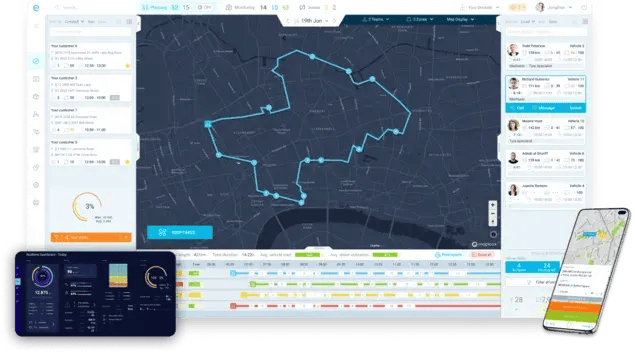
eLogii IS the execution layer. It doesn't force change. And it doesn't replace your existing system of record.
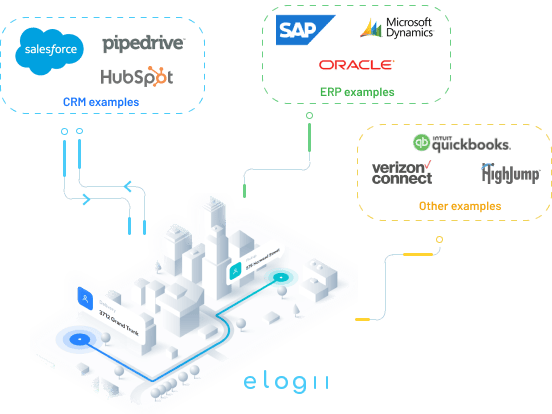
The category language is worth being precise about, because it's how these tools actually relate:
- FSM, CAFM, ERP - Systems of record
- Telematics, fleet management - Visibility layer
- eLogii - Execution layer
eLogii is API-first and built to sit alongside embedded systems, which suits complex, high-volume field and delivery operations rather than simple single-tool setups.
It's designed for organizations managing large fleets and field teams that need to run the live work well without ripping out what already holds their data.
That's the relevant profile here, and it's why the fit conversation is about coexistence rather than displacement.
How Existing Systems Can Work with eLogii
Most organizations don't need to remove what they have, because eLogii layers on top of the systems already in place.
The question worth answering is practical:
How does an execution layer work with the systems we already run?
The table below maps common system categories to their role and how an execution layer sits on top.
Here's how layering eLogii alongside your existing tools works in each category (no pitting tools against each other):
| System Category |
Example Platforms |
Primary Role |
How eLogii Layers On Top |
| Field Service Management |
ServiceTitan, BigChange, Joblogic, ServiceMax, Dynamics 365 Field Service, Salesforce Field Service |
System of record for jobs, assets, and work orders |
Runs and optimizes the live routing and dispatch of that work, feeding results back to the record |
| Enterprise Resource Planning |
NetSuite, SAP S/4HANA, Dynamics 365 Business Central, Infor CloudSuite Distribution, Kerridge K8 |
System of record for finance, inventory, and orders |
Executes the last-mile and field delivery those orders generate, without touching the core ledger |
| Warehouse Management |
Manhattan Active WMS, SAP EWM |
System of record for warehouse and stock movement |
Picks up at the warehouse boundary and executes the outbound field and delivery flow |
| Transportation / Visibility |
Oracle OTM, project44, FourKites |
Transportation planning and shipment visibility |
Adds live execution and dynamic optimization on top of the planned and tracked movement |
| Telematics / Fleet |
Verizon Connect, Webfleet, Geotab, Motive |
Visibility layer for vehicle and driver data |
Uses that visibility as input to sequence, route, and adjust live operations |
| CRM |
Salesforce, HubSpot |
System of record for customer relationships |
Turns committed orders and service requests into executed field work and delivery |
The through-line across every row is the same.
Your systems of record keep their job, your visibility layer keeps feeding data, and the execution layer runs the live work on top.
Coexistence, not displacement.
Who This Buying Framework Is (and Isn't) For
This framework fits complex operations with real downside exposure, and it deliberately doesn't fit simpler buyers. That's a feature, not a limitation.
Forcing it onto the wrong context just adds overhead.
It fits organizations with:
- 50 to 500+ field staff
- SLA, compliance, or penalty exposure
- Embedded FSM, CAFM, or ERP as a system of record
- Multiple stakeholders in the decision
- Prior disappointment with an ops software investment
You should probably stop reading if you're a small team with a single decision-maker, a feature-led buyer who genuinely just needs the longest capability list, or a first-time ops software purchaser without an existing stack to protect.
This is self-selection, not exclusion. Your buying process is simpler, and simpler is fine.
For everyone in the first list, a shared framework speeds alignment, because the whole committee ends up evaluating against the same definition of risk instead of five private ones.
That alone can take months out of a cycle.
Bottom Line: Reducing Risk Starts When You Understand the Process
Ops software buying is slow because the risk is asymmetric and unowned, and it speeds up the moment the execution risk is named, owned, and contained. The process isn't broken. It's protecting the organization from a downside nobody has agreed how to carry.
The mechanics come down to three things:
- Why it's slow - Nobody wants to own the downside, so caution compounds.
- What actually moves it - Shared recognition of the execution risk, plus clear ownership of the outcome.
- How to evaluate without paralysis - Layer rather than replace, and score outcomes over features.
The next step is practical. Run your current evaluation through this framework: name the execution problem precisely, agree architectural fit before anyone opens a matrix, and require a low-risk deployment path before you score a single feature. Do that and the committee stops circling.
If you want to see how teams de-risk ops software decisions in practice, look at execution-first modernization:
Adding capability on top of what you already run, so the downside stays contained and the decision can finally move.