Route optimization for utilities is one of those ideas that reads well on a slide and then falls apart the moment a real workday starts.
In fact, most utility companies want it, and they can see the benefits. But once they get handed the tools, they quickly realize that most tools can't deliver results at the scale and complexity their operations actually run at.
This guide explains why that happens, what utilities miss when they evaluate software, and why the execution of routes matters far more than the planning of them.
You'll learn:
- Where traditional route optimization for utilities breaks down
- How reactive and planned work collide,
- Why FSM scheduling struggles once conditions change
- What a modern execution layer does differently
- And more
If you run large, regulated, asset-heavy field operations, this maps to your reality.
Here's a quick overview of what's to come:
Key Takeaways
- Route optimization works, but planning-only tools stall at scale. Tools built to produce a static morning plan can't keep pace once volume, territories, and unpredictability grow.
- Reactive and planned work don't share a pipeline well. Outages, faults, and emergency repairs have different priorities, timelines, and metrics than maintenance and inspections. Forcing them through one process creates conflict.
- FSM, CAFM, and EAM are systems of record that store work orders, assets, and history brilliantly. They aren't built to manage work as it unfolds in the field.
- Optimization is an execution problem, while the complexity of your operations lives between "planned" and "completed," where priorities shift and new work keeps arriving.
- An execution layer closes the gap because it sits between planning systems and crews, continuously re-optimizing schedules, routes, and priorities in real time.
- It complements existing systems because their goal isn't to replace FSM, CAFM, EAM, and GIS. The execution layer makes your existing investments actually execute in the real world.
- Complexity, not headcount alone, decides fit. Utilities with 50+ field workers, mixed work, multiple territories, and SLA pressure benefit most.

The Big Problem With Route Optimization for Utilities Companies: Scale
Route optimization software works for utilities field operations, but most tools hit a hard wall once operations scale in size and complexity.
The common approach still delivers value on paper. But the limitation is that tools built to plan static routes can't keep up when volume, territories, and unpredictability all grow at once.
Consider the simple math:
A handful of jobs across a few crews is easy to sequence. Add hundreds of technicians, thousands of daily work orders, multiple depots, skill and certification constraints, and compliance windows, and the number of possible routing and scheduling combinations explodes into figures no dispatcher can reason about by hand.
Now add time.
A plan that's optimal at 7:00 AM is already stale by mid-morning once an outage lands, a crew calls in sick, or a permit slips.
This is the reality for large, regulated utilities and network-scale field teams.
It has little to do with meter-only routing, simple delivery routes, or shaving fuel cost alone.
Plan-only tools produce a beautiful snapshot of a moment that no longer exists an hour later.
At small scale, a planner patches the gaps manually.
At network scale, the manual patching becomes the operation, and the "optimization" quietly stops optimizing.
Here's where it starts to break down:
How Do Utilities Manage Reactive and Planned Work?
Most utilities try to run reactive work (outages, faults, emergency repairs) and planned work (maintenance, inspections, upgrades) through the same operational process. Then, they expect a single pipeline to create efficiency.
This instinct is reasonable. But in practice, the two types of work pull in opposite directions.
Reactive and planned work have fundamentally different priorities, timelines, resource requirements, and performance metrics:
- An emergency repair is measured in minutes and safety.
- A planned inspection is measured in compliance windows and cost per visit.
Trying to serve both from one queue means one constantly interrupts the other.
This gets harder as utilities grow, territories expand, and customer expectations rise.
Picture a normal Tuesday:
- An outage pulls two qualified crews off scheduled inspections, and those inspections now slip past their compliance window.
- Emergency work eats the afternoon, so planned maintenance backs up and reappears as tomorrow's overtime.
- Dispatchers reshuffle by hand, and crew allocation drifts from "efficient" to "whoever's closest and free."
The consequences compound: delayed maintenance, scheduling conflicts, prolonged outage response, and utilization that looks busy but produces less finished work.
A more effective approach separates the management of reactive and planned work while keeping full visibility and coordination across both.
Emergency response gets its own logic.
Planned work keeps its own cadence.
Neither silently steals from the other.
That separation only holds if the technology underneath it can support it, which raises the next question.
What Software Do Utilities Companies Use to Manage Field Operations?
Utilities rely heavily on Field Service Management (FSM), Computer-Aided Facilities Management (CAFM), Geographic Information Systems (GIS), and Enterprise Asset Management (EAM) platforms to plan and manage field operations.
These are valuable, mature systems, and no serious utility should run without them.
It helps to name the layers clearly, because the rest of this guide uses them consistently:
- Systems of record: FSM, EAM, and CAFM. They store work orders, asset records, history, and compliance data.
- Visibility layer: Telematics and ETAs. They show where crews and vehicles are.
- Planning and scheduling: Building the initial plan for the day or week.
The core problem is that many utilities expect these systems to manage every aspect of operations, including real-time execution.
Systems of record are built to store information, maintain asset records, manage work orders, and support planning. They aren't designed to dynamically manage work as it unfolds.
Watch a real workday and the mismatch shows:
Schedules change, emergencies arise, crews go unavailable, jobs run long, priorities shift, and new work keeps arriving. A static plan meets a moving operation.
Relying on these platforms alone produces predictable costs:
→ Inefficient resource utilization
→ Delayed responses
→ Heavy manual intervention
→ Dispatcher overload
→ Reduced visibility into live work
The plan is fine. The execution of the plan is where value leaks.
This is also why the difference between route optimization and FSM software matters so much for utilities.
Here's what leading utilities use to bridge that gap:
| Layer |
Primary job |
Examples |
What it can't do |
| System of record |
Store work, assets, and history |
FSM, EAM, CAFM |
Adapt work in real time as conditions change |
| Visibility layer |
Show location and ETAs |
Telematics, GPS, ETAs |
Decide what should happen next |
| Execution layer |
Continuous re-optimization |
Live field execution platform |
Replace core records or compliance systems |
Why Scheduling With FSM Software Doesn't Work for Utilities Companies
FSM scheduling tools help create a plan, but they aren't built to manage utility field operations as conditions change through the day.
FSM scheduling is genuinely useful, and it's often marketed as a complete solution for field work.
Keep it.
The point is understanding what it does and doesn't cover.
FSM scheduling works well when jobs are predictable, durations are known, priorities stay stable, and schedules can be set in advance.
That describes plenty of field environments.
Utility operations rarely sit still. Emergencies appear without warning, outages reprioritize everything, crews become unavailable, permits get delayed, jobs run long, and new work orders keep entering the system.
Picture the workday:
At 7:00 AM the schedule looks efficient: every crew has a full, well-sequenced route. By 9:00 AM a substation fault has pulled three crews off plan, a customer commitment has jumped the queue, and half the morning's sequencing is now fiction.
The consequences are familiar to any operations leader:
- Dispatchers manually reshuffling work all day
- Crews waiting for their next assignment
- Emergency jobs disrupting planned maintenance
- Missed service windows
- Low crew utilization
- Excessive overtime
Scheduling and execution are NOT the same thing.
FSM is valuable for planning and work order management, and it should stay in the stack.
What utilities also need is an operational layer that continuously adapts schedules, resources, priorities, and routes as the day moves.
The same limitation applies to manual methods, which is exactly why spreadsheets don't work for routing at scale. The real challenge begins once the schedule meets reality.
What Do Utilities Services Actually Need to Optimize Field Operations?
Optimizing utility field operations is fundamentally an execution problem, not a planning problem, which is why adding more software modules or automation rarely fixes it.
Utilities already run FSM, CAFM, GIS, and EAM, and still struggle with day-to-day execution. More features on top of a planning system don't change the underlying gap.
The complexity lives in the space between "planned" and "completed." That's where the day actually happens:
- Priorities change
- Emergencies occur
- Crews become unavailable
- Job durations vary
- New work enters the system
- Travel times change
- Customer commitments shift
Static schedules, spreadsheets, and manual dispatcher intervention can't manage this at scale. A planner can hold a dozen moving pieces in their head. No one holds a thousand.
What utilities need is a dedicated execution layer that sits between planning systems and field crews. Its job is to keep work flowing efficiently while conditions change. Concretely, that layer should:
- Dynamically prioritize work as new jobs arrive
- Continuously optimize schedules, not just build them once
- Manage reactive and planned work together
- Allocate crews and resources intelligently against skills and location
- Adapt to disruptions in real time through continuous re-optimization
- Provide live visibility into field execution
The goal isn't to replace FSM, CAFM, GIS, or EAM. It's to make them effective by ensuring their plans survive the real world.
This is the same discipline behind strong planning and scheduling field service operations, extended into live conditions.
Here's what that execution layer looks like in practice.
Why Does Adding an Execution Layer Solve These Problems?
An execution layer solves the problem because the gap in most utility stacks is the absence of a system dedicated to managing work as conditions change.
Utilities already have planning, asset management, work order, and record-keeping systems, and inefficiency still persists because work rarely unfolds as planned.
Systems of record answer one set of questions well:
- What work needs to be done?
- Which assets are affected?
- Which crews are qualified?
- What was completed?
An execution layer answers a different set, continuously, all day:
- What should happen next?
- Which crew should take this job now?
- How do priorities change when new work arrives?
- How should resources be reallocated when disruptions hit?
Take a concrete case.
A maintenance schedule is planned perfectly on Friday. Monday morning a storm causes multiple outages and an emergency repair.
The plan is instantly obsolete, and every crew assignment needs rethinking against safety, skills, and location.
The execution layer acts as the operational control center between enterprise systems and field crews.
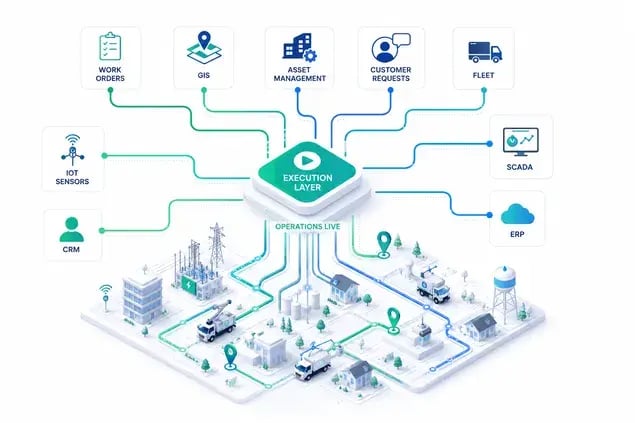
It continuously evaluates work priorities, resource availability, crew skills, geographic constraints, travel times, regulatory requirements, and live operational events, then coordinates work automatically rather than leaving dispatchers to rebuild the day by hand.
The outcomes are the ones operations leaders actually care about:
- Faster outage and emergency response
- Better crew utilization
- Reduced overtime
- Stronger utilities SLA management and service levels
- Higher completion rates
- Better balance between planned and reactive work, which supports compliance scheduling utilities depend on
It complements FSM, CAFM, EAM, GIS, and scheduling systems rather than competing with them, and it's especially relevant for safety and compliance work where windows can't slip.
Here's what happens when planning and execution finally work together.
What Does Managing Utilities Operations With the Execution Layer Look Like?
With an execution layer in place, field operations shift from a fixed morning plan to a plan that continuously adapts as the day changes.
Terms like dynamic scheduling and real-time optimization can sound abstract, so it helps to follow work through a typical utility day.
Start with the scene:
Hundreds or thousands of work orders exist across the territory such as planned maintenance, inspections, reactive callouts, and emergency repairs.
Crews carry different skills, certifications, locations, and availability.
Traditional systems build the initial plan, and then the day arrives:
- Emergency work appears without warning
- Job durations vary from estimates
- Traffic and travel times change
- Crews finish early or run late
- New priorities emerge
The execution layer continuously re-evaluates all of this and automatically adjusts assignments, schedules, routes, and priorities.
Compare that with the manual approach, where dispatchers update spreadsheets, phone crews one at a time, and rebuild the plan by hand every time something moves.
Route optimization and dynamic scheduling are where this shows up most clearly.
A modern engine can evaluate vast numbers of routing and scheduling combinations in seconds, balancing priorities, constraints, SLAs, crew skills, and cost in a way no manual process can match.
For proof that execution-layer thinking works, look at Brymec.
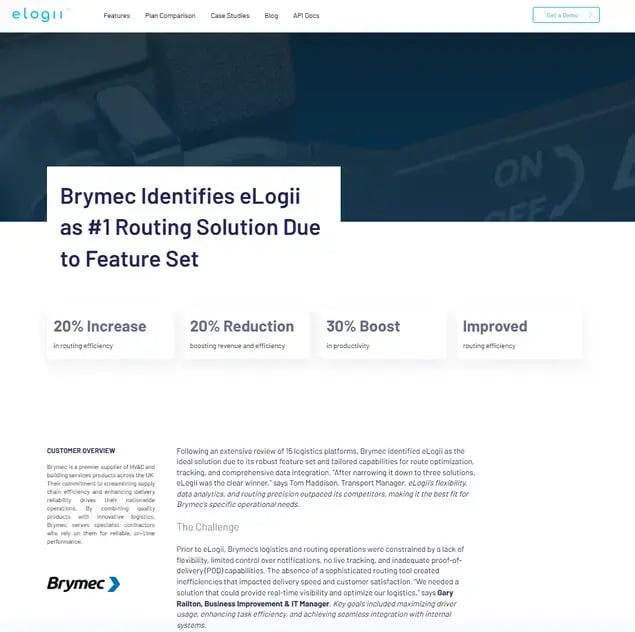
Following an extensive review of 15 logistics platforms, Brymec chose the one that had the best fit for route optimization, tracking, and data integration. After Brymec uses route optimization to run a zone-based operation, the results were clear:
- Increased driver productivity by 20%, allowing more work orders without adding staff.
- 20% Increase in Routing Efficiency: Optimized routing within assigned zones cut empty miles by 15%, resulting in reduced fuel expenses and improved task timing.
- Live tracking now gives customers full visibility, reducing calls to support by over half.
Brymec is a UK supplier of HVAC and building services. But the operational challenges match closely all the same: complex field operations, mobile workforces, dynamic schedules, constant change through the day, and a real need for visibility and optimization.
You can see similar patterns in other complex field operations, including work with providers serving utilities clients.
For utility leaders, an execution layer translates into:
- Better crew utilization
- Faster outage and emergency response
- Higher completion rates
- Reduced dispatcher workload
- Lower operational cost
- Live visibility into field work
- Improved customer service
Utilities don't need more systems of record. They need a system that ensures plans survive contact with reality.
How Does eLogii Fit Into Your Utilities Management Stack?
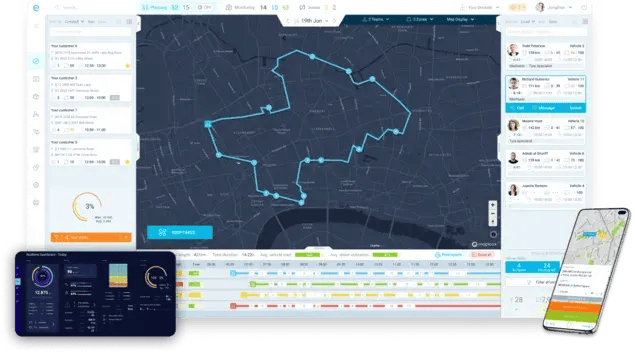
eLogii fits as the execution layer between your systems of record and your field crews, and it isn't a replacement for FSM, CAFM, EAM, GIS, ERP, or CRM.
Adopting new software often raises fears of ripping out existing systems or launching a multi-year transformation.
That concern doesn't apply here.
Your existing systems keep doing what they do well:
- Asset management
- Work order creation
- Customer information
- Regulatory compliance
- Planning and reporting
- Historical records
These remain essential as systems of record.
The gap opens after work is created, prioritized, and planned, when utilities still need to coordinate, optimize, and execute that work as conditions change.
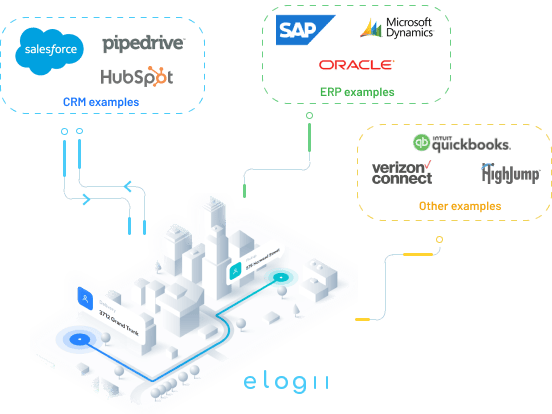
That's the space eLogii occupies.
Information flows in a simple loop:
- Existing systems generate work orders and business rules.
- eLogii receives them through its API-first architecture.
- eLogii continuously optimizes schedules, routes, priorities, and resource allocation.
- Crews receive the most efficient work plans on the driver app.
- Operational updates flow back into your enterprise systems.
A simple analogy:
Your existing systems create the playbook, and eLogii acts as the coach making real-time decisions during the game. FSM, CAFM, EAM, GIS, and ERP decide what needs to happen. eLogii helps decide how, when, and by whom it gets done.
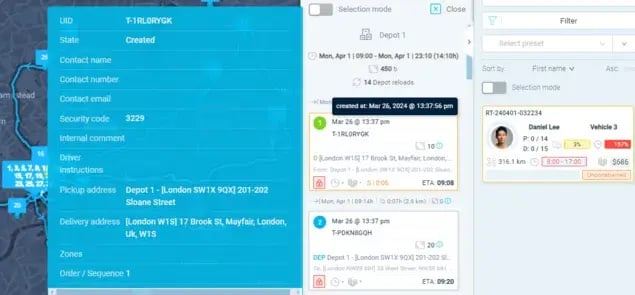
That distinction matters because it targets the execution challenges utilities feel most:
- Dispatcher overload
- Inefficient routing
- Resource underutilization
- Balancing reactive and planned work
- Constant operational disruptions
The same execution engine already runs demanding field operations, from property maintenance routing to route optimization for test and inspection services, so customer outcomes stand as evidence of execution improvement rather than system replacement.
Utilities don't need another system of record. They need a system of execution.
What Types of Utilities Companies Should Consider Adding an Execution Layer?
Not every utility needs an execution layer, and it's built for utilities whose operational complexity has outgrown planning-only tools rather than for solving simple scheduling.
Execution layers manage complexity at scale.
If your work is simple and predictable, they're overkill.
Consider an execution layer when you have several of these:
- 50+ field technicians, engineers, inspectors, or crews
- Large-scale operations across multiple territories
- A mix of reactive, urgent, and planned work
- Mobile workforces operating all day
- Multiple assets, sites, or networks to maintain
- SLAs and customer commitments
- Frequent disruptions and shifting priorities
- Heavy coordination requirements across crews, assets, and work
Complexity, not company size alone, is the deciding factor.
A smaller operation with volatile, mixed work can need it more than a larger one with steady routines.
Several utility segments feel this acutely:
- Electricity and power distribution - Outages reprioritize inspections and maintenance without notice.
- Water and wastewater - Emergency repairs constantly compete with planned asset maintenance.
- Gas - Safety-critical response work has to slot in around routine maintenance.
- Telecom and broadband - Installs, repairs, and network faults collide across the day.
- Renewable energy operators - Distributed assets and technicians spread across large areas make coordination hard.
Watch for the operational warning signs, which are usually symptoms of an execution problem rather than a planning problem:
- Dispatchers spend hours reshuffling schedules
- Emergencies routinely disrupt planned maintenance
- Crews sit underutilized despite heavy workloads
- Overtime keeps climbing
- Travel time is hard to optimize
- Work is constantly reprioritized
- Managers lack live visibility
- SLA and compliance performance is inconsistent
An execution layer usually isn't necessary for small utility contractors, teams under 50 field workers, limited service areas, highly predictable schedules, or work that can be planned once and executed as scheduled.
In those environments, traditional FSM scheduling is often sufficient.
The same logic separates high-volume waste collection routing from a simple fixed round.
| Signal |
Needs execution layer |
FSM scheduling sufficient |
| Field workforce size |
50+ workers |
Under 50 workers |
| Work mix |
Reactive + planned combined |
Predictable, planned only |
| Service territory |
Multiple regions |
Single limited area |
| Disruption frequency |
Constant |
Rare |
| SLA/compliance pressure |
High |
Low |
| Dispatcher workload |
Overloaded, manual reshuffling |
Manageable |
The more dynamic, distributed, and complex the environment, the greater the need for a dedicated execution layer.
Bottom Line: Route Optimization Works for Utilities Operations
Many utilities see route optimization only as a way to cut travel time, which is a small part of its value.
Route optimization for utilities delivers the most impact when it's part of an execution layer that continuously adapts field operations as conditions change.
FSM, CAFM, and scheduling tools are built for planning and record-keeping.
Route optimization inside an execution layer manages work in motion, resequencing crews, routes, and priorities as the day moves.
It creates the most value for utilities with large mobile workforces, mixed reactive and planned work, shifting priorities, service commitments, and complexity at scale.
Route optimization doesn't simply help utilities plan better. It helps them execute better.
Want to see how this looks like?
Click the banner below to book a demo and see the execution layer in action.
FAQ about Route Optimization for Utilities Companies
Does route optimization work for emergency utility work?
Yes, when it's part of an execution layer that re-prioritizes and reassigns work in real time. Static route planners can't handle emergencies because they optimize a fixed plan. An execution layer treats a new outage as a live event, reassigning the right crew and resequencing everyone else's work automatically.
Is route optimization the same as scheduling?
No. Scheduling creates the initial plan for the day or week. Route optimization and execution manage and re-optimize that plan continuously as conditions change. Scheduling answers what the day should look like at 7:00 AM. Execution answers what should happen next once reality intervenes.
Can route optimization replace FSM software?
No. It complements FSM as an execution layer, and FSM remains your system of record for work orders, assets, and compliance history. The two work together: FSM defines what needs doing, and the execution layer decides how, when, and by whom it gets done in the field.
How many field workers do you need before route optimization becomes valuable?
Value grows with complexity more than headcount. Execution layers typically fit operations of 50+ field workers with a mix of reactive and planned work across multiple territories. Below that, with predictable schedules and few disruptions, standard FSM scheduling is usually enough.
Does route optimization only reduce travel time?
No. Travel and fuel savings are one benefit. The larger gains come from higher crew utilization, stronger SLA performance, reduced overtime, higher completion rates, and better balance between reactive and planned work across the operation.
How does route optimization handle changing priorities?
Through continuous re-optimization. As new or urgent jobs arrive, the execution layer reassigns crews and resequences work automatically, weighing skills, location, travel time, and SLAs. Priorities update as a live decision rather than a manual dispatcher scramble.
Can route optimization help balance planned and reactive work?
Yes. An execution layer coordinates both in one live operating picture instead of forcing you to trade one against the other. Emergency response and planned maintenance keep their own logic while sharing crews and visibility, so neither silently starves the other.
How does route optimization improve SLA performance?
By continuously matching crews, skills, and priorities to your commitments and adapting when conditions shift. When an emergency or delay threatens a service window, the execution layer resequences work to protect at-risk SLAs and compliance windows rather than discovering the miss after the fact.
How does an execution layer integrate with existing systems?
Through APIs. It receives work orders and rules from FSM, EAM, and GIS, optimizes execution in real time, and pushes updates back into those systems. Your systems of record stay in place, and the execution layer handles the live work in between.