Your HVAC scheduling worked perfectly. Then you added electrical. Your planner coped. Then fire systems. Then plumbing. Then fabric maintenance. Suddenly, your FSM tool didn't stop working - it just stopped coordinating execution.
Multi-trade facilities management scheduling doesn't add complexity linearly. It multiplies it combinatorially, exposing design boundaries in FSM and CAFM tools built as systems of record, not real-time execution engines.
If you're managing 50-500+ engineers across multiple trades and multi-site estates with PPM and reactive work, this explains why adding trades made everything harder. The tool didn't get worse. Your operating model outgrew it.
Key Takeaways
- Multi-trade scheduling doesn't just add complexity - it multiplies it. You're no longer optimizing routes. You're coordinating skills, dependencies, compliance windows, and resource conflicts across variables that shift constantly.
- FSM and CAFM tools were built as systems of record, not execution engines. They track obligations and create audit trails, but weren't designed to coordinate hundreds of engineers across multiple trades in real-time.
- The problem isn't the tools - it's what you're asking them to do. Single-trade scheduling optimizes routes. Multi-trade operations juggle skills, sequencing, SLAs, access windows, and emergencies that blow up your planned schedule.
- Traditional FSM platforms rely on batch planning and manual conflict resolution, but more trades mean exponentially more decisions - causing poor routes, duplicate visits, missed SLAs, and midnight planner shifts.
What FSM and CAFM Tools Were Designed to Do
Traditional FSM, CAFM, and CMMS platforms were built as systems of record, not systems of execution.
They excel at tracking obligations, creating audit trails, and proving compliance - capturing what needs to happen, when contracts require it, and whether work was completed.
FSM platforms manage mobile workforces through job assignments and completion tracking. CAFM systems handle asset registers, space allocation, and contract management. CMMS tools focus on maintenance operations and equipment lifecycles. These distinctions blur in practice, but they share the same core philosophy.
Every large-scale FM operation needs systems of record. Without them, you can't manage contracts, demonstrate compliance, or track asset performance over time.
The problem emerges when organizations expect these tools to coordinate real-time, multi-trade execution across hundreds of engineers and dozens of sites simultaneously. That requires different architectural decisions than tracking obligations after the fact.
Most legacy platforms assumed planners had time to think and schedules could be built in batches. They were designed when FM operations were simpler: fewer trades per site, more predictable PPM schedules, less reactive work mixing with planned maintenance. Multi-trade complexity exposes where that assumption breaks.
What Multi-Trade Scheduling Actually Means in FM
Multi-trade facilities management scheduling means coordinating engineers across HVAC, electrical, fire, plumbing, fabric, and mechanical trades at multiple sites, each with different compliance windows, SLA requirements, access constraints, and sequencing dependencies.
Single-trade scheduling is geographic optimization: who goes where, when. Multi-trade scheduling adds skill matching, trade sequencing, compliance overlaps, and resource conflicts that turn route optimization into orchestration.
You're not finding the fastest path - you're coordinating the right combinations of people, skills, timing, and dependencies across a constantly shifting landscape.
Here's what that looks like. Three sites need HVAC and electrical work. A single-trade contractor schedules three visits geographically.
A multi-trade FM provider calculates differently: send two engineers to the same site, or one multi-skilled engineer?
Split visits across days based on SLA priorities?
Coordinate with existing PPM schedules to avoid duplicate trips?
The answer shifts hourly based on current engineer locations, skill availability, compliance deadlines, access windows, whether jobs are PPM or reactive, and travel time between sites.
Multi-trade scheduling is a coordination problem, not a volume problem. You're managing planned preventive maintenance alongside reactive work that constantly disrupts optimized schedules, continuously rebalancing skill allocation, compliance risk, SLA exposure, and operational efficiency as new work arrives and priorities shift.
Why Multi-Trade Complexity Multiplies Scheduling Difficulty
Multi-trade facilities management scheduling multiplies complexity exponentially, not linearly.
Consider 10 HVAC engineers and 10 jobs - that's 3.6 million possible route combinations. Add 10 electrical engineers with 10 jobs at the same sites, and you're coordinating which trade visits when, in what sequence, with dependencies between them. Add a third trade and planners can't keep up.
Sequencing dependencies ripple across your operation. Electrical rough-in must happen before drywall. Fire alarm testing waits for ceiling work. These constraints multiply at every site.
Skill conflicts add another layer. Your best HVAC engineer is handling emergency work when a planned PPM requires HVAC at the same site where electrical work is scheduled. Each choice carries cost - overtime, SLA risk, duplicate travel.
Geographic optimization for one trade creates inefficiency for others. The HVAC-optimized schedule routes engineers east-to-west while the electrical-optimized schedule goes north-to-south. You either balance these conflicts or accept suboptimal routes.
Time-window conflicts compound everything. HVAC compliance expires Thursday. Electrical SLA requires completion by Friday. Site access is only Tuesday and Wednesday. Planners juggle these constraints across dozens or hundreds of jobs simultaneously.
This is why planners work late reconfiguring schedules, engineers make duplicate visits to the same sites, and SLA breaches spike as your operation scales.
What FSM and CAFM Tools Are Designed to Do Well
Before we explore where FSM and CAFM platforms hit their limits, let's acknowledge what they do well.
These tools excel as systems of record. They create job records, track work orders from request through completion, maintain asset registers with service histories, manage contracts and SLAs, store compliance certificates, and generate audit trails that satisfy regulators and clients.
FSM and CAFM platforms replaced clipboards, spreadsheets, and filing cabinets with centralized repositories that give operations managers unprecedented visibility.
You can see every job created, every engineer assigned, every completion logged. You can prove compliance and answer client audits with a few clicks instead of days of paper-shuffling.
Mobile access lets engineers update job status, capture photos, log materials, and close work orders from the field. Integration with financial systems enables automated invoicing tied to job completion. Historical performance data accumulates for analysis and process improvement.
These platforms are mature, proven technology. Decades of development have created robust systems that handle operational record-keeping at scales that would be unmanageable otherwise.
Here's the critical framing: FSM and CAFM tools excel at managing obligations. They track what needs doing, who's responsible, and whether it met the required standard. This is foundational work that large-scale facilities management couldn't function without.
But these strengths reveal their design purpose. They're optimized for recording and reporting on work - not for coordinating how that work gets executed in real-time across multiple trades with constantly shifting priorities.
Where FSM and CAFM Tools Reach Their Design Boundary
FSM and CAFM platforms organize work around individual jobs. Each job gets its own record with location, trade, priority, and SLA. The scheduler assigns jobs to engineers based on these attributes, which works perfectly for single-trade operations.
Multi-trade operations break this job-centric design. When a site needs HVAC, electrical, and fire safety work, the system creates three separate jobs and assigns three different engineers. It won't coordinate them to visit the same day, recognize that one multi-skilled engineer could handle two trades, or sequence work to respect installation dependencies.
The second constraint is batch planning. These tools work in daily or weekly cycles where planners assign work and publish schedules that stay relatively stable. Multi-trade operations run on continuous disruption - emergency calls arrive mid-day, jobs finish early or run late, traffic delays cascade, and site access changes. FSM platforms don't recalculate, forcing planners to manually intervene every time.
This turns your planners into the execution engine, manually coordinating trade sequences, matching multi-skilled engineers to job combinations, and juggling SLA priorities in real time.
These aren't missing features. They're deliberate design choices that prioritized recording obligations over coordinating live execution. FSM and CAFM tools chose job-centric architecture and batch planning to support their primary purpose: creating audit trails and maintaining compliance records.
This explains why adding trades made everything harder even though your FSM functionality didn't change. Your operating model outgrew the architectural assumptions.
The Cascading Effects When Multi-Trade Scheduling Fails
When multi-trade coordination breaks down, the financial and operational damage compounds quickly.
-
Duplicate site visits erode margins fast. An HVAC engineer visits a site Tuesday for PPM work. An electrical engineer visits the same site Thursday for a separate PPM job. That second visit burns travel time, fuel, and utilization. Across hundreds of sites monthly, you're losing 15-20% of your travel budget to coordination gaps.
-
Trade mismatches trigger expensive deferrals. A job needs HVAC expertise, but the planner assigns a multi-skilled engineer qualified for electrical and plumbing. The engineer arrives, realizes they lack the specific HVAC certification, and the job gets deferred. Second visit required, SLA clock still ticking.
-
Missed compliance windows create penalty exposure. A fire safety certificate expires at month-end. Reactive work disrupts the schedule. Your planner reschedules the fire work but misses that the electrical verification wasn't rescheduled in sync. The fire work can't complete without electrical sign-off. Compliance breach. Client penalty.
-
Overtime costs spike as the week progresses. Planners optimize schedules for each trade separately. By Thursday, accumulated inefficiencies create backlog. Weekend overtime becomes necessary to meet SLAs, and those overtime rates erode monthly margins.
The human cost hits hard too. Planners spend hours re-coordinating schedules as reactive work disrupts plans. Engineers receive constant schedule changes and lose confidence in the system. Clients see duplicate visits and missed SLAs despite your team's competence.
This isn't operational failure by your FM team. It's the inevitable consequence when coordination complexity exceeds your tool's architectural capacity.
Why Adding Planners and Better Planning Don't Solve Multi-Trade Complexity
When multi-trade scheduling breaks down, the instinctive response is hiring more planners and tightening planning discipline. Build better schedules. Plan further ahead. Add headcount to handle the coordination load.
This provides temporary relief, then hits diminishing returns fast.
The problem is brittleness.
A detailed multi-day schedule across four trades looks elegant Monday morning. Tuesday's emergency electrical job disrupts the electrical schedule, which cascades to HVAC because they share sites with sequencing dependencies. Reconfiguring HVAC impacts Wednesday's fire engineer availability for PPM work. The disruption spreads.
The headcount economics don't work either.
Your first planner manages 30 single-trade engineers effectively. Add a second trade, you need 1.5 planners because of coordination overhead. Add a third trade, you need 2.5 planners. Add a fourth, you need 4+ planners. Coordination overhead grows faster than linear trade addition.
Even brilliant planners hit cognitive limits. Simultaneously optimizing 100+ jobs across five trades with different SLAs, skills, sequencing rules, and geographic constraints exceeds human working memory. Planners resort to heuristics: prioritize emergencies, schedule obvious same-site work, accept suboptimal routes.
Coordination latency compounds the problem. A planner receives an emergency notification, assesses impact, identifies a re-optimization opportunity, and communicates changes to affected engineers. This takes 30-60 minutes. Meanwhile the situation evolves. By the time the solution reaches engineers, it's already outdated.
You can't manually coordinate a combinatorial problem at scale. Human intelligence excels at judgment and exception-handling, not continuously recalculating optimal solutions to multi-constraint optimization problems.
What Multi-Trade FM Operations Do Differently at Scale
Operations managing 100+ engineers across multiple trades optimize for adaptability over perfection. They expect schedules to change constantly and re-optimize hourly, treating the schedule as a living document rather than a static plan.
Instead of manual coordination decisions, they establish clear rules: "When two trades are needed at the same site within 48 hours, schedule same visit or sequential visits." These rules codify best practices and remove hundreds of micro-decisions from planners.
They maintain detailed skill matrices and actively develop multi-skilling, which reduces coordination conflicts. They use decision frameworks for when reactive work disrupts PPM schedules based on penalty exposure, client value, and resource availability.
The planner's role shifts from making every decision to supervising outcomes, handling exceptions, and identifying systemic improvements.
These are operational practices, not software features. The problem is implementing them manually across 100+ engineers and hundreds of daily jobs. You need to treat multi-trade coordination as a continuous computational problem, not a human planning task.
Systems of Record vs Systems of Execution
Your FSM or CAFM tool isn't broken. It's doing exactly what it was designed to do - and that's the problem.
Most FM technology platforms are systems of record. They capture, store, and report on business transactions - which jobs were requested, which engineers were assigned, when work was completed, what compliance certificates were generated. FSM and CAFM tools do this exceptionally well, and you can't operate without them.
But systems of record weren't designed to coordinate how work gets done in real-time. That requires systems of execution - platforms that optimize resource deployment, adapt to changing conditions, and coordinate complex workflows as they happen.
In multi-trade FM, an execution layer sequences multi-trade work at the same sites, continuously re-optimizes as jobs complete and reactive work arrives, and adapts to real-world conditions like traffic delays or site access changes.
The integration model is straightforward: your execution layer consumes job data from your FSM or CAFM via API, performs continuous coordination optimization, directs engineers on execution sequence, then feeds completion data back to the system of record for reporting.
Think of your FSM or CAFM like your accounting system - essential for recording transactions and generating reports, but you wouldn't expect it to optimize procurement decisions or manage cash flow in real-time.
If your FSM or CAFM works well for tracking but coordination still breaks down, you don't have the wrong tool. You have an incomplete stack.
eLogii Fits as the Execution Layer for Facilities Management
eLogii sits between your FSM or CAFM platform and your engineers as the execution layer those systems weren't built to provide.

It pulls job data from your existing FSM or CAFM, applies continuous multi-trade optimization to coordinate execution, directs engineers on priorities and sequencing in real-time, and feeds completion data back for recording and reporting.
Your FSM or CAFM platform remains your single source of truth for contracts, compliance records, client reporting, and audit trails.
eLogii becomes your system of action, handling continuous multi-trade route optimization, skill-based job matching across trades, SLA-aware prioritization, same-site multi-trade coordination, and real-time re-optimization as conditions change.
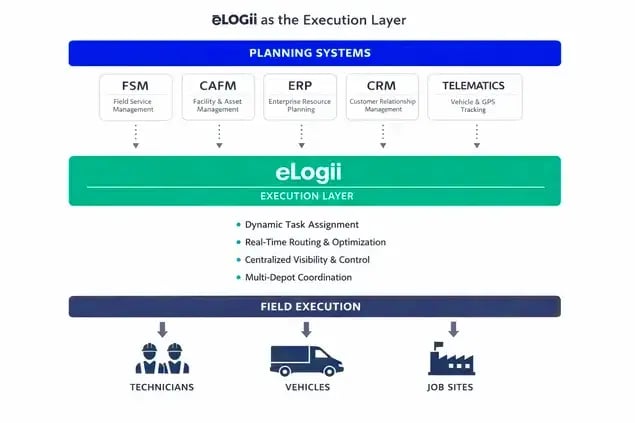
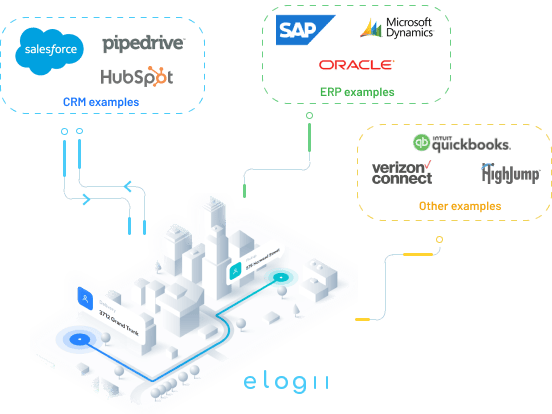
The integration is straightforward. eLogii's API-first architecture connects to major FSM and CAFM platforms, pulls job requirements and engineer availability, runs optimization continuously, and pushes execution updates back to maintain your single source of truth.
The operational value is tangible:
-
Planners shift from firefighting coordination to supervising outcomes.
-
Duplicate visits drop through intelligent same-site scheduling.
-
Resource utilization improves, protecting margins.
SLA compliance holds because the system maintains priority awareness across all trades and sites.
We're not replacing your FSM or CAFM. We're adding the execution intelligence your stack is missing.
Who This Perspective Is (and Isn't) For
This article addresses a specific operational reality. If you're not in this context, traditional FSM tools likely serve you well.
| This Is For |
This Is Not For |
| Multi-trade FM providers managing 50-500+ engineers across HVAC, electrical, fire, plumbing, fabric services |
Single-trade contractors operating only one specialty |
| Complex multi-site estates with hundreds or thousands of locations requiring coordinated service |
Operations under 20 engineers with predictable, low-complexity work |
| PPM schedules constantly disrupted by reactive and emergency work |
Purely reactive work without compliance windows or SLA obligations |
| Contracts with SLA penalties, regulatory compliance requirements, and financial risk exposure |
Stable environments where human planners coordinate effectively without strain |
If you're managing multi-trade complexity at scale with compliance exposure, this explains why coordination breaks down despite good tools and capable planners.
Bottom Line: FSM and CAFM Tools Can Only Get You So Far
If multi-trade complexity has overwhelmed your scheduling, your planners aren't failing and your FSM tool isn't broken. It's doing what it was designed to do:
Record obligations ≠ Coordinate real-time execution.
Operations at scale need both - FSM or CAFM as the system of record, plus an execution layer for coordination intelligence.
Getting this right protects margins, maintains compliance, and restores planner capacity for strategic work.
Examine whether your technology stack includes an execution layer or relies entirely on systems of record.
Multi-trade coordination at scale is solvable - it requires acknowledging architectural boundaries and completing the stack.
FAQ about Multi-Trade Scheduling for Facilities Management
What is the main difference between FSM and CAFM tools?
FSM manages work orders and technician schedules, while CAFM adds space and asset tracking. Both document what happened for audit trails, but neither handles live orchestration - coordinating hundreds of engineers with conflicting schedules, different skill requirements, and dependencies that shift throughout the day.
Why does multi-trade scheduling create more complexity than single-trade operations?
The complexity grows exponentially. Ten HVAC engineers and ten jobs create 3.6 million possible combinations. Add electrical engineers, and you're now coordinating sequencing dependencies (electrical before drywall), skill conflicts, SLA deadlines across trades, and routing that works for one team but creates chaos for another.
Can I upgrade my existing FSM or CAFM system to handle multi-trade coordination?
Most FSM and CAFM platforms were built for batch planning, not real-time execution. Add an execution layer through API integration instead of waiting for your vendor to rebuild their architecture. Large operations run both systems together: FSM/CAFM handles record-keeping while the execution layer manages real-time coordination.
How do I know if my operation needs an execution layer?
Look for these signs: planners spend hours reconfiguring schedules daily, trades make duplicate site visits, SLA breaches rise as you scale, and coordination problems persist despite adding planning staff. Multiple yes answers mean you've outgrown batch planning and need real-time execution coordination.
Does adding an execution layer mean replacing our FSM or CAFM system?
No. The execution layer integrates with your existing FSM or CAFM through APIs, serving as the real-time coordination engine while your current system remains the source of truth for jobs, compliance, and reporting. This approach protects your technology investment while solving the coordination problem.