This article maps the specific mechanics behind debt enforcement scheduling for you.
In it, we're going to dive deep into:
- What makes debt enforcement scheduling fundamentally different from standard field service scheduling,
- Where traditional models collapse
- What repeat visits actually cost at the systems level
- What execution maturity looks like in practice
If you're wondering why better planning hasn't fixed the problem, we'll give you the diagnostic framework that shows it.
So if you're running 50 to 500+ enforcement agents across multiple regions, managing court-ordered visits with statutory compliance windows and high repeat-visit rates, this article is definitely for you.
Here's a quick rundown of what else you'll find in this guide:
Key Takeaways
- Enforcement is regulated execution with statutory visit windows, mandatory revisit intervals, and evidentiary requirements. This makes debt enforcement scheduling fundamentally different from other field services.
- Static schedules collapse within hours due to enforcement volatility (failed contacts, shifting case priorities, access windows closing). This destroys plan-once-execute-all scheduling models at any meaningful agent volume.
- Repeat visits are structural requirement of real-world operations with a significant proportion of first visits result in no contact. Scheduling systems must optimize around this reality rather than treat revisits as exceptions.
- Poor scheduling creates direct legal exposure through missed compliance windows, incorrect revisit sequences, and gaps in data. It also carries financial and reputational consequences that exceed the cost of scheduling infrastructure.
- Execution maturity means optimizing for outcomes. Most high-performing enforcement operations schedule for success probability and compliant contact rates, with plan fidelity as a secondary concern.

What Makes Debt Enforcement Scheduling Different
Debt enforcement is regulated execution. It requires you to schedule agents around operational preferences, but also legal and statutory constraints that determine visit sequencing, timing, and documentation.
This distinction is what reshapes every scheduling decision that you make from the ground up.
That includes several key conditions that debt collection schedules must meet which makes them unique:
First, legal visit windows impose hard boundaries that must occur within defined time bands. Rescheduling outside those windows carries compliance consequences.
Second, mandatory revisit logic adds a layer that standard field service never encounters: a failed contact is not a closed task. It triggers a procedural obligation to revisit within specific parameters.
This creates a persistent and growing backlog of active cases that compete with new instructions for agent capacity every single day.
Third, address-level dependencies further constrain routing flexibility because agent assignments often carry geographic, legal, or compliance continuity in their requirements.
For example, the same agent may need to return to the same address across multiple visits, which means routing cannot treat each visit as an independent job.
Finally, agent safety and evidentiary requirements add operational constraints that scheduling must take into account. This includes:
- Documented outcomes
- Timestamped evidence
- Specific agent certification
And in some cases, none of these conditions are optional. Which makes scheduling even more difficult.
The table below gives you a clear distinction between standard field service and enforcement field operations:
| Scheduling Dimension |
Standard Field Service |
Enforcement Field Operations |
| Visit Timing |
Flexible windows, customer-negotiated |
Statutory windows, legally defined |
| Failed Contact Outcome |
Closed or rescheduled at convenience |
Mandatory revisit within compliance interval |
| Agent Assignment |
Skill-based, interchangeable |
Case continuity, geographic and legal constraints |
| Compliance Obligation |
SLA-driven, contractual |
Statutory, evidentiary, legally binding |
| Route Flexibility |
High - optimize freely by geography |
Constrained by case history, agent continuity, timing rules |
Why Traditional Scheduling Models Break Down for Debt Collection Operations
Traditional field service scheduling assumes relative stability, which is why most scheduling tools operate on a plan-once, execute-all model:
→ Jobs are assigned.
→ Routes are built.
→ Your plan is executed.
Debt enforcement destroys this assumption.
At its core, debt enforcement operations have different inputs:
- Contact success
- Access to debtor
- Case status
All of these inputs change continuously throughout the day.
As a result, enforcement operations generate new priority cases, failed contacts requiring reassignment, and access windows that close and reopen, all in real time.
A static planning tool cannot accommodate a workflow where the queue reshapes itself every hour.
Generic routing tools also optimize the sequence of tasks for a single agent without understanding case-level context.
In debt enforcement routing, a route is a prioritized set of compliance obligations. It has different urgency levels, legal statuses, and success probabilities. So sequencing by geography alone misses the entire point.
Dynamic prioritization is where the model fractures most visibly.
For example:
When a high-priority warrant lands mid-morning, or a case contact window closes unexpectedly, a static schedule has no mechanism to absorb the change without manual planner intervention.
At low volumes, this is manageable. But at 50, 100, or 300+ agents, the exception queue overwhelms any planning team.
The consequence is predictable and consistent across scaled debt enforcement operations:
Planners spend the majority of their day managing exceptions rather than planning, because enforcement volatility destroys static schedules within hours
The people you hired to think strategically about agent deployment are instead manually patching a plan that was accurate only at the moment it was created.
The Repeat Visit Problem in Enforcement Operations
Repeat visits are an execution reality built into enforcement operations by statute, access constraints, and debtor behavior.
The question worth asking is how to optimize around them - because eliminating them is not a realistic objective.
Across debt enforcement, High Court enforcement, and tax enforcement operations, a significant proportion of first visits result in no contact.
Each of these becomes an active case requiring a sequenced return visit within a compliance window.
Failed contact is a structural input to the scheduling system. Any debt enforcement planning model that treats it as an exception will be overwhelmed within days of deployment.
Access constraints compound the challenge through time-of-day restrictions, residential access rules, and jurisdiction-specific permitted hours for enforcement action. This means that you can't schedule revisits when it's convenient.
Statutory retry rules also apply in certain enforcement regimes. They mandate specific intervals between visits, specific notice requirements before re-entry, or specific outcome documentation before escalation.
These rules are non-negotiable. So, they must be encoded into scheduling logic rather than managed through planner memory or spreadsheet notes.
Without revisit-aware routing, return visits are treated as new jobs and inserted into available capacity without reference to agent location history, case geographic clustering, or contact probability by time of day.
The result is significant wasted mileage and lost agent capacity.
This is a cost that compounds across every shift and every region in a scaled operation.
The Real Cost of Poor Enforcement Scheduling
Poor debt enforcement scheduling creates compounding operational drag. At scale, the costs extend well beyond wasted time into direct legal and financial exposure.
Here are five ways bad debt enforcements schedules impact your operational costs:
#1 Lost Agent Capacity
Lost agent capacity is the most immediate cost. Enforcement agents are a constrained, specialized resource. Every hour spent on low-probability visits, inefficient routing, or duplicated revisits that could have been sequenced more tightly is permanently lost capacity that cannot be recovered in the same shift.
#2 Higher Travel Time
Increased travel time accumulates quietly but significantly. Across a multi-agent enforcement operation, unoptimized routing erodes productive visit time. Even a 15% reduction in productive visit time per agent across a 200-agent operation represents thousands of lost hours per month.
#3 Lost Planner Capacity
Planner firefighting converts strategic resources into reactive coordinators. Experienced, compliance-aware staff spend their days manually correcting schedule failures rather than making capacity decisions, handling complex cases, or managing escalations. This is an expensive and unsustainable deployment of skilled personnel.
#4 Compliance Risk
Compliance risk is the most consequential cost. Missed statutory visit windows, improperly sequenced revisits, or gaps in evidential documentation caused by scheduling errors create direct legal exposure. In High Court enforcement and regulated debt collection environments, compliance failures carry financial and reputational consequences that dwarf the cost of better scheduling infrastructure.
#5 Case Resolution Delays
Delayed case resolution ties everything together. Every unnecessary revisit, every misrouted agent, and every compliance window missed extends case duration, delays recovery for the creditor, and increases the total cost per case - a metric that PE-backed enforcement businesses and ops-focused CFOs monitor directly.
Breakdown of Debt Enforcement Scheduling Costs
Here's a quick overview of scheduling costs in debt enforcement:
| |
Immediate Operational Impact |
Downstream Business Consequence |
| Static planning |
Schedules invalid within hours |
Planner capacity consumed by exceptions |
| Unoptimized revisits |
Wasted mileage, low contact rates |
Extended case duration, higher cost per case |
| Planner overload |
Reactive coordination, no strategic planning |
Increased staffing cost, staff burnout |
| Missed compliance windows |
Evidential gaps, procedural violations |
Legal exposure, regulatory risk |
| Reactive agent dispatch |
Low-probability visits prioritized |
Lost agent capacity, reduced recovery rates |
Why FSM and Generic Field Tools Fall Short
This is a category-level architectural mismatch, not a vendor deficiency. Generic FSM tools were built for job completion. Enforcement requires managing outcomes.
Most FSM platforms are designed around a task with a location, a time window, and a completion status.
On the other hand:
Enforcement cases are ongoing legal proceedings with multiple visit attempts, compliance obligations, and case-level context that must persist across the scheduling cycle.
The data model is fundamentally different. That's why no amount of configuration changes the underlying assumption.
FSM tools don't natively understand statutory visit windows, mandatory retry intervals, or evidentiary requirements.
These constraints must be managed externally rather than being embedded in the scheduling and routing logic itself. Typically, it comes down to planners adding manual overrides.
At scale, that becomes the primary source of planner overload.
Revisit optimization is particularly costly for debt enforcement operations because generic tools don't allow you to weigh:
- Visit assignments by contact probability
- Time-of-day success patterns
- Agent familiarity with a case address
Instead, most FSM tools treat a revisit as a new job. Doing this means losing all contextual intelligence accumulated from prior attempts.
And you end up scheduling every return visit like you're starting from zero.
The execution layer gap is the core issue because most FSM tools manage jobs.
In reality:
Debt enforcement requires managing the probability of a compliant, documented, successful contact across a sequence of visits at the same address.
That is a fundamentally different optimization problem.
What High-Maturity Enforcement Operations Do Differently
The behaviors below describe an operating model, not a technology stack. They represent a maturity framework that enforcement operations leaders can benchmark against regardless of current tooling.
#1 Visit-Level Optimization
Visit-level optimization is the foundational shift. High-maturity operations treat individual visits as the unit of planning rather than daily schedules. Each visit is assessed for contact probability based on time of day, day of week, case history, and geographic clustering before it enters the route. This is the difference between filling a schedule and building one that maximizes productive contacts.
#2 Probability-Weighted Routing
Probability-weighted routing changes how agents move through their day. Agents are routed by the likelihood of productive contact on each visit, not just geographic proximity. A cluster of high-probability cases in one area at the right time outweighs a geographically efficient route through low-probability addresses. The metric shifts from miles driven to contacts achieved.
#3 Dynamic Re-Optimization
Dynamic reprioritization absorbs the volatility that breaks static models. When conditions change mid-shift - new warrants arrive, a contact window closes, an agent resolves a case faster than expected - high-maturity operations have a mechanism to reprioritize and re-sequence remaining visits without manual planner intervention for each change.
Operational Outcome
The structural outcome is that planners manage genuine exceptions: complex cases, compliance escalations, agent capacity decisions. The system absorbs routine volatility. The planner handles edge cases that require human judgment. This is where enforcement scheduling stops being a bottleneck and becomes a source of operational advantage.
What Scheduling Enforcement Agents at Scale Actually Requires
These are capabilities that any enforcement scheduling system must deliver to function at scale - framed as a specification, not a product description.
#1 Dynamic Case Prioritization
Dynamic prioritization means the system continuously ranks active cases by urgency, compliance deadline, contact probability, and geographic efficiency, and adjusts that ranking as conditions change throughout the day. A morning priority list that remains static until the next planning cycle is insufficient for enforcement.
#2 Revisit Optimization
Revisit-aware optimization means routing and scheduling logic understands that a return visit to an address carries specific constraints: agent continuity, statutory interval, time-of-day success pattern. These must factor into assignment decisions automatically rather than relying on planner memory.
#3 Compliance Window Management
Compliance-window logic means the system encodes visit timing rules, statutory retry intervals, and SLA deadlines as hard or soft constraints that govern when visits can be scheduled. These constraints must shape the schedule at generation time, not serve as manual checks performed after the fact.
#4 Continuous Re-Optimization
Continuous re-optimization means a single planning cycle at the start of the day is insufficient. The system must re-optimize active routes as visits complete, fail, or new cases arrive - without rebuilding the entire schedule from scratch.
Impact
The main principle behind all of these capabilities:
Enforcement scheduling must optimize for success probability, because the goal is the highest proportion of compliant, productive contacts across your team.
How eLogii Optimizes Debt Enforcement Scheduling
eLogii operates as the execution layer between case management systems and enforcement agents in the field.
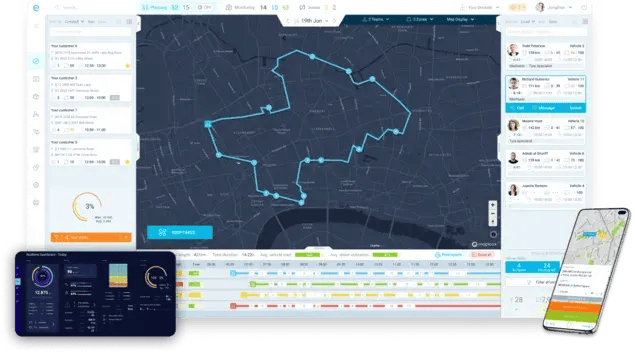
Case management systems remain your system of record, which you continue to use to tack legal status, case history, and creditor instructions.
eLogii takes active cases and optimizes the field execution of the actual visits. And our software does this dynamically, continuously, and at scale.
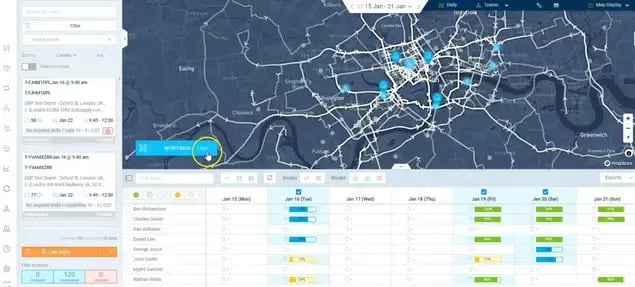
In practical, enforcement terms, this means
- Routing agents to the right addresses at the right times based on contact probability and compliance constraints.
- Re-optimizing route recommendations as conditions change (NOT requiring planners to manually rebuild routes).
- Doing this across 50, 200, or 500+ agents simultaneously without the need to hire more planners or scale workload.
In that sense, eLogii doesn't replace planners' compliance expertise or the legal intelligence of case management systems.
Instead:
eLogii automates that intelligence at the execution layer.
This is the point where we see scheduling decisions historically degrade into manual coordination:
→ The case management system defines what needs to happen.
→ eLogii optimizes how and when it happens in the field.
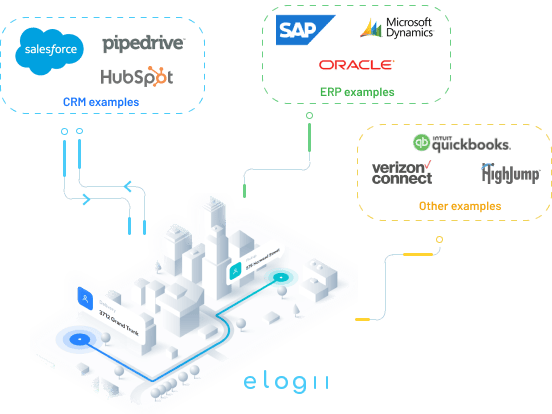
For debt enforcement agencies, High Court enforcement companies, and scaled debt collection operations, this is the layer that has historically been missing:
The gap between case instruction and field execution where planner capacity, agent productivity, and compliance integrity are all won or lost.
Who This Model Is For
The execution-first enforcement scheduling model is designed for agencies running 50+ enforcement agents with court-ordered or compliance-driven visit obligations, high repeat-visit rates, and multi-region operations managed by central planning teams.
This extends to PE-backed enforcement businesses where case throughput and agent productivity are directly tied to EBITDA.
It also applies to High Court enforcement companies (in the UK) managing large warrant volumes, scaled debt collection agencies with enforcement field operations, and insolvency practitioners overseeing significant enforcement caseloads.
If your operation measures cost per case, agent utilization rate, and compliance adherence as core KPIs, this model speaks directly to your operating reality.
This model isn't designed for operations running low-volume or ad-hoc enforcement without structured compliance obligations.
It's not a fit for manual or paper-based operations that haven't yet established basic digital scheduling infrastructure.
And it isn't for single-region operations with fewer than 20 to 30 agents where planner-driven coordination remains manageable.
That distinction is intentional and useful.
If you don't fit the profile, self-select out rather than proceed to a conversation that won't serve you until you scale.
The Bottom Line
Enforcement scheduling is structurally hard and throwing more planners at it doesn't fix that.
Statutory constraints, mandatory revisit logic, narrow compliance windows, and continuous case volatility create a scheduling environment that static planning models can't sustain at scale.
That's why hiring more planners only addresses symptoms, but the structural problem stays intact.
What actually changes the operating model is execution maturity:
Shifting from plan fidelity to outcome optimization, from job-centric routing to visit-level intelligence, and from planners correcting schedules to systems absorbing volatility.
That's the capability gap between enforcement operations that scale and those that just grow.
And if you want to see how this looks like according to your operations, your next step is to:
FAQ about Debt Enforcement Scheduling
What is debt enforcement scheduling? How is it different from standard field service scheduling?
Debt enforcement scheduling covers the planning and coordination of field visits by agents with legal authority - High Court enforcement, tax enforcement, and regulated debt collection. These visits run under compliance windows, mandatory revisit intervals, and case continuity rules that standard dispatch tools don't handle.
At what scale does enforcement scheduling require dedicated route optimization and dynamic reprioritization?
Once you're running 50+ enforcement agents, manual coordination stops keeping up. Failed contacts, new priority cases, and shifting compliance windows pile up faster than any planner can track. At that scale, route optimization and dynamic reprioritization are how the operation stays functional.
How does an execution layer like eLogii complement an existing case management system in enforcement operations?
Your case management system holds the legal record, including case history, status, and creditor instructions. eLogii sits between that system and the field, optimizing when and how visits happen based on agent availability, compliance constraints, and contact probability. Case intelligence shapes execution, and execution data flows back to the record.
What are the compliance risks of poor enforcement scheduling for debt collection agencies and High Court enforcement companies?
Poor scheduling creates missed statutory visit windows, out-of-sequence revisits, and gaps in evidential documentation - all direct compliance risks. In regulated enforcement, those failures carry financial penalties and creditor relationship damage that far outweigh whatever time the bad schedule saved.