CAFM scheduling looks like a solved problem on implementation day.
Your CAFM system is configured.
Asset registers are loaded.
PPM calendars are generated.
Work orders flow into the queue.
The team trains, the planners plan, and the first few weeks run smoothly.
Then the reactive work starts climbing, multi-trade dependencies multiply, and SLA clocks begin ticking across a growing number of sites.
By mid-morning, the schedule built at 7 a.m. is already fiction.
This article is for FM operations managing 50 to 500+ technicians or engineers across multi-site portfolios.
In this article, we're going to breakdown:
- What CAFM was built to do
- Where the gap appears at scale
- Why configuration can't close it
- What the hidden costs look like
- What facility management scheduling actually requires when complexity scales
- And more
So if:
✓ You're managing 50 to 500+ technicians or engineers across multi-site FM portfolios
✓ You're running PPM and reactive work concurrently
✓ You're under SLA or penalty-driven contracts
✓ You have a CAFM system already in place
✓ Your planners have the technology but they're still firefighting
This article is for you.
Here's a quick overview of everything that's to come:
Key Takeaways
- CAFM is a system of record that excels at defining what must be done (assets, compliance, PPM calendars) but can't continuously adapt how execution unfolds once the day starts.
- Facility management complexity compounds faster than what your planners can handle. Adding sites, trades, and reactive jobs creates interdependencies that grow exponentially, not linearly, overwhelming any batch-planned schedule.
- Configuration increases rigidity, which tightens rules engines, priority matrices, and escalation logic that addresses anticipated scenarios. CAFM software can't resolve unanticipated disruptions that define daily FM execution.
- Most FM margin leaks occur between jobs through duplicate site visits, unoptimized drive time, planner rework loops, and SLA penalties. All of this accumulates in the gaps that static scheduling can't manage.
- Scheduling at scale requires continuous, automated re-optimization. This allows you to treat the morning schedule as a starting point, while execution capability adjusts it in real time as reactive callouts, traffic delays, access changes, and job overruns reshape your day.

What CAFM Scheduling Is Actually Designed to Do
Computer-Aided Facility Management (CAFM) software is a system of record that centralizes asset data, compliance tracking, work order generation, and PPM calendars for FM operations. It's the operational backbone most FM providers depend on, and for good reason.
CAFM excels at:
Maintaining detailed asset registers across sites
Surfacing compliance obligations
Generating PPM schedules based on fixed intervals and statutory requirements
Tracking work order history with full auditability.
CAFM scheduling logic is rational on paper:
→ Match jobs to engineers by skill, location, and availability.
→ Build weekly schedules in batches.
→ Push them to the field.
CAFM systems are excellent at defining what must be done. What they aren't designed to do is to continuously adapt to how the execution of your schedules unfolds once the working day starts.
That distinction matters more than any feature gap, and it's where the boundary sits for facility management software in high-volume operations.
| What CAFM scheduling does well |
Where CAFM scheduling reaches its boundary |
| PPM calendar management |
Absorbing same-day reactive overrides |
| Work order generation and tracking |
Dynamic re-sequencing across live jobs |
| Compliance and statutory tracking |
Continuous SLA-aware execution decisions |
| Batch allocation by skill and location |
Multi-trade coordination in real time |
| Audit trails and reporting |
Adapting to field conditions mid-day |
Why FM Execution Becomes Non-Linear at Scale
FM scheduling works predictably at low-to-mid volume because PPM dominates the calendar and reactive work is infrequent enough to absorb manually.
In facilities with larger campus environments or considerable amounts of travel time between locations, the percentage of reactive work can reach 25 to 30 percent of total available manpower, even under well-managed programs.
At scale, that percentage represents hundreds of daily disruptions.
Here's what changes when you add regions, contracts, and trades:
- A new territory doubles reactive volume.
- Statutory compliance spans multiple trades with different inspection cadences.
- Site access restrictions multiply across retail, healthcare, and manufacturing environments.
The complexity drivers that CAFM batch planning can't track in real time stack on top of each other:
- PPM and reactive work collide daily: Every emergency callout displaces planned work for engineers in that area
- Trade dependencies create downstream blockers: One delayed HVAC job means a dependent fire safety inspection can't proceed
- Access windows narrow scheduling options: A hospital ward that's only accessible between 6 a.m. and 8 a.m. leaves zero room for slippage
- SLA clocks run continuously: They don't pause because your morning schedule is already behind
Picture this:
An HVAC engineer delayed 45 minutes by traffic means a dependent inspection can't proceed on time. The CAFM still shows the original schedule, completely disconnected from field reality.
Coordination complexity at scale grows exponentially. More trades, more sites, and more reactive volume interact with each other.
They don't just accumulate independently.
Where CAFM Scheduling Breaks First
The first failure point is same-day reactive overrides.
When an emergency callout arrives, it doesn't just add a job to the queue. It forces a re-sequencing of every other job for engineers in that region, and CAFM systems aren't built to cascade that change automatically.
Static PPM calendars compound the problem.
PPM schedules are built in weekly or monthly batches. They don't know that an engineer is now 90 minutes behind, that a site has restricted access until noon, or that a higher-priority reactive job just appeared.
The calendar says one thing. The field says another.
This triggers what planners know as the rework loop: manually rebuilding parts of the schedule through phone calls, emails, and re-assignments.
Every reactive event generates a ripple of administrative overhead that grows in proportion to portfolio size.
The result for technicians is fragmented days.
Job sequences become inefficient, wait time at sites increases, and drive routes aren't re-optimized after the first disruption.
Most field service organizations aim for utilization rates between 65 and 80 percent as a realistic and sustainable target, but when schedules fragment under reactive pressure, effective utilization drops well below that range.
| Schedule dimension |
Morning state (7 a.m.) |
Mid-morning state (after two reactive callouts) |
| Planned jobs |
8 jobs sequenced per engineer |
5 to 6 still achievable, 2 to 3 displaced |
| Actual job sequence |
Optimized by geography |
Re-ordered manually, gaps introduced |
| Planner interventions required |
0 |
4 to 6 calls/messages per affected engineer |
| Technician idle time |
Minimal |
30 to 60 minutes of accumulated wait time |
| SLA risk created |
None visible |
1 to 2 PPM jobs now at risk of window breach |
The more reactive work enters the day, the less relevant the original static schedule becomes.
And CAFM has no mechanism to close that gap continuously.
Why "Better Configuration" Doesn't Fix This
The natural response to scheduling failures in facility management is to refine the CAFM system:
- Add priority rules.
- Tighten SLA escalation logic.
- Build more sophisticated allocation matrices.
It's the instinct every operations team follows, and it makes sense up to a point.
The structural problem is that configuration defines rules for anticipated scenarios. Execution requires decisions about unanticipated ones:
An emergency callout at 9:15 a.m. that collides with a restricted-access PPM window and a trade dependency on a different site isn't a scenario your rules engine was built to adjudicate in real time.
When rules engines are pushed to cover execution complexity, they produce more rigidity:
- Edge case conflicts multiply.
- Override workflows pile up.
- Planners have to resolve the exceptions manually.
The system becomes better at processing known patterns. It doesn't gain the ability to continuously re-optimize across all live variables simultaneously.
Configuration makes CAFM scheduling better at what it already does. It doesn't give the system execution capability it was never designed to have.
Configuration increases rigidity. Execution requires adaptability.
These are different problems requiring different capabilities.
The Hidden Cost of CAFM-Led Scheduling
The cost of scheduling that can't adapt isn't a one-time implementation issue. It's structural and ongoing, compounding across every engineer, every site visit, and every contract.
- Duplicate site visits: When replanning happens manually and incompletely, engineers return to sites that could have been combined into a single visit. Each trip carries mobilization cost, drive time, and site access overhead.
- Wasted drive time: Unoptimized job sequences after reactive disruption burn technician hours and fuel costs that are invisible in the P&L but accumulate across hundreds of engineers daily. Companies using smart routing report 12 to 18 percent fuel savings and more jobs completed per day, which gives a sense of how much is left on the table without it.
- Planner headcount growth: As reactive volume grows, FM operations hire more planners to manage the rework loop rather than addressing the structural cause. Headcount grows in proportion to scheduling volatility.
- SLA penalties and compliance risk: Missed SLA windows under penalty-driven contracts generate direct financial exposure. Compliance visit slippage under statutory schedules creates regulatory risk that compounds across a growing portfolio.
- Technician frustration and retention: Fragmented days, unclear job sequences, and constant reactive disruption are operationally demoralizing. The Professional Facility Management Institute reported that 50% of facility managers anticipated having open positions, with staffing challenges attributed to difficulties in finding individuals with the necessary technical and managerial skills. Turnover cost in skilled FM trades is a real margin line.
Most FM margin leakage occurs between jobs.
The scheduling gaps, travel inefficiencies, and rework loops are where the P&L erodes, not during the jobs themselves.
Why CAFM + FSM Still Doesn't Solve Execution
Many FM operations add a Field Service Management (FSM) platform alongside CAFM, expecting the combination to close the execution gap.
It's a logical step.
But FSM systems share the same structural limitation in this context:
FSM software is also a system of record.
FSM manages job data, engineer profiles, and dispatch workflows. Its scheduling optimization typically runs in static windows rather than continuously.
Jobs are optimized individually or in daily batches, which works for straightforward dispatch scenarios.
Facility maintenance execution requires something different:
Optimizing across interdependent jobs, trades, site windows, and SLA priorities simultaneously and continuously.
Both CAFM and FSM assume planners make reactive decisions when conditions change. Neither system autonomously re-optimizes the full schedule when an emergency callout shifts the entire day's dynamics mid-execution.
Adding systems of record doesn't create a system of action. The execution gap is architectural. It isn't a data availability problem.
What Scheduling at Scale Actually Requires in FM
Execution capability, as distinct from record-keeping and static scheduling, means the ability to make and remake allocation decisions continuously throughout the working day.
Here's what that looks like in practice:
- Visit-level optimization: Sequencing jobs across technicians in real time, accounting for geographic clustering, trade skill matching, parts availability, and access windows simultaneously
- Dynamic PPM and reactive trade-offs: When a reactive callout arrives, the system automatically assesses which PPM jobs can absorb a small delay without SLA risk and which can't, then re-sequences accordingly without planner intervention
- Continuous re-optimization: The schedule isn't rebuilt once in the morning. It adjusts continuously as traffic delays, job overruns, emergency callouts, and site access changes alter the real-world picture
- SLA-aware execution decisions: The system understands SLA windows at job level and prioritizes sequences that protect contract compliance, not just fill capacity
FM scheduling only works at scale when execution decisions are continuous, automated, and SLA-aware.
The morning schedule is a starting point. It isn't a finished plan.
How eLogii Improves CAFM Scheduling (Without Replacing It)
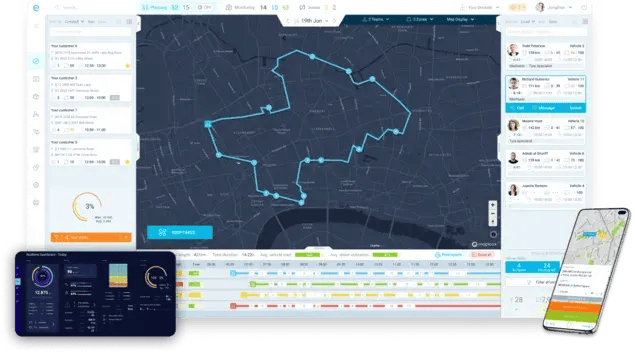
eLogii is the execution layer that sits between your CAFM system and your field engineers, dynamically optimizing daily job allocation as conditions change.
The architecture is straightforward:
- CAFM software (such as Facilio, Upkeep, Planon, IBM Maximo, and others) remains the system of record. It holds contracts, assets, compliance schedules, and job history.
- eLogii takes today's work queue and continuously re-optimizes allocation across available engineers, absorbing the volatility that CAFM surfaces through work order generation but can't resolve through static scheduling.
Reactive callouts, job overruns, access delays, and trade dependencies are handled as they happen, not after a planner spots them.
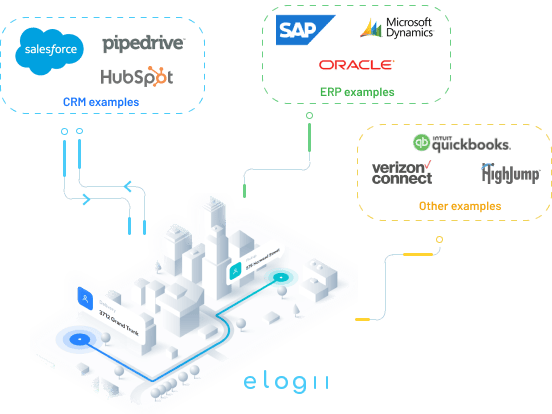
eLogii's API-first design pulls jobs from CAFM, applies FM-specific routing and allocation logic, and pushes completion status back.
→ Your operational database stays intact.
→ Your execution becomes dynamic.
This isn't a replacement conversation. It's an architecture conversation about where execution decisions should live when your operation runs at the scale where static scheduling breaks down.
Who This Distinction Matters For (and Who It Doesn't)
This execution-layer distinction applies to:
- Multi-site FM providers managing concurrent PPM and reactive work across 50 to 500+ engineers
- PE-backed FM platforms scaling through acquisition, where each new portfolio multiplies scheduling complexity
- FM operations under SLA or penalty-driven contracts where scheduling failures have direct financial consequences
It doesn't apply to:
- Static PPM-only operations where reactive volume is low and predictable
- Single-site or low-complexity FM where planner headcount comfortably matches scheduling demand
- Small portfolios where batch planning is sufficient and margins aren't under pressure
If you recognize your operation in the first group, the question isn't whether your CAFM is configured correctly. It's whether you have execution capability that matches the complexity you're managing.
The Bottom Line
CAFM scheduling breaks at scale for structural reasons, not configuration reasons. The system was built to define and track planned maintenance. It wasn't built to continuously optimize live execution across competing priorities, reactive disruptions, and SLA constraints.
This means:
- Investing in better CAFM configuration addresses the wrong problem once reactive job volume and multi-site complexity are real
- Adding another system of record (FSM) alongside CAFM doesn't close the execution gap
- The margin leakage, planner overhead, and SLA risk sitting inside your operation are symptoms of a missing execution layer, not a missing feature
What FM leaders should evaluate differently is straightforward:
Does your scheduling architecture include the ability to continuously re-optimize allocation as the day unfolds?
If the answer is "our planners do that manually," you've found the bottleneck.
See how execution-first FM teams schedule at scale or explore dynamic FM execution in practice.
All you have to do is:
FAQ about CAFM Scheduling
What is CAFM scheduling and what does it include?
CAFM scheduling is the scheduling functionality within Computer-Aided Facility Management software. It includes PPM calendar management, work order generation, compliance tracking, and batch allocation of engineers by skill and location. It's designed to define what planned maintenance work must happen and when. It doesn't include dynamic execution optimization or continuous re-sequencing of live schedules in response to changing field conditions.
Why does CAFM scheduling fail as FM operations scale?
CAFM scheduling fails at scale because its batch planning logic can't absorb the volume and unpredictability of concurrent PPM and reactive work across multi-site portfolios. Static PPM calendars become outdated the moment reactive callouts arrive, and the system has no mechanism to re-optimize the full schedule continuously. The execution gap between what's planned and what actually happens widens as site count, trade dependencies, and reactive volume grow.
Can you fix CAFM scheduling problems by configuring it better?
Configuration helps when the problem is rules clarity or data quality. It doesn't help when the problem is structural. Rules engines address anticipated scenarios, but FM execution at scale is defined by unanticipated ones. Adding more rules increases rigidity. When you find that planners are still manually rebuilding schedules despite tighter configuration, the limitation is architectural, not configurational.
What is the difference between CAFM, FSM, and an execution layer?
CAFM and FSM are both systems of record. CAFM manages assets, compliance, and PPM schedules. FSM manages job data, engineer profiles, and dispatch workflows. Both optimize in static windows (daily or weekly batches). An execution layer is a system of action that continuously re-optimizes live allocation across all engineers, jobs, and constraints as conditions change throughout the day. It sits alongside systems of record and turns planned work into optimized field execution.
What should FM operations evaluate when CAFM scheduling is breaking at scale?
Focus on execution capability rather than feature lists. Ask whether your scheduling architecture supports continuous re-optimization, SLA-aware job sequencing, and dynamic trade-offs between PPM and reactive work without planner intervention. Evaluate whether the system can absorb mid-day disruptions automatically or whether every reactive callout triggers a manual rework loop. These are capability questions that determine whether your scheduling can match the complexity of your operation.