Same-day route reoptimization is a process that recalculates and adjusts routes after the workday has started.
It’s what helps technicians and other field agents stay on schedule when an emergency occurs or something unexpected happens during the day.
But understanding same-day reoptimization means recognizing it as a dual process.
It re-evaluates your schedule and re-arranges it according to delays, emergencies, and new jobs using dynamic scheduling.
And it re-plans existing routes to match those schedule changes, as well as the operational changes happening in the field.
This type of route optimization keeps routes and schedules efficient throughout the day.
The result?
It maximizes the performance of field operation for the ENTIRE day.
(Regardless of what can and does happen.)
Thanks to field execution software, it does this automatically. And across any scale.
For most enterprise operations that manage 50+ technicians, this changes the stakes.
FSM, CAFM, ERP, EWM, and other tools help you plan routes and schedules at the start of the day. Execution layers like eLogii keep them efficient no matter what happens by the end of the day without replacing those tools.
In this guide, we explain how same-day route reoptimization helps to achieve this, what triggers it, and why it matters for you.
So if you’re looking to overcome delays, cancellations, and urgent job callouts without affecting the efficiency of your field operations, this is for you.
Here’s a quick rundown of what you’ll find in this guide:
Key Takeaways
- Routes change because they only reflect information at the moment you plan them. They don’t take into account actual field conditions during the day, which is why efficiency doesn’t survive it.
- Cancellations, delays, traffic, sick leave, urgent callouts, and emergency jobs are normal daily occurrences in field operations. And your plans and schedules should treat them as such.
- Route reoptimization is a decision as much as a calculation of the shortest path between stops. It weighs skills, SLAs, time windows, overtime, and priorities across your whole operation.
- Real value of reoptimization shows up in the productive hours technicians gain, jobs they complete, and your business’ SLA performance. That’s why ROI is wider than mileage.
- Good reoptimization protects finished and in-progress jobs while reconsidering only the work that remains. Which means, completed work stays fixed, while route and schedule changes apply only to what’s to come.
- Same-day route optimization is part of an execution layer. This tool sits on top of your existing FSM, CAFM, or ERP systems rather than replacing them.

What Is Same-Day Route Reoptimization?
Same-day route reoptimization is the process of recalculating and adjusting field service routes after the workday has started, using real-time operational data such as job changes, delays, cancellations, and new requests to improve efficiency, reduce travel time, and maintain service performance throughout the day.
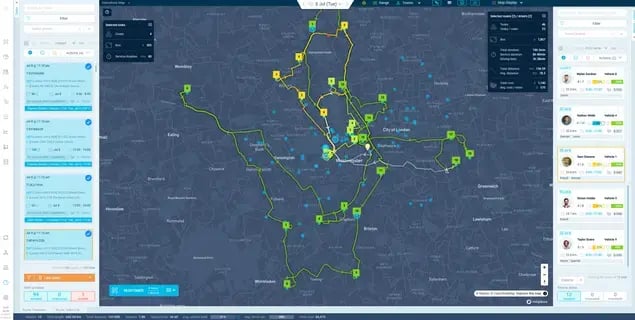
Most route planning happens before anyone leaves home. Planners, dispatchers, and route optimization software build schedules from the information available that morning.
On paper, the routes look efficient and tightly sequenced.
The moment field operations begin, the assumptions behind those routes start changing. New information keeps entering the operation all day:
- Customer cancellations
- New service requests
- Emergency jobs
- Traffic disruptions
- Delayed appointments
- Technician availability changes
- Higher-priority work orders
Each event chips away at the original plan.
Reoptimization is continuous process of recalculating routes and assignments as conditions move. So the operation adjusts to reality instead of following a plan that's already out of date.
Picture a team that starts the day with 100 scheduled jobs. By noon, several customers have cancelled, an urgent job has landed, congestion has slowed travel, and one technician is running behind.
The original routes are no longer the best way to complete the day. Without reoptimization, dispatchers patch things by hand or crews keep driving inefficient routes.
Most people treat route optimization as a morning exercise. The larger opportunity sits in improving routes as the day unfolds, which drives:
- Reduced travel time
- Better technician utilization
- Faster response to urgent work
- Improved schedule adherence
- Lower dispatcher workload
- Increased daily job capacity
- Better customer service performance
Route efficiency has to be maintained as conditions change during the day.
That's why the big question for you is whether your operation can adapt when this happens.
Why Static Routes Fail Throughout the Day
If a route was optimized before the workday began, it should stay efficient all day. On the surface that's a reasonable assumption.
Good software already accounts for travel times, availability, appointment windows, priorities, and job locations. But reality is quite different.
A route is only as accurate as the information available when it was built. While field operations run in a constantly moving environment.
That's why the route that was optimal at 7:00 AM may already be slipping by 10:00 AM and genuinely inefficient by mid-afternoon.
Think of the morning plan like a flight plan filed before takeoff. It's useful and necessary, but pilots still adjust for weather and traffic along the way. Field operations face the same reality.
When routes aren't updated to match changing conditions, the costs stack up quietly:
- Increased travel time
- Lower technician productivity
- More idle time
- Higher fuel and vehicle costs
- Missed appointment windows
- Reduced schedule adherence
- Greater dispatcher intervention
- Lower daily completion rates
These losses are gradual and easy to miss.
Your team still finishes the work. They just finish it less efficiently than they could have.
This is exactly why real-time field visibility matters for spotting when routes have drifted from the plan.
Operational reality simply moved on from the initial reality of your plan, while the route stayed still.
Many teams respond by adjusting schedules manually, which works until volume and complexity make it exhausting.
The gap between planned and actual routes grows fastest in operations with mobile workforces, large territories, high daily volumes, tight SLA and appointment commitments, and reactive work running alongside planned PPM.
The challenge is keeping them efficient after the day begins.
To understand why static routes struggle, it helps to look at the events that reshape field operations throughout the day.
Events That Trigger Route Reoptimization
Routes fail because they lose efficiency when the conditions they were built around have changed. And the more dynamic the operation, the more often that happens.
That's why the goal is to plan routes that adapt when those changes occur.
Customer Cancellations
A cancelled appointment creates capacity that didn't exist when the route was planned. Left unaddressed, that gap turns into technician idle time, unnecessary travel, and underused workforce capacity.
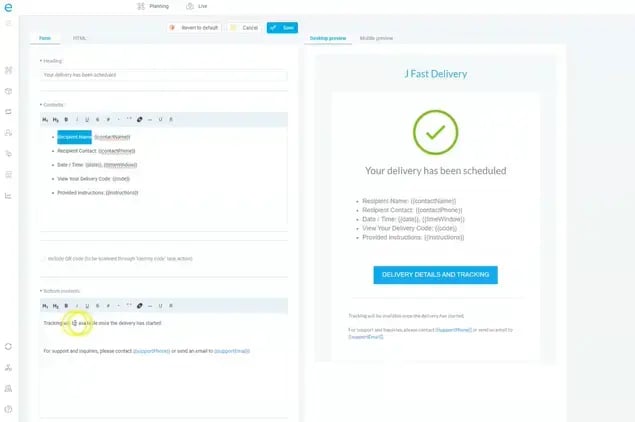
A technician is booked for an 11:00 AM visit. The customer cancels at 9:30 AM, opening a hole in the route that a nearby job could fill.
Teams that reallocate quickly recover productivity that would otherwise vanish, making better use of the capacity they already have.
Traffic and Travel Delays
Travel conditions rarely hold steady. Congestion, accidents, road closures, and weather all reshape planned timings, and a single delay usually affects far more than one stop.
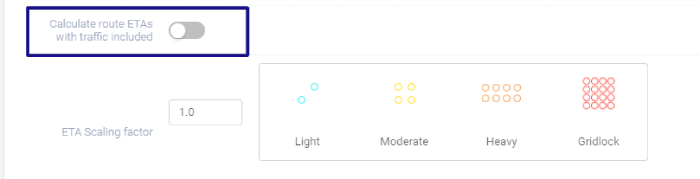
A 30-minute holdup on the way to the second job pushes back everything after it.
Traffic-aware routing that accounts for live road conditions helps contain the downstream impact before it cascades across the schedule.
Technician Availability Changes
Routes are built on assumptions about who's available. When those assumptions break, efficiency breaks with them.
Common causes include unexpected absences, late starts, extended jobs, vehicle breakdowns, illness, and schedule overruns.
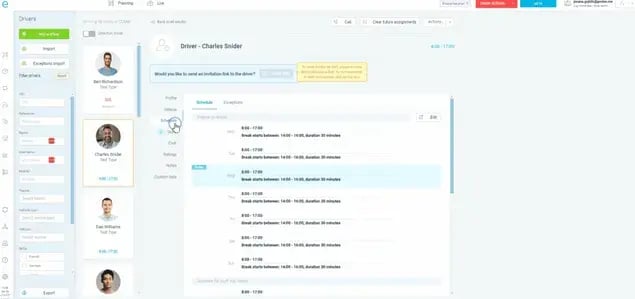
A technician calls in sick after routes are already assigned. Their work has to be absorbed elsewhere, which quickly creates imbalances if nothing changes.
Smart workload balancing spreads that absorbed work fairly across the team instead of dumping it on whoever is closest, keeping productivity intact despite the disruption.
Emergency Job Requests
Many operations juggle planned work with urgent, unplanned work: outages, emergency repairs, critical maintenance, and high-priority customer requests.
This is a constant reality in telecom field operations, where a service disruption can't wait for tomorrow's schedule.
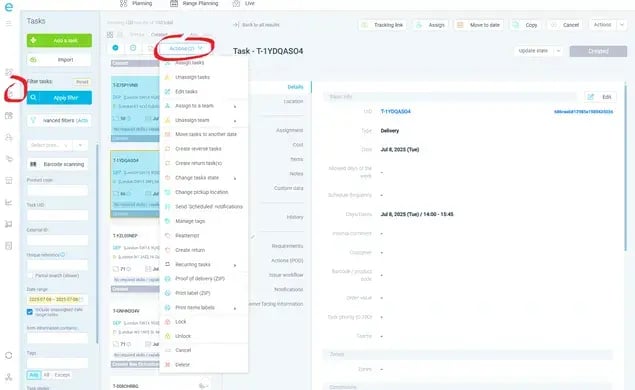
A critical issue is reported halfway through the day, and the nearest qualified technician isn't the one originally assigned to that patch.
Inserting urgent work creates knock-on effects across routes and workloads, so the aim is responding fast while minimizing disruption to everything else.
These four events look different but create the same problem: the earlier route is no longer the most efficient way to execute the work.
For most operations, they are the normal texture of a working day. And the more often they occur, the wider the gap between your plans and outcomes grows. (Along with the costs, dispatcher workload, and service risk.)
The challenge is responding to these events fast enough to maintain operational efficiency.
How Route Reoptimization Engines Make Decisions
Many people assume reoptimization simply finds the shortest route between jobs. The real decision-making is far more involved, because when conditions change there's rarely a single best answer.
The system has to evaluate multiple alternatives and find the option that produces the best overall outcome.
That's why reoptimization is about optimizing the whole operation while balancing competing objectives.
Evaluating Route Alternatives
Every disruption opens up multiple possible responses.
A cancellation, a delay, a new job, or a change in travel conditions can each be handled in dozens of ways, and an engine works through many potential route and scheduling combinations to find the most effective one.
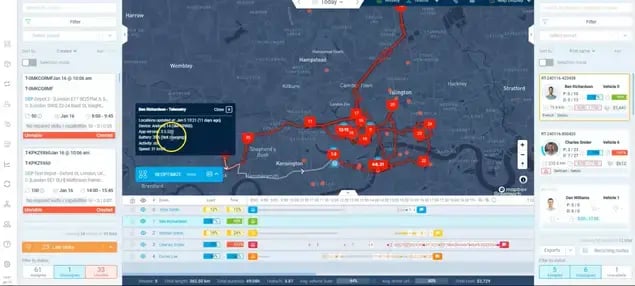
A high-priority job enters the schedule at noon. The nearest technician looks like the obvious pick, but assigning it there might delay several other appointments and create bigger problems elsewhere.
A technician who's slightly farther away can produce a better overall result.
Reaching that answer while operations are live depends on a fast optimization mode that recalculates in seconds rather than hours, improving overall performance instead of one route in isolation.
Balancing Constraints and Priorities
Route decisions are rarely about travel time alone.
Field operations balance many requirements at once:
- Customer appointment windows
- Service-level agreements
- Technician skills and certifications
- Job priorities
- Travel times and working hours
- Asset availability and territory restrictions
- Overtime limits and workforce utilization
An emergency work order arrives. The closest technician is fully booked and near the end of a shift, while another slightly farther away can take it without breaching SLAs or triggering overtime.
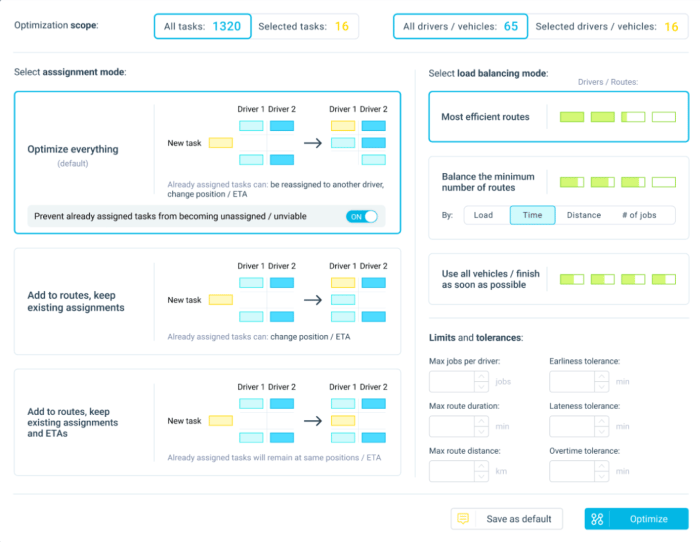
Getting this right depends on realistic timing, which is where ETA adjustment factors feed real-world assumptions into the decision.
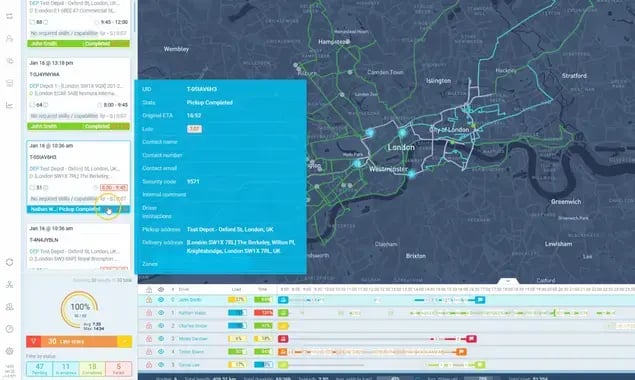
The goal is to create the best overall balance across priorities.
That's why the real challenge is to make trade-offs.
Because every adjustment touches technicians, customers, schedules, resources, and commitments, a good engine evaluates those trade-offs consistently.
This is what shows up as improved utilization, better route efficiency, higher schedule adherence, stronger SLA performance, faster urgent response, reduced costs, and lower dispatcher workload.
Business Benefits of Real-Time Route Reoptimization
Route optimization is usually judged by miles or minutes saved. Those matter, but they're only part of the case.
The deeper value of real-time reoptimization is protecting operational performance when the day doesn't go to plan, using existing capacity rather than adding technicians, vehicles, or hours.
Higher Workforce Utilization
Cancellations, gaps, and delays leave technicians underused when routes stay static. A technician finishes early or loses an appointment, and instead of a dead gap, nearby work slots into the route.
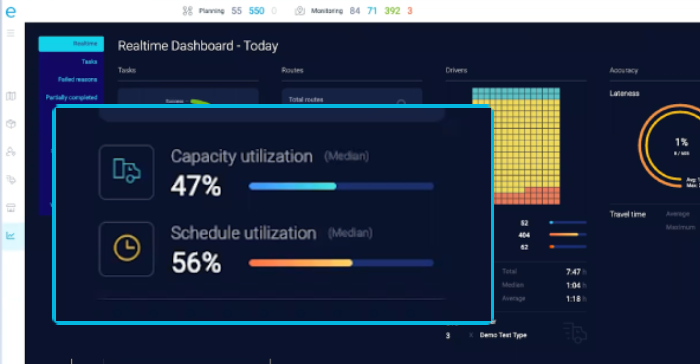
That translates into:
- More jobs completed with existing resources
- Less idle time
- Better utilization
- Increased daily capacity
- Reduced unnecessary overtime
Better Service Levels
Delays cascade. A 30-minute holdup can push every later appointment out of its window unless assignments and sequencing adjust to protect the most important commitments.
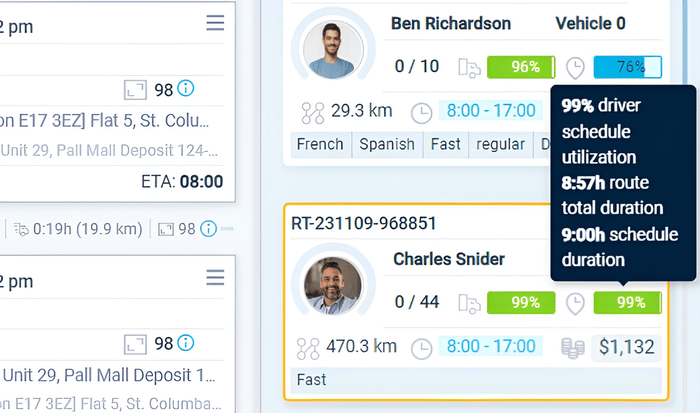
The payoff:
- More reliable arrival times
- Better SLA performance
- Fewer missed windows
- Faster urgent response
- Improved customer experience
Greater Operational Agility
An urgent job arrives while crews are already deployed across the territory. Rather than rebuilding the whole schedule by hand, the operation finds the best way to insert it with minimal disruption, delivering:
- Faster response to changing priorities
- Less manual intervention
- Lower dispatcher workload
- Greater resilience
- More complexity handled without proportionally more resources
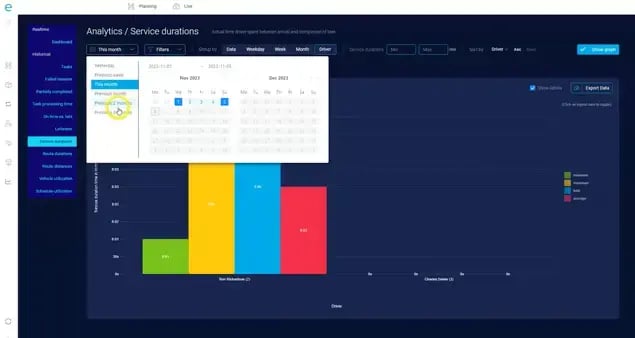
Utilization, service levels, and agility reinforce one another.
Better decisions raise utilization while protecting commitments, and faster adaptation reduces disruption while stretching existing capacity.
That's why the ROI shouldn't be measured only in miles.
| Measure |
What it captures |
Why it matters |
| Miles/minutes saved |
Direct travel efficiency |
Lowers fuel and vehicle cost |
| Productive hours gained |
Time redirected from travel to jobs |
Turns waste into billable capacity |
| Additional jobs completed |
Output from the same workforce |
Grows revenue without hiring |
| SLA performance |
Commitments met on time |
Protects contracts and reputation |
| Overtime reduction |
Work absorbed within shifts |
Cuts premium labor cost |
| Technician utilization |
Share of the day spent productive |
Reveals hidden capacity |
| Dispatcher intervention reduced |
Manual fixes avoided |
Frees planners to scale the operation |
Across field service deployments, mileage reductions of 20-40% and 1-3 additional jobs per technician per day are typical outcomes.
The best route is the one that helps your operation deliver the most value when conditions keep changing.
Real-World Results of Same-Day Route Reoptimization
Two operations in completely different industries show what adaptive routing changes in practice.
Vergo Pest Management
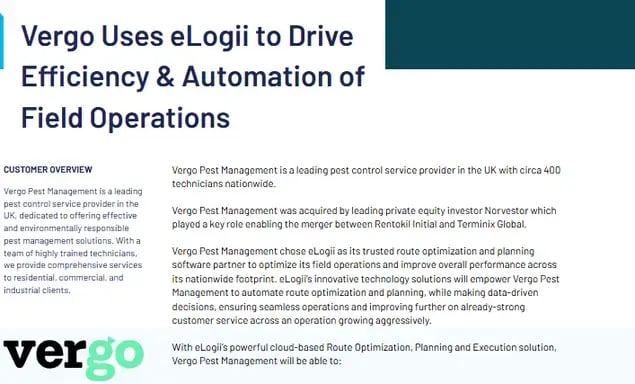
Vergo is a leading UK pest control provider with a large, geographically distributed mobile workforce, and this pest control route optimization example shows why scale demands adaptability.
Vergo Pest Management is a leading pest control service provider in the UK with circa 400 technicians nationwide. The operation needed to keep schedules and routes efficient as conditions shifted across the day, without adding planners to match its growth.
Automated route optimization and planning replaced manual scheduling, accounting for complex operational rules and adjusting as work evolved.
For a business with strict compliance obligations, effective pest control route planning has to enforce safety and service-level constraints automatically, not leave them to memory.
The results were operational:
Cut mileage 35%, add 3+ more jobs per technician per day, and automate 90% of your route planning and scheduling tasks.
On the return, their team was direct: we've beaten all records that we put in place, generated 3–4x ROI and I think we're heading well ahead of that.
The win was was running a large workforce more efficiently, cutting planning effort, and adding productive capacity at scale.
Northern Care Alliance NHS Foundation Trust
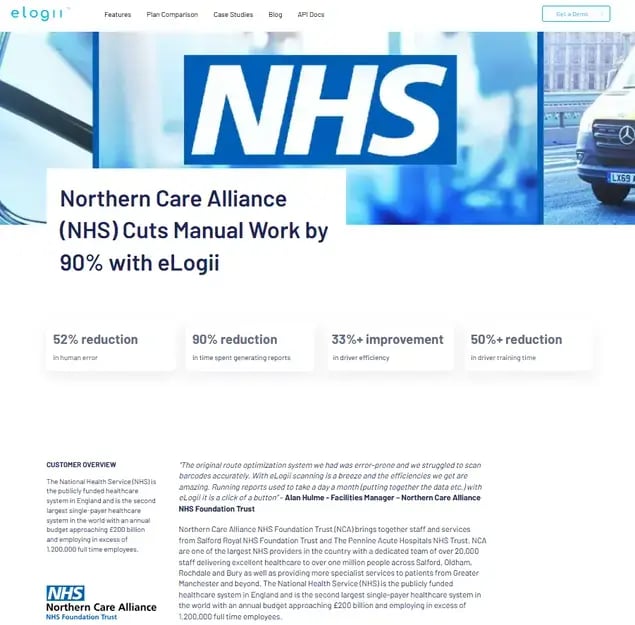
The context here is very different:
Time-sensitive healthcare logistics collecting blood samples from medical facilities across Greater Manchester, with strict time windows and a real need for accuracy.
This is a genuine large-scale workforce scheduling challenge where recurring routes meet daily change.
The Trust had a solution that scanned barcodes when picking up blood samples from doctors surgeries around the region, but the scanning was hit and miss and pickups, which are highly time sensitive, often took longer than desired.
The approach combined daily route adjustments, recurring templated routes, and dynamic planning with driver-availability exceptions.
If regular drivers were away, ill or on holiday, the Trust can set exceptions that exclude particular drivers from planning for a defined period and allow relief drivers to automatically be considered in the planning.
The headline outcome:
Northern Care Alliance NHS Foundation Trust cut manual work by 90% while improving efficiency.
Alongside a 60%+ reduction in planning time and far greater speed and flexibility, the real win was adapting routes and resources daily while protecting time windows and slashing manual work. (Not just reducing mileage.)
Two industries, one shared lesson:
The plan can't be treated as fixed once the day begins.
Route optimization is less a morning planning activity than an ongoing execution capability. The biggest gains come from keeping routes efficient as the operation changes.
The lesson from both operations is simple:
Route efficiency is something you maintain throughout the day.
How eLogii Adds Same-Day Route Reoptimization to Your Field Operations Stack
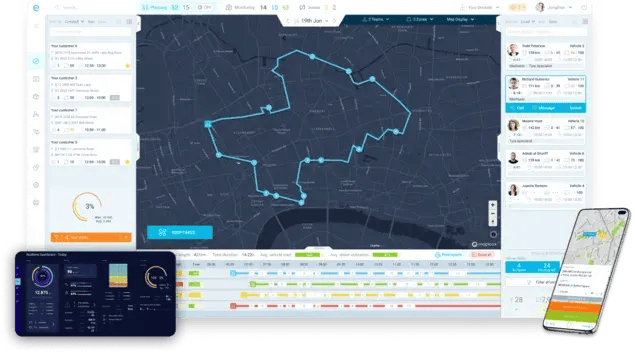
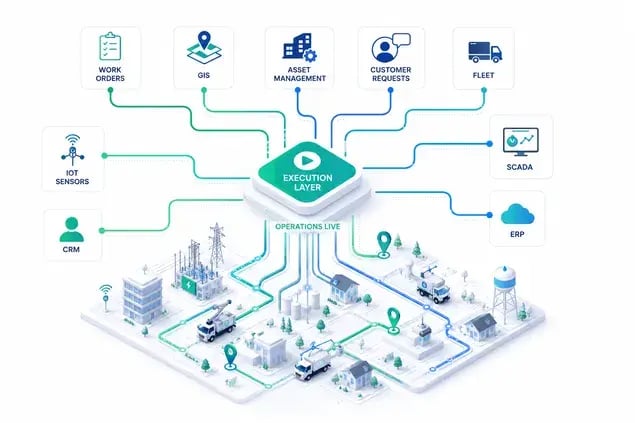
Adding route reoptimization doesn't mean ripping out your FSM, CAFM, ERP, EAM, or CRM. eLogii sits on top of the systems you already run as an execution layer.
Those systems keep owning work orders, customers, assets, technicians, and service requirements.
eLogii uses that information to optimize how the work gets executed as conditions change, powered by dynamic route reoptimization that keeps the plan current all day.
The workflow is straightforward:
- Existing systems provide the work and context: work orders, technician details, priorities, locations, and service requirements flow into the execution layer.
- Routes are optimized on the current plan, and the day starts on that plan.
- Something changes: a cancellation, an urgent job, an absence, or a delay.
- eLogii reoptimizes the remaining work, triggered manually or automatically, respecting completed and in-progress stops while recalculating everything still to come.
- Updated routes are sent to field teams, so people work from a current plan.
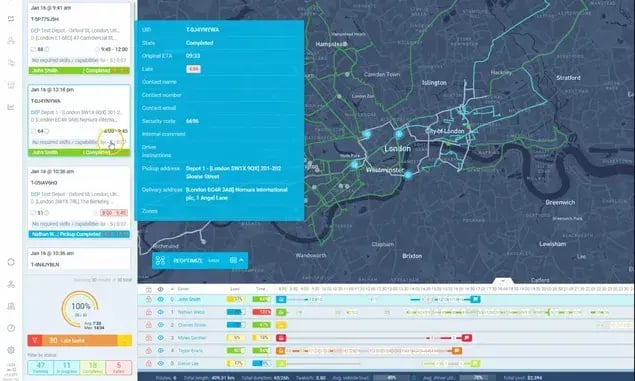
Consider an HVAC company that starts with 200 scheduled jobs.
At 11:00 AM an emergency boiler breakdown comes in.
Instead of manually shuffling afternoon appointments, the execution layer evaluates the live operation, identifies the best technician for the callout, and recalculates the remaining routes while protecting work already done or underway.
This kind of responsiveness is exactly what modern HVAC dispatch operations need.
The point is that the entire remaining operation is reconsidered around the new reality.
That's the difference between two questions.
Morning optimization answers:
"What's the best way to execute today's work based on what we know now?"
Same-day reoptimization answers:
"Given everything that's happened so far, what's the best way to execute the work that remains?"
The operational outcomes:
- Less manual route rebuilding
- Better technician utilization
- Faster urgent response
- Reduced unnecessary travel
- Better protection of windows and SLAs
- More jobs completed with existing resources
- Greater ability to absorb disruption
For some operations, that can mean more same-day jobs completed without adding vehicles, though results vary by operation.
eLogii doesn't need to become the system of record to create value. Its job is connecting operational information with real-time execution decisions.
Your existing systems don't have to change. The missing piece may simply be the layer that keeps the plan optimized after the day begins.
Bottom Line: Route Optimization Doesn't End When the Day Begins
Route optimization isn't a one-time morning exercise.
In dynamic field operations, routes have to stay efficient as conditions change all day.
Cancellations, delays, absences, and emergency jobs disrupt the plan within hours. Reoptimization engines respond by weighing trade-offs across the whole operation.
The payoff spans utilization, service levels, capacity, and agility, and it lands well beyond mileage saved.
Best of all:
This capability adds as an execution layer on top of your existing systems rather than replacing them.
Explore how eLogii's dynamic scheduling and same-day reoptimization fit your existing stack.
Book a demo and see how keeping routes efficient all day changes your numbers.
FAQ about Route Reoptimization
How often should routes be reoptimized during the workday?
There's no universal interval. Reoptimize when meaningful operational changes occur, not continuously for its own sake. The right frequency balances responsiveness against route stability and practicality, since incorporating new information fast has to be weighed against disrupting technicians already executing their day.
Should every route be reoptimized when a disruption occurs, or only the affected routes?
It depends on the disruption's reach. A localized change, like one cancellation, usually justifies reoptimizing only the affected routes to limit unnecessary churn. A broader disruption, like multiple absences or a major traffic event, may warrant evaluating a wider group. Modern systems support both targeted and broader reoptimization.
How much of a technician's existing route should be allowed to change during reoptimization?
That depends on your operational rules, what work has already started, and customer commitments. Completed jobs stay fixed, and work already in progress is generally protected, while unstarted jobs can be reconsidered. The goal is improving the remaining route without disrupting work that's underway.
Can same-day reoptimization protect appointments that are already in progress or close to their time window?
Yes. Constraints and frozen portions of a route protect important appointments while the rest of the day is optimized around them. Time windows and in-progress work feed directly into the recalculation, so critical commitments and jobs a technician is already handling aren't disturbed.
How does route reoptimization prevent constant changes from confusing field technicians?
Reoptimization is governed by rules, thresholds, and priorities rather than triggered for every minor event. Technicians receive an updated route only when a meaningful change genuinely improves execution. The aim is controlled adaptation, not constant reshuffling, so people trust the plan they're following.
Can route reoptimization work when new jobs arrive continuously throughout the day?
Yes, and this is one of its primary use cases. New jobs are folded into the remaining workload while considering existing routes, technician availability, priorities, and constraints. The key requirement is an optimization process fast enough to respond while operations are live rather than overnight.
What data does a route reoptimization engine need to make reliable decisions?
Useful data includes job locations, priorities, time windows, technician availability, skills and certifications, current route status, travel conditions, and operational constraints like working hours and overtime limits. Better and more current data lets the engine make decisions that reflect actual field conditions rather than the original morning plan.