Manual sequencing is the reason most field service operations never capture the bundling opportunities sitting inside their own job pools.
But here's the thing that nobody tells you about job bundling:
Planners aren't the problem. The process how you bundle jobs is.
When you order jobs one by one against a static snapshot of the day, you're solving for sequence, not consolidation. And those are fundamentally different problems.
This article breaks down why manual job sequencing (no matter how skillfully applied) structurally misses bundling opportunities in complex field operations.
We'll walk through
- What sequencing actually is
- How it differs from bundling
- Why live conditions destroy both
- What it takes to capture consolidation opportunities that manual processes leave on the table
If you're running 50 or more technicians across multiple jobs per day in a multi-trade or multi-service environment, under SLA pressure, with margin on the line, this is written for you.
Here's everything you'll find in this guide at a glance:
Key Takeaways
- Manual sequencing solves for order, not consolidation. It produces a coherent plan at a fixed point in time but cannot evaluate bundling combinations across a full, shifting job pool.
- Bundling requires continuous, cross-job awareness. A perfectly sequenced day can still generate duplicate visits to the same site because sequencing and bundling operate on different inputs.
- Live conditions invalidate static sequences. Reactive jobs, cancellations, and SLA escalations destroy bundling opportunities that were never explicitly captured.
- The decision space is exponential. Even mid-size operations generate combinatorial complexity that no planning team can fully evaluate before the day begins.
- FSM platforms aren't designed to solve this. They manage work orders effectively, but their static optimization windows inherit the same limitations as manual sequencing.
"We Just Need Better Sequencing" Doesn't Capture Job Bundling Opportunities
Every morning, the same scene plays out:
→ Planners arrive early, pull up the job pool, and start building routes.
→ They cluster by geography, sort by SLA priority, match trades to technician skills
→ They produce a set of sequences that look solid by 7 AM
There's a quiet confidence in the room. The routes are tight. The day is planned.
But by month's end, your numbers tell a different story:
Duplicate visits accumulate. Return trips to sites that could have been handled in a single visit erode margin in ways that are hard to trace back to any one decision.
Bundling opportunities vanish, not because planners missed them, but because the process itself couldn't surface them.
The core tension is straightforward:
Manual sequencing optimizes a moment in time, while your field operations require optimization over time.
That gap between a plan that's correct at 7 AM and an operation that shifts continuously until 5 PM is where bundling opportunities disappear.
What Is Manual Sequencing in Field Service Operations
Manual job sequencing is the process of ordering work assignments for a technician or team based on geography, priority, time windows, and planner judgment, executed at a fixed point before the day begins.
Whether it happens on a whiteboard, a spreadsheet, or inside a basic FSM calendar view, the underlying process is the same: A field service planner evaluates the available jobs and decides what order they should be completed in.
This process does several things well:
- It applies geographic heuristics efficiently.
- It reflects local knowledge (which technician knows a particular site or which route avoids traffic bottlenecks)
- It respects skill and trade matching.
And at the moment of creation, this plan is coherent and defensible.
What manual route sequencing doesn't do so well is:
- Evaluate consolidation opportunities across the full job pool
- Account for jobs that arrive after the plan is locked
- Recalculate as conditions shift during execution
Sequencing orders doesn't optimize outcomes.
This matters because it holds regardless of the tool you use.
Manual stop sequencing on a spreadsheet and manual stop sequencing inside a scheduling calendar and FSM/CAFM share the same structural constraint:
The plan reflects one moment, and the operation moves on without it.
Job Sequencing vs Job Bundling: Why They Aren't the Same Thing
Job bundling in field service is the consolidation of related work into a single visit or tightly grouped sequence that eliminates a return trip. Related work just means same site, same asset type, same trade, proximate geography, or any combination that makes a second visit unnecessary.
Bundling demands a fundamentally different type of decision than sequencing:
Where sequencing asks "what order should these assigned jobs go in?", bundling asks "which of these jobs across the full pool can be combined before they're assigned at all?"
One operates on a fixed input. The other requires cross-job awareness across every open work order at a given moment.
| |
Job Sequencing |
Job Bundling |
| Key consideration |
Assigned jobs |
Full job pool |
| Decision type |
Ordering |
Consolidation |
| Timing |
Pre-day, fixed |
Continuous |
| Input required |
Geography + priority |
Site, trade, asset, SLA, proximity |
| Outcome |
Ordered plan |
Reduced visits |
A planner can sequence a day's work perfectly and still generate three separate visits to the same site that could have been one.
That's not a planning error. That's the structural limit of sequencing as a method.
Bundling only becomes visible when evaluating the full job pool against real-time constraints simultaneously. And this is a fundamentally different operation from arranging pre-assigned stops.
Why Manual Sequencing Breaks Under Live Conditions
Manual sequencing rests on a core assumption:
The job pool, access conditions, technician availability, and SLA priorities at the start of the day will remain stable enough for the sequence to hold. In complex operations, that assumption fails before lunch.
The disruption types are familiar to anyone running field operations:
- Reactive emergency jobs inserted mid-morning that displace planned stops
- Customer cancellations that leave gaps in geographic clusters
- Access restrictions discovered on arrival, forcing technicians to skip sites
- SLA escalations that require immediate re-prioritization of the remaining sequence
- Technician delays from a single long-running job cascading across every subsequent stop
Each disruption doesn't affect just one stop. It reshapes the geometry of every downstream bundling opportunity that was implicitly embedded in the original sequence.
For example:
A cancellation at site A doesn't just remove one job. It removes the geographic anchor that made bundling two adjacent jobs at site B viable within the same route window.
Even sophisticated dispatch tools require manual intervention to rebuild sequences after disruption, because the tool's optimization window closed when the day's plan was set.
Sequencing assumes stability. Execution guarantees disruption.
And every disruption destroys bundling opportunities that were never explicitly captured in the first place.
The Decision Volume Problem That Your Planners Face
Job sequencing with deadlines across multiple technicians, trades, and sites is a combinatorial optimization problem. The number of possible assignment and sequencing combinations doesn't grow linearly with job volume. It grows exponentially.
This class of problem, studied for decades under labels like the job sequencing problem and job shop scheduling problem, is classified as NP-hard.
In practical terms:
This means no human and no simple algorithm can evaluate all possible options within an operational time window.
To make this concrete:
A mid-size operation with 80 technicians running six jobs each faces a decision space of staggering scale. No planning team, no matter how experienced, can fully evaluate every bundling combination before 8 AM, let alone re-evaluate as conditions shift through the day.
What planners do instead is apply heuristics. Geographic clustering, skill-match filters, SLA priority sorting, which produces defensible plans. (And they should.)
But heuristics systematically miss bundling combinations that only become visible when evaluating the full job pool simultaneously across every constraint.
Bundling decisions are exponential. Human sequencing is linear. So no amount of additional planner headcount resolves that mathematical gap.
This isn't a criticism of planners. It's a recognition that the problem they're asked to solve by hand exceeds what any linear process can deliver.
Why FSM and Scheduling Tools Inherit the Same Limitation
Most organizations at this scale have invested in FSM or CAFM platforms, and those investments are well placed.
These tools are effective systems of record for work orders, assets, compliance tracking, and customer history.
They do what they're designed to do.
But the limitation is architectural, not qualitative.
FSM and CAFM tools manage individual work orders and their assignment to technicians, but their optimization logic typically runs once, at scheduling time, against the jobs visible at that moment. Once the planning window closes, the sequence is set.
When the underlying sequencing input is manual, or when the FSM optimization window is static and doesn't continuously re-evaluate the full job pool as new jobs arrive and conditions change, the tool inherits the same limitation as the planner.
The job pool at 7 AM isn't the job pool at 11 AM, but the optimization reflects only the earlier snapshot. But this isn't a failure of FSM platforms.
Workflow orchestration, compliance tracking, and work order management are their design purpose, and they deliver on that purpose.
Tools that rely on manual sequencing inherit human limits, regardless of how sophisticated the surrounding workflow management is.
The gap is in continuous execution optimization, which sits outside the scope these platforms were built to address.
The Cost of Missed Bundling Opportunities
Missed bundling isn't a scheduling inconvenience. It's a structural source of margin erosion that compounds across every working day, and it shows up in cost categories that operations and finance leaders already track.
| Cost Category |
Mechanism |
Operational Impact |
| Duplicate visits |
Extra travel to same site |
Increased cost-per-visit and fuel |
| Idle time gaps |
Unbundled stops leave schedule gaps |
Reduced jobs-per-technician-per-day |
| SLA knock-ons |
Return visits compete with priority jobs |
Higher SLA breach probability |
| Planner overload |
Manual re-sequencing after disruption |
Increased admin cost and error rate |
| Margin erosion |
Cumulative across all of the above |
Reduced contract profitability |
The SLA knock-on effect deserves particular attention. When bundling opportunities are missed and return visits are required, those return visits compete with SLA-constrained jobs for technician availability.
The return trip that could have been avoided now displaces or delays a priority job elsewhere in the schedule, increasing breach probability across the wider operation.
For a 100-technician operation, the daily accumulation of missed bundling opportunities across duplicate visits, idle gaps, and SLA penalties is not a rounding error.
It's a recoverable margin line that most organizations never isolate because the cause is distributed across hundreds of small sequencing decisions rather than concentrated in one visible failure point.
What Capturing Bundling Opportunities Actually Requires
The problems described above point toward a specific set of operational requirements, not a product category. But a capability set that follows logically from how bundling works.
- Visit-level optimization. The system must evaluate work at the level of the individual visit, not the day-level route. Each stop needs to be assessed for consolidation potential with adjacent or related work, both before and during execution.
- Continuous re-optimization. Bundling can't be solved once at the start of the day. It must be recalculated as new jobs arrive, cancellations occur, and technician positions change throughout the day. A static optimization window that closes at 8 AM cannot capture afternoon bundling opportunities.
- Trade- and site-aware logic. In multi-trade operations, bundling decisions require awareness of which trades can be combined at a site, which asset types have been serviced recently, and which compliance or access rules govern visit consolidation. Geographic proximity alone is not sufficient.
- SLA-aware trade-offs. The system must evaluate whether a bundling opportunity is worth taking given the SLA status of the jobs involved. A bundled visit that causes an SLA breach on a priority job isn't a saving. It's a net loss.
The organizing principle across all four requirements is the same:
Bundling must be recalculated continuously.
Any approach that locks in optimization at a single planning point will miss the opportunities that emerge after that point.
How High-Maturity Teams Think About Sequencing
In the most operationally mature field service organizations, sequencing has become a secondary output rather than a primary activity.
The shift is subtle but structural: instead of planners building sequences from scratch each morning, systems propose execution plans based on continuous optimization, and planners manage exceptions.
Operationally, this looks like planners defining constraints, SLA tiers, trade rules, and capacity parameters, then allowing an execution system to generate and continuously update the plan as the day unfolds.
The planner's judgment still matters. It's applied to the constraints and exceptions that require human evaluation, not to the ordering of 400 individual stops.
The contrast with common practice is sharp. In lower-maturity operations, planners own the sequence and the system records it. In higher-maturity operations, the system owns the sequence and planners govern it.
This shift has direct implications for planner workload and organizational design:
The planner role doesn't disappear. It moves from manual sequencing labor to exception management and constraint calibration, which is where human judgment adds genuine value.
The measurable outcomes follow:
- Fewer return visits
- Tighter cost-per-visit
- Higher SLA compliance
- More predictable margin
Because the execution layer recalculates faster and more completely than any manual job sequencing process can.
eLogii Helps You to Take Advantage of Job Bundling Opportunities at Scale
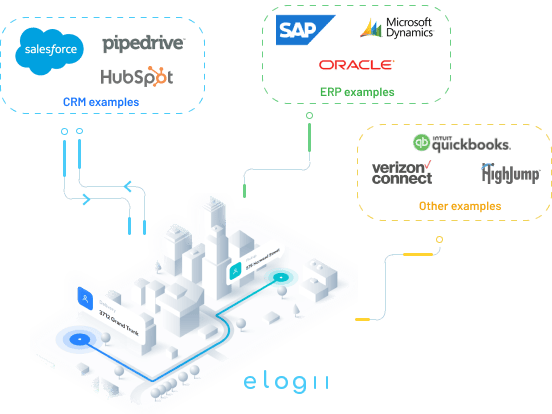
eLogii operates as the execution layer between the FSM or CAFM system of record and the field.
It doesn't replace existing platforms. It extends them with continuous, visit-level optimization that captures bundling opportunities those platforms aren't designed to surface.
The architecture is complementary.
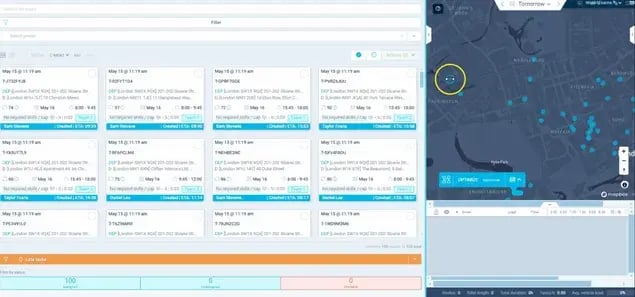
FSM and CAFM platforms manage work orders, compliance, asset history, and customer data. eLogii optimizes how that work is executed:
- Sequencing visits dynamically
- Identifying bundling opportunities in real time
- Recalculating as conditions change throughout the day
eLogii delivers visit-level optimization, continuous re-optimization, trade- and site-aware logic, and SLA-aware trade-off handling.
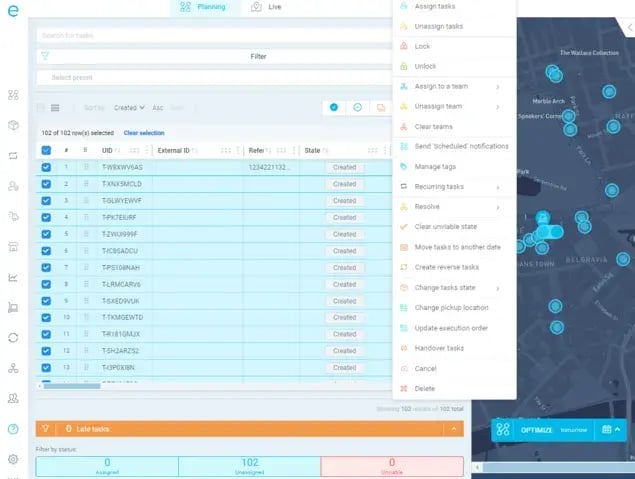
It connects with IWMS and CAFM platforms including IBM TRIRIGA, Planon, and ARCHIBUS, as well as CMMS platforms including IBM Maximo and Fiix, via API. Adoption doesn't require replacing systems of record.
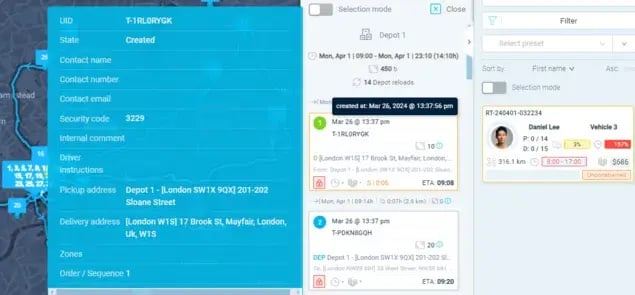
The positioning is straightforward:
eLogii is where bundling decisions get made and remade, continuously, against the live job pool.
Who This Is (and Isn't) For
This argument applies to a specific operational profile:
- Multiple jobs per technician per day
- Multi-trade or multi-service environments
- SLA or compliance pressure that makes return visits costly
- Margin measured at the contract or visit level
- Enough job volume that the combinatorial problem exceeds human evaluation capacity
It does not apply to operations running static, single-job routes where each technician handles one assignment per day.
It doesn't apply to low-variance scheduling environments where job arrival is fully predictable and sequenced well in advance. And it doesn't apply to small teams where planner cognitive load is genuinely manageable across the full job pool.
If your operation doesn't experience disruption during execution, doesn't have same-site or proximate-site visit patterns, and doesn't carry SLA obligations across a dynamic job pool, better manual sequencing may be sufficient.
The structural limitation described here only becomes costly when the operation's complexity exceeds what a linear, point-in-time planning process can address.
Bottom Line: Don't Rely on Manual Sequencing Anymore to Bundle Jobs
The logic chain is straightforward:
Manual sequencing is a point-in-time linear process. Bundling is a continuous combinatorial problem. These two cannot converge through human effort alone.
This isn't a failure of planners or FSM tools. It's a structural property of the problem.
Any organization that relies on manual sequencing as its primary execution mechanism will systematically miss bundling opportunities, regardless of planner experience or tool sophistication.
The math doesn't care how early your planners start or how good your FSM calendars look.
What changes the outcome is moving from a sequencing-first model to a continuous execution-layer model where bundling decisions are recalculated dynamically against the live job pool.
That shift doesn't require replacing your systems of record. It requires adding an optimization layer that operates at visit level, continuously, with full awareness of trade, site, SLA, and proximity constraints.
If the argument here matches what you're seeing in your operation, it's time to take the next step:
FAQ about Manual Sequencing and Job Bundling
What is manual job sequencing in field service?
Manual job sequencing means ordering a technician's jobs by geography, priority, and time windows - usually before the day starts. It relies on planner judgment rather than algorithmic evaluation, so the plan only reflects what was visible at the moment it was created.
What is the difference between job sequencing and job bundling?
Job sequencing orders already-assigned jobs. Job bundling consolidates related work from the full job pool to eliminate return visits. The key difference is scope: sequencing works with a fixed set, while bundling evaluates every open work order. They also run on different timelines: Sequencing happens once before the day starts, while effective bundling requires continuous reassessment.
Why do FSM tools not automatically solve the bundling problem?
Most FSM platforms are built around job-centric calendars designed for work order management, compliance tracking, and workflow orchestration. Their optimization logic typically runs once at scheduling time against the jobs visible at that moment, creating a static optimization window. When new jobs arrive or conditions change after that window closes, the system doesn't re-evaluate bundling potential across the full pool. This is a reflection of their design purpose, not a flaw.
What is the job sequencing problem in operations?
The job sequencing problem refers to the combinatorial challenge of ordering jobs across multiple resources, constraints, and deadlines. The decision space grows exponentially with job volume, meaning a modest increase in technicians or daily jobs creates a massive increase in possible sequences. This problem is classified as NP-hard in operations research, which means no simple algorithm or human process can evaluate all options in a reasonable time frame. Planners manage this by applying heuristics, which produce defensible plans but systematically miss optimal bundling combinations.
What does an execution layer do that an FSM system does not?
An FSM system orchestrates workflows: it manages work orders, tracks compliance, stores asset and customer data, and assigns jobs to technicians. An execution layer continuously re-optimizes how that work is carried out in the field, evaluating visit-level bundling opportunities, recalculating sequences as conditions change, and making SLA-aware trade-offs in real time. The two are complementary. The FSM is the system of record. The execution layer is where dynamic optimization happens against the live job pool.