Reducing field service visits is one of those operational challenges that sounds deceptively simple until you're running 200 technicians across multiple trades and watching your cost-per-visit climb quarter over quarter.
Most ops leaders have tried the obvious fixes:
- Tighter scheduling windows
- More experienced dispatchers
- Stronger Monday morning planning routines
- And more
But the fragmentation persists anyway, and reactive follow-ups accumulate. The schedule looks right on paper.
However:
Your execution tells a different story.
The operations that have genuinely solved this don't talk about visit reduction as a scheduling challenge. They've redesigned how execution works at a systems level.
And the result is that fewer visits emerge structurally.
(Not a metric the team is chasing.)
This article breaks down what those operations do differently, why the FSM-led models most organizations rely on can't fully replicate it, and what actually changes the outcome.
Key Takeaways
- Visit reduction is an execution outcome, not a KPI. High-performing field operations design execution so fragmentation structurally cannot appear. Fewer visits follow as a by-product, and teams that set it as a target risk creating perverse incentives instead.
- Job-centric planning is the root structural barrier. When planners optimize individual work orders rather than site visits, duplicate attendances, trade splits, and partial completions become structurally inevitable (regardless of planner quality).
- High-performing teams plan by site and estate, not by job. Geography and scope aggregation come first. Job-by-job timing is a secondary constraint applied within that frame.
- FSM systems manage jobs well; they don't manage execution dynamics. Visit-level optimization and continuous re-optimization require a separate execution layer. One that FSM platforms were never designed to provide.
- When execution collapses work into fewer visits, planner workload falls in parallel. Fewer conflict points, fewer escalations, and fewer intraday replans shift the planner role from reactive coordination to proactive oversight, with real implications for headcount ratios at scale.

The Best Teams Don't Just Work Faster
Average field operations treat fragmentation as an inevitable condition of scale.
A return visit here, a trade split there, a partial completion that becomes next week's reactive call. The schedule holds together well enough, and the team moves on.
High-performing operations are built differently. They don't accept fragmentation as inherent to complexity.
Instead, they design execution so fragmentation structurally cannot appear. The return visits, the split attendances, the partial completions that average operations generate as a side effect of volume.
This article is written for a specific type of operation:
Field service operations running 50 to 500+ technicians, where multiple jobs per technician per day is standard, multi-trade or multi-service delivery is the norm, and SLA or margin pressure makes every unnecessary visit a real financial event.
If your operation runs static, single-job routes with predictable daily schedules, this framework isn't aimed at you.
Our core argument:
High-performing ops teams design execution so fragmentation never appears.
What "Fewer Visits" Actually Means
Fewer visits gets used loosely in ops conversations, which creates confusion when teams try to act on it.
Before getting into how high-performing operations achieve visit reduction, it's worth establishing a shared definition of what it actually covers.
There are four distinct dimensions, each with a different structural root cause:
| Visit Type |
Root Cause |
Structural Fix Required |
| Site returns |
Repeat attendance to resolve an issue not closed on first visit |
First-visit completion logic built into execution sequencing |
| Trade-split visits |
Electrical, compliance, and maintenance attended separately on different days |
Cross-trade bundling at the visit composition stage |
| Reactive follow-ups |
Unplanned returns caused by incomplete planned work |
Scope verification and intraday re-optimisation |
| Partial completions |
Technicians leaving jobs unfinished due to sequencing or scope failures |
Visit-level sequencing that accounts for full outstanding scope |
Each dimension has a different origin. A single scheduling policy or planning rule can't address all four simultaneously. This is precisely why one-size approaches to visit reduction fail at scale.
What matters most:
Fewer visits is an execution outcome, not a KPI target.
Operations that set visit reduction as a reported metric can create perverse incentives. For example, technicians rushing to close jobs to avoid return flags, planners deferring reactive work to keep the numbers clean.
But operations that design for it structurally achieve it as a by-product of how execution runs.
Why Most Teams Can't Achieve This Consistently
Fragmentation in field operations is caused by a structural mismatch between how work is organized and how execution actually behaves in the field. Here are the biggest challenges most field services face:
- Job-Centric Planning: When planners think in jobs rather than visits (when the work order is the unit they're optimizing for), they assign each job correctly without ever evaluating what else could be served at the same site on the same day. The schedule fills; the visit composition question is never asked.
- Static Routing: A schedule built once per day or week is a plan for conditions that will have changed before the first technician leaves the depot. No-access events, job overruns, new reactive calls, and technician availability shifts all create fragmentation that static plans cannot absorb. The schedule holds its shape; the execution doesn't follow it.
- Manual Job Sequencing: When planners are managing hundreds of individual assignments manually, geographic density and scope aggregation become casualties of cognitive load. Planners focus on what's controllable (individual job start times, technician calendars), while the broader visit composition question never gets answered because it's never been framed as a question worth asking.
- Reactive Disruption: Every unplanned event triggers a replanning cycle, and under time pressure that cycle defaults back to job-centric thinking. The nearest available technician gets the reactive job; the displaced planned work becomes a standalone future visit; fragmentation re-enters the schedule.
Most operations optimize jobs. High-performing teams optimize visits. The unit of planning is what separates them.
The Common Structural Traits of High-Performing Ops Teams
The operations that consistently achieve visit-level efficiency share a set of structural characteristics that hold across industries and scales. These are traits and behaviors. (The what before the how.)
And here are the most common traits that high-performing field ops share:
- Visit-Level Thinking: These teams plan around where work happens, not what work is happening. Sites and estates are the primary unit; jobs are secondary. A technician attends a site and completes jobs while there - not the other way around.
- Cross-Job Coordination: High-performing teams have mechanisms to identify when multiple jobs, trades, or SLAs can be served by a single technician attendance. This requires visibility across the full outstanding job pool, not just today's assigned schedule. A job that appears isolated looks entirely different when an estate-level view shows two other outstanding items at the same site.
- Trade-Aware Execution: Job bundling electrical, fire safety, compliance, and general maintenance into one visit requires execution logic that accounts for technician skills, certifications, available time, and scope dependencies simultaneously.
- Tolerance for Plan Flexibility: High-performing teams design plans that expect to be revised. Re-optimization is a standard operational behavior built into how execution runs, not an exception. The plan is a starting point; the execution layer manages what actually happens.
How These Teams Think About Time, Geography, and Scope
Conventional scheduling asks: which technician is available for this job, and when?
The job is the input; the technician and time slot are the outputs.
High-performing operations ask a different questions first:
- What is the full scope of work outstanding across this geographic zone or estate?
- What visit composition covers it most efficiently?
Geography and scope come first. Individual job timing is a constraint applied afterward.
This geography-first principle means technician routes are built around density:
Which sites can be served in the same patch on the same day. Not job priority order or customer-preferred time windows alone.
Within SLA boundaries, route shape is driven by proximity and scope aggregation before it's driven by job sequence.
Scope aggregation across trades is the natural extension.
When a site visit is being planned, the question is what is the full scope of work outstanding at this location across all trades and SLA windows. This requires cross-trade visibility at the visit level. A fundamentally different data view from the work order list most operations use.
The time trade-off logic follows from this:
Collapsing work into fewer visits sometimes means moving a job within its SLA window rather than scheduling it at first preference:
- The visit window becomes the SLA unit.
- The individual job's preferred time slot becomes a secondary constraint.
They optimize where work happens before when it happens.
Why Planner Effort Drops as Visit Efficiency Improves
There's a compounding relationship between visit efficiency and planner workload worth making explicit, particularly for CFOs evaluating the cost of coordination at scale.
When work naturally collapses into fewer visits, the number of conflict points in a daily schedule falls significantly:
- Fewer jobs compete for the same time window
- Fewer trades need manual coordination across sites
- Fewer SLAs are simultaneously at risk because more of them are being closed in a single attendance
Escalation volume falls with it, and planners in fragmented operations spend significant time managing consequences:
- Customer complaints about return visits
- SLA breach warnings triggered by partial completions
- Technician overruns caused by scope discovered on site
Visit-level efficiency could have anticipated most of this, and, in fact, removes most of these triggers structurally.
The intraday replan cycle shrinks too, and a large proportion of intraday replanning is caused by fragmentation.
For example:
A technician can't complete a job because a related visit was missed the day before. Or, a reactive call displaces a job that becomes an orphan in the next day's schedule.
Visit-level execution breaks this chain by treating the visit, not the individual job, as the unit that must be protected.
When work collapses naturally, planners stop firefighting. Their role shifts from reactive coordination to proactive oversight.
At scale, this directly affects planner-to-technician ratios (a meaningful cost line for any organization).
Why Traditional FSM-Led Models Can't Replicate This
Field service management platforms are excellent systems of record for work orders, asset history, compliance logs, customer contracts, SLA terms. In fact, this is what FSM systems are built to manage. And they do it well.
The limitation appears when FSM scheduling logic is asked to do something it was never designed for.
FSM platforms are built around the job as their atomic unit. Their scheduling logic assigns jobs to technicians based on availability, skills, and basic proximity.
That logic doesn't evaluate visit composition, because composition isn't a job-level problem.
The absence of continuous re-optimization is the specific gap.
FSM scheduling engines optimize at the point of scheduling. Once a job is assigned, it stays assigned unless a planner manually intervenes. As conditions shift through the day (no-access events, job overruns, new reactive demand) the schedule drifts, and fragmentation re-enters.
The FSM system records what happened, but it doesn't recalculate what should happen next.
| Capability |
FSM / CAFM System |
Execution Layer |
| Job creation and storage |
Yes |
No |
| Basic scheduling |
Yes |
Yes |
| Visit-level optimization |
No |
Yes |
| Dynamic bundling |
No |
Yes |
| Continuous re-optimization |
No |
Yes |
| SLA-aware trade-off logic |
Partial |
Yes |
| Real-time intraday adjustment |
No |
Yes |
FSM tools don't manage execution dynamics. And this is a category distinction, not a criticism.
The two functions are genuinely different problems, and the execution layer exists precisely because FSM was never designed to solve the second one.
What Enables Work to Collapse into Fewer Visits at Scale
The capabilities that make visit-level efficiency possible at scale are distinct from conventional scheduling:
- Visit-Level Optimization is the ability to evaluate the full scope of outstanding work across a site, estate, or geographic zone and determine the optimal visit composition before dispatch - which jobs, which trades, which SLA windows, assembled as a visit rather than as a list of individually assigned jobs.
- Dynamic Job Bundling is the automated identification of jobs that can be served by a single technician attendance at a site. This accounts for technician skills and certifications, scope dependencies, available time, and SLA windows simultaneously. It differs from manual batching in that it operates continuously and at a scale no planning team can match manually across hundreds of technicians.
- Continuous Re-Optimisation means the execution environment recalculates visit composition in real time as conditions change. New reactive jobs, no-access events, technician availability shifts, and SLA escalations all trigger recalculation without planners having to initiate it. The schedule adapts; the fragmentation that would otherwise accumulate doesn't.
- SLA-Aware Trade-Off Logic is what makes automated bundling safe at scale. When collapsing work into fewer visits creates tension between a preferred visit time and an SLA deadline, the execution layer resolves that trade-off according to defined constraint rules - not by defaulting to the safest option, which is usually doing nothing and leaving fragmentation intact.
Fewer visits emerge when execution decisions are automated and continuous. The planners don't work harder; the execution layer handles the volume of optimization that human coordination cannot sustain at scale.
eLogii Helps High-Performing Field Ops Teams Add Structure to Actually Reduce Service Visits
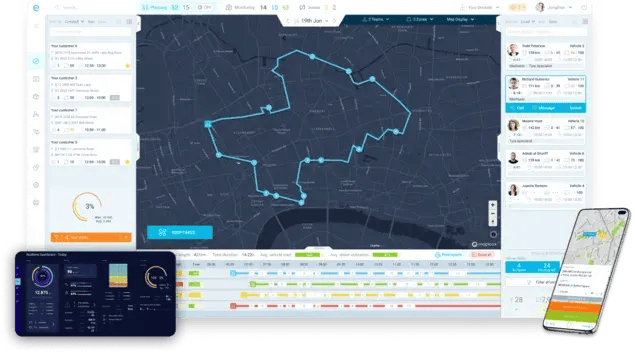
eLogii operates as the execution layer between FSM/CAFM systems and the technicians working in the field.
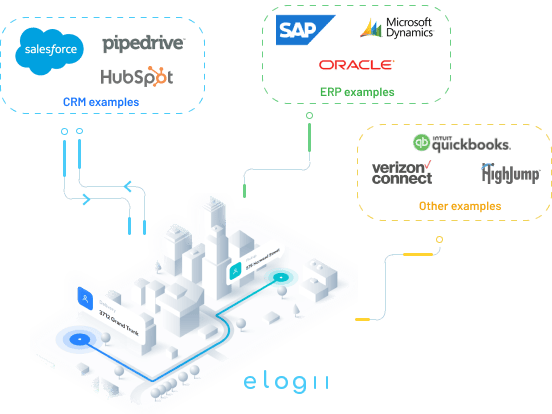
- Jobs flow from the FSM or CAFM system into eLogii via API and webhooks
- eLogii applies visit-level optimization logic:
→ Bundling jobs by site and estate
→ Evaluating trade requirements
→ Balancing SLA windows
→ Sequencing routes by geographic density
- Optimized visit compositions and routes flow out to technicians
- Completions sync back to the FSM system
(This leaves the system of record intact and the compliance log uninterrupted.)
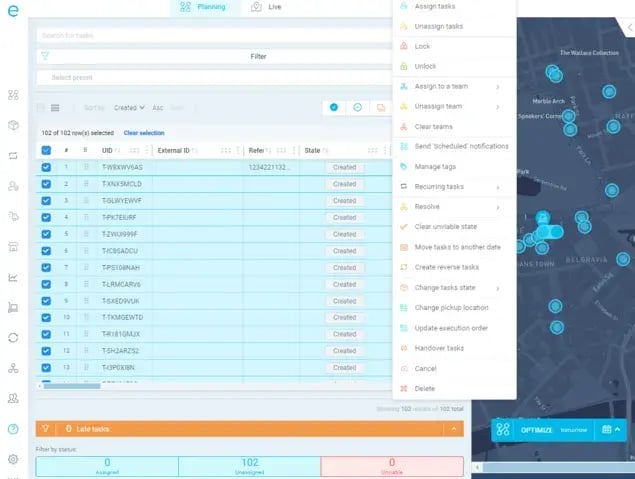
The upstream workflow for planners and the downstream record-keeping for compliance are unchanged:
The FSM or CAFM system remains the authoritative source for work orders, asset history, and customer contracts. What eLogii provides is the execution logic those systems were never designed to deliver:
- Continuous re-optimization as conditions change intraday
- Dynamic bundling across trades and SLA windows
- Visit-level decision-making at a scale that manual planning cannot sustain
For multi-trade, multi-region operations under SLA and margin pressure, visit efficiency becomes a structural property of how execution runs. (Not a goal that planners chase and dispatchers try to hold together under pressure.)
Who This Model Is (and Isn't) For
Visit-level optimization delivers meaningful outcomes in a specific type of operation.
Knowing whether that profile fits yours is worth being direct about:
| Organization Profile |
Good Fit |
Poor Fit |
| Technician count |
50 - 500+ |
Under 20 |
| Jobs per technician per day |
4 - 8+ |
1 |
| Trade complexity |
Multi-trade or multi-service |
Single trade |
| SLA pressure |
Yes - compliance or safety obligations |
Minimal |
| Reactive workload mix |
Significant |
Negligible |
| Planning team size |
3+ planners managing dynamic schedules |
One scheduler |
The right-fit operation runs multiple jobs per technician per day across multiple trades, operates under SLA or compliance obligations, and faces margin pressure where cost-per-visit is a real financial lever.
Fragmentation is a recurring problem, and the coordination overhead of managing it is visible in planner headcount and escalation volume.
The poor-fit operation runs single-job routes, has highly predictable schedules, and faces fragmentation rarely or not at all.
Manual coordination remains viable at that scale, and the overhead of execution-layer infrastructure wouldn't justify itself.
Bottom Line
High-performing field operations achieve fewer visits because their execution model is structurally designed to collapse work at the visit level.
The teams aren't working harder, the planners aren't more experienced, and the schedules aren't built with greater care. The execution model is different.
What actually changes the outcome is a specific combination of factors:
- The unit of planning shifts from job to visit
- Bundling and sequencing are automated rather than manual
- Re-optimization runs continuously rather than being triggered by disruption
- SLA trade-offs are handled by constraint logic rather than planner judgment under time pressure
The implication for operations leaders is direct.
If fragmentation, repeat visits, and planner overload are persistent problems in a scaled field operation, the cause is structural.
So the solution needs to be structural too.
(Better planning effort won't fix a structural problem.)
And if you're looking to fix this structural problem in your field operations, here's the next step you need to take:
FAQ about Reducing Field Service Visits
What does "reducing field service visits" actually mean in practice?
Visit reduction has four root causes: site returns (same issue, repeat visit), trade-split visits (electrical, compliance, and maintenance handled separately when one trip would do), reactive follow-ups (returns from incomplete work), and partial completions (jobs abandoned due to sequencing failures). Blanket scheduling rules might fix one. They rarely fix all four.
Why do high-performing field operations teams achieve fewer visits than others?
High-performing teams plan around the site, not the work order. Cross-job coordination surfaces bundling opportunities across the full job pool, and continuous intraday re-optimization consolidates multiple jobs, trades, and SLA windows into single visits. The difference is structural.
Can FSM or CAFM systems deliver visit-level optimisation on their own?
FSM and CAFM systems are good systems of record - work orders, asset history, compliance logs, SLA terms. But their scheduling logic treats each job as a standalone unit, built for assignment rather than visit composition, and it doesn't re-evaluate that composition as conditions shift through the day. Visit-level optimization needs a separate execution layer that sits alongside FSM, pulls jobs from the system of record, applies composition logic, and returns completion data back.
What is dynamic bundling in field service operations?
Dynamic bundling groups jobs a single technician can handle in one visit, factoring in skills, certifications, scope dependencies, SLA windows, and capacity. Manual batching locks groupings in at the start of the day and stays there. Dynamic bundling runs continuously across the full job pool and adjusts as conditions change.
Which types of field operations benefit most from visit-level optimization?
It works best for operations with 50 to 500+ technicians across multiple trades, handling four or more jobs per day, under SLA pressure, with real margin constraints. Where reactive workload and fragmentation are ongoing problems, the value compounds fast. Single-job, static route operations aren't the right fit.