A thorough analysis of static vs dynamic route planning to help you better understand what’s working for multi-drop site distribution operations right now.
ON THIS PAGE
The debate over static vs dynamic route planning is over.
In this article, we're going to give you a breakdown of both approaches and show you why top-performing distributions treat routing as a continuous process.
This includes:
- A head to head comparison of static vs dynamic routing
- What stops working in enterprise distributions at scale
- How to improve operational performance once that happens
- Industry examples from across the distribution industry
- Questions to ask when evaluating route planning software
- And more
So if you're looking to know where routing breaks in real distribution operations and how to fix it effectively at the fraction of the cost, this article is for you.
Let's get started with a quick overview of what's to come:
Key Takeaways
- Static routing creates fixed routes that you dispatch to drivers before they set off on their delivery run. As your live operations encounter disruptions, it has no mechanism to absorb the changes to those plans.
- Dynamic routing manages the actual operations with continuous re-optimization. This adjusts sequences, timing, and assignments in real time as conditions change throughout the day.
- One delay can cascade across the entire route. In a 30-stop route with tight delivery windows, a single 20-minute delay at stop six can breach time windows at 10 or more downstream stops.
- Failed deliveries carry structural cost to your operation because each missed stop triggers redelivery attempts, potential SLA credits, customer service contacts, and possible account churn.
- Dynamic routing removes manual data processing, which frees up dispatchers to focus on decisions that require context.
- Industries like food service distribution, building materials, flooring, and trade wholesale sit at the high end of disruption frequency. This is what makes dynamic routing a competitive requirement, and the real value to multi-drop distribution.

Static vs Dynamic Route Planning: What Does It Look Like in Multi-Drop Distribution
You know this moment when it happens:
Routes go out clean to drivers at 7 AM and start unraveling by 9 AM.
The core tension is that your plan is fixed, but your operational reality isn't.
In multi-drop distribution, that gap has a direct cost through SLA failure, redelivery expenses, margin erosion, and fleet underutilization.
All of these costs compound quietly behind a static plan, and accumulate across dozens of stops and multiple vehicles.
So you may not even realize, but the morning's route was obsolete two hours after dispatch.
The fact of the matter is this:
Static routing plans the day you hoped for.
Dynamic routing manages the day you actually get.
Disruptions WILL happen in your operations, so the question you need to ask yourself is:
Whether your route planning software can absorb them without manual intervention, failures, or missed delivery windows.
Why Multi-Drop Distribution Is So Hard to Route Efficiently
Multi-drop route planning means managing 20 to 60 stops per route with interdependent time windows, vehicle constraints, and customer-specific rules.
The route doesn't stay fixed because it isn't just plotting a path from A to B to C.
These routing constraints compound on each other:
- Customer time windows: Often as narrow as 30 to 60 minutes in foodservice distribution
- Vehicle load sequencing: Last-in-first-out loading means stop order affects what can physically come off the truck
- Vehicle type restrictions: Some sites require tail lifts, specific axle weights, or refrigeration
- Depot balancing: Distributing volume across multiple depots to avoid overloading one site
- Customer-specific access rules: Site entry hours, loading bay bookings, install slots, residential delivery restrictions
One constraint failure doesn't stay isolated.
A missed time window at stop eight forces a resequence that can break windows at stops 12, 18, and 25.
And these variables change daily through shifts in order volumes, customers rescheduling, drivers calling in sick, and same-day orders arriving throughout the morning.
This is why generic routing tools and ERP batch routing struggle at this scale.
The problem is constraint management under uncertainty, more than distance optimization ever was.
What Is Static Route Planning?
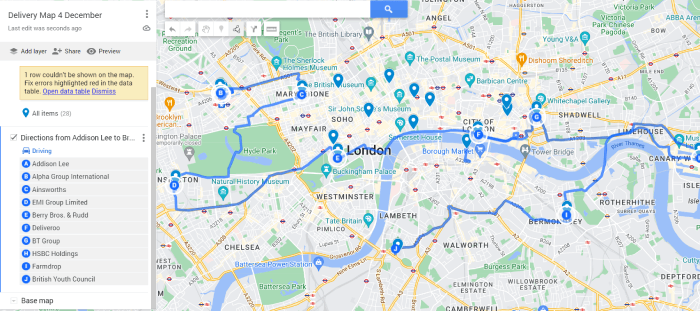
Static route planning is the practice of creating fixed delivery routes in advance, typically the night before or morning of dispatch, that remain unchanged throughout the day.
In practice, it works like this:
→ You plan routes using historical order data, spreadsheet calculations, ERP batch exports, or basic mapping tools.
→ Sequences are locked before drivers leave the depot.
→ Drivers receive their run via printout, text, or a static list on a handheld device.
→ Drivers set off on their route, and move to the first and second stop.
→ Operational circumstances change at the third or fourth stop.
→ The planned route becomes unusable because it's based on conditions that no longer exist.
You'll see static routing in several common forms:
- Spreadsheet route planning: A planner manually groups orders into runs, sequences stops by rough geography or delivery window, and exports the final list to drivers.
- ERP route planning: Routes get calculated in batches, once at the start of the day, then locked in. There is no way to adjust for changes or exceptions, even if a stop is canceled, a new order comes in, or traffic makes the original sequence impossible.
- "Set and forget" route plans: Drivers get a fixed stop sequence at the start of their shift, with no way to report exceptions, skip failed deliveries, or flag anything back to the planner until they return to the depot.
Static routing works in highly stable, predictable environments with consistent customers, fixed schedules, and low daily variability.
Think regular pharmacy replenishment or scheduled retail deliveries with wide time windows.
The structural limit for multi-drop operations is that static route planning has no mechanism to absorb change.
Any disruption, from a canceled order to a road closure, requires manual dispatcher intervention to fix.
What Is Dynamic Route Planning?

Dynamic route planning is continuous route optimization that adjusts delivery sequences, timing, and assignments in real time as conditions change throughout the day.
In this context, Dynamic doesn't mean re-running yesterday's plan each morning.
Instead:
Dynamic routing means the system responds to live events as they happen, which includes traffic incidents, order additions and cancellations, driver delays, failed delivery attempts, and vehicle breakdowns.
The key inputs a dynamic system responds to include:
- Live traffic data: Real-time road conditions, current traffic congestion or road closures, etc.
- GPS driver positions: Exact vehicle location right now, updated live as drivers move through their routes
- Real-time order changes: New orders added, cancellations that need stops removed, and order priority changes
- Time window calculations: Whether each delivery window can be met given current progress, delays, or route changes
- Vehicle capacity status: Remaining cargo vs remaining stops (whether a driver can take on extra stops or needs support)
Dynamic systems work in two modes:
- Dispatcher-triggered changes let planners manually intervene with system support.
- Automatic rebalancing lets the system re-sequence stops within defined rules without requiring human input.
Dynamic route optimization powered by real-time data is distinct from simply re-running a static plan each morning.
Platforms like eLogii deliver real-time dynamic routing, live tracking, and deep workflow configurability suited for the complexity multi-drop distribution demands.
Static vs Dynamic Routing: Comparison
These two approaches differ in operational philosophy, not just technology or software features and capabilities.
One treats your route plan as a finished product. The other treats it as a continuous process.
Here is a side-by-side comparison table that shows how static and dynamic route planning treat each routing input:
| Static Route Planning | Dynamic Route Planning | |
|---|---|---|
| Planning moment | Once at dispatch | Continuously throughout the day |
| Response to disruption | Manual dispatcher intervention | Automated re-optimization |
| Dispatcher workload | High: exceptions handled manually | Lower: system flags and resolves |
| SLA resilience | Vulnerable to cascade failure | Absorbs disruption at stop level |
| Cost per stop | Rises with failed deliveries and overtime | Optimized through rebalancing |
| Scalability | Difficult across depots and fleets | Scales with order volume and fleet size |
| ERP/system integration | Limited or batch-synced | Real-time API integration |
Real-time route optimization is the mechanism that separates these two approaches in practice. And as you scale, the operational gap between them widens because your stop count, fleet size, and customer complexity increase.
What Breaks With Static Routing in Multi-Drop Operations
These are the daily failure patterns that surface in real distribution networks.
Static routing assumes the day unfolds as planned. Multi-drop distribution guarantees it won't.
Here's exactly where static routes break in your operations:
Same-Day Order Additions and Cancellations
Static routing has no insertion logic. Adding or removing a stop mid-route requires manual replanning of the entire affected sequence. The dispatcher pulls the route, adjusts manually, and re-sends to the driver, who may already be at stop eight of 25. The disruption compounds from there.
Every manual exception costs dispatcher time, risks sequencing errors, and often results in a suboptimal insertion that adds miles or breaks a time window downstream.
In trade wholesale and foodservice distribution, same-day additions aren't exceptions. They're routine.
Time Window Misses Cascade Across the Day
In a 30-stop route with tight delivery windows, a 20-minute delay at stop six doesn't just affect stop six. It shifts every subsequent ETA.
One traffic delay or extended service time can breach time windows at five, 10, or 15 downstream stops. The dispatcher often doesn't know until drivers start calling in.
Each failed delivery carries a measurable cost, with direct expenses including labor for re-attempts, customer service handling, and logistical disruption that adds up per every failed package.
To reduce failed deliveries in this context, you need a system that can detect the cascade before it happens. Static routing can't.
Traffic, Delays, and Unexpected Constraints
Routes planned the night before use historical traffic assumptions. They have no mechanism to respond to a road closure at 9am, an accident on a key arterial, or a congested jobsite at 11 AM.
Drivers either follow the plan and run late, or deviate independently and create gaps the dispatcher can't see.
In distribution, route constraints aren't just traffic. They include jobsite access hours, equipment schedules, and loading bay queues that change without notice.
Vehicle Breakdowns and Driver Absences
Static routing allocates all stops to specific vehicles and drivers at the start of the day. If a vehicle breaks down at stop four, the remaining 20 stops are unassigned with no automated recovery.
A dynamic system handles this differently: stops are immediately rebalanced across available vehicles using capacity, location proximity, and remaining time windows as inputs. No manual rebuild required.
The difference between a breakdown that costs 20 failed deliveries versus three is almost entirely a function of whether your routing system can rebalance in real time.
Failed Deliveries and Redelivery Cost Explosion
A single failed delivery in multi-drop distribution isn't just one missed stop. It triggers a redelivery attempt (additional vehicle, fuel, driver time), a potential SLA credit, a customer service contact, and a possible order cancellation.
The margin impact at scale is significant. Across a fleet of 20 vehicles each running 35 stops, even a 5% failed delivery rate means 35 failed stops per day.
Each failed attempt costs retailers in re-delivery, handling, and customer support. Multiply that across five days, and the cost becomes structural.
Delivery exception management is the ability to detect, reassign, or proactively communicate around an at-risk delivery before it fails. It's also a core differentiator between static and dynamic systems.
Customer churn in distribution is closely tied to delivery reliability, where one missed drop can cost a long-term account.
How Dynamic Routing Improves Enterprise Distribution Performance
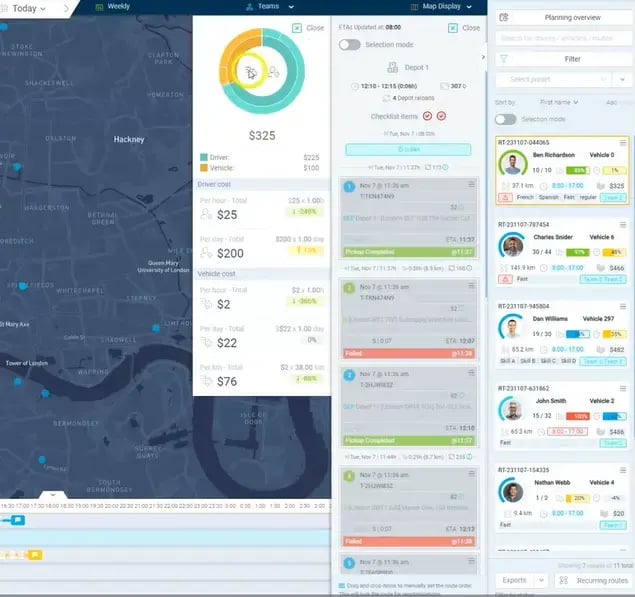
Dynamic route optimization actively improves distribution performance across measurable dimensions. These include:
- Fewer failed deliveries: Proactive ETA monitoring means at-risk stops are flagged and reassigned before failure, not after. The system identifies when a driver is falling behind schedule and either adjusts the sequence or moves stops to a nearby vehicle with capacity.
- Higher OTIF rates: Continuous re-optimization keeps each stop's ETA accurate and achievable even as conditions change, protecting on-time-in-full performance throughout the day.
- Reduced total miles: Dynamic resequencing eliminates the inefficient stop order that results from manually inserting same-day additions into a static plan.
- Better fleet utilization: Load balancing across vehicles and depots means trucks run fuller and drivers aren't returning to depot with undelivered stops while nearby drivers have capacity.
- Lower dispatcher workload: The system handles exception logic automatically, freeing dispatchers from reactive firefighting and enabling proactive oversight of the entire fleet.
Enterprise route optimization software in this category should handle the full scope of multi-drop complexity.
eLogii's platform delivers real-time dynamic routing with live tracking and deep workflow configurability for operations managing up to 10,000+ daily tasks, with routing and planning time cut by 50% or more regardless of order volume.
Dispatcher Role in Dynamic Routing: Human-in-the-Loop
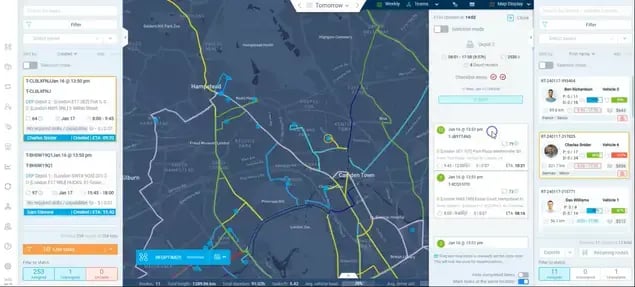
Dynamic routing software removes the manual data processing burden so dispatchers can focus on decisions that actually require dispatcher input.
Most operations leaders we've talked to worry that automated re-optimization removes visibility or control.
In well-designed systems, the opposite is true because dispatchers can:
- See live route status across the entire fleet
- Override any system recommendation
- Manually reassign stops
- Flag priority deliveries for protection
The acceleration dynamic works like this:
→ The system surfaces exceptions and proposes responses.
→ The dispatcher confirms or overrides in seconds. (No need to spend 20 minutes manually rebuilding a route.)
→ The difference is speed and accuracy. (Control has nothing to do with it.)
There's a compliance and audit benefit too.
Every change is logged: dispatcher overrides, system recommendations, timing deviations. This creates a full execution record for SLA disputes, customer queries, and continuous improvement analysis.
eLogii was built with non-expert users in mind.
Despite its configurability, the dispatcher tools are visual and intuitive, designed so that anyone can learn the system quickly regardless of their background in logistics or fleet management.
Distribution Industry Examples Where Dynamic Routing Matters
Dynamic routing's value scales with operational volatility. These verticals sit at the high end of that spectrum.
- Foodservice distribution: Delivery windows are narrow (often 30 to 60 minutes), kitchen prep schedules depend on accurate ETAs, and same-day additions from hospitality clients are routine. Static routing compounds lateness across the entire day's run.
- Building materials delivery: Jobsite access is unpredictable. Crane schedules, site access hours, and congestion around active builds mean planned arrival windows are frequently unreliable. Dynamic rerouting absorbs site-level volatility without cascading delay.
- Flooring distribution: Drops are install-linked, meaning a late delivery doesn't just inconvenience the customer. It delays a trade crew and triggers installation rescheduling costs. Time window protection is critical.
- Bathroom and kitchen logistics: High-value drops with narrow access windows, often requiring specific vehicle types and offload support. Any delay or failed delivery carries high cost per stop and customer relationship risk.
- Trade wholesale multi-drop networks: Dense urban routes with 30 to 50 stops, frequent same-day additions from trade accounts, and customers who expect confirmed ETAs before 8am. This combination requires continuous re-optimization, not a fixed morning plan.
Questions to Ask When to Evaluate Dynamic Routing Software
These questions serve as a functional test of whether a platform truly delivers dynamic optimization or just faster static planning.
If you're evaluating distribution routing solutions, bring this list to every vendor conversation:
- How quickly can routes be re-optimized after a disruption?
Look for sub-minute re-optimization. Anything requiring manual rebuild is static routing with a dynamic label.
- Can dispatchers override the system instantly without losing route integrity?
Human-in-the-loop control is non-negotiable at enterprise scale. The system should support overrides while preserving downstream optimization.
- How are time-critical stops prioritized during rebalancing?
The system should protect high-priority or tight-window stops first, not optimize for total distance alone.
- Can it scale across multiple depots and fleets simultaneously?
Single-depot optimization doesn't translate to multi-site enterprise operations. Ask about concurrent multi-depot routing.
- How does it integrate with your ERP and ePOD systems?
Real-time data sync is the foundation of dynamic routing. Batch integration undermines it. eLogii's API-first architecture and well-documented integration capabilities set the standard here.
- What visibility does dispatch have into live route status?
A dynamic system without real-time fleet visibility is half a solution. You need live map views, ETA tracking, and exception alerts in one screen.
- How does it handle failed delivery reassignment?
The answer reveals whether delivery exception management is a core feature or an afterthought. Look for automatic reassignment logic with configurable rules.
Bottom Line: Static planning is a cost ceiling. Dynamic routing is how you move past it.
Static routing was built for a predictable world. Multi-drop distribution has never been that world.
If you're still running fixed routing plans, you're probably already seeing this through the cost in failed deliveries, overtime, and customers who didn't come back.
Four things to take away from this guide:
- Static routing plans the day you hoped for. Dynamic routing manages the day you actually get.
- Multi-drop distribution requires adaptability at every level:
✓ Stop sequencing
✓ Time window management
✓ Vehicle allocation
✓ Exception handling - Dynamic routing absorbs disruption at the stop level before it spreads across the fleet.
(This is what protects your SLAs and margins.) - The best distributors optimize continuously.
(Not just once at 6 AM.)
If you want to know more, book a demo to explore eLogii's dynamic route optimization for enterprise distribution in action:
FAQ About Static and Dynamic Route Planning
What is the difference between static and dynamic route planning?
Static route planning fixes delivery routes before dispatch and keeps them unchanged all day. Dynamic route planning re-optimizes in real time as conditions shift. Static works for predictable, low-variability operations, while dynamic routing is built for environments where disruptions, same-day changes, and tight time windows are the norm.
Why does static routing fail in multi-drop distribution?
Static routing has no mechanism to respond to disruption. In a multi-drop route, one delay cascades forward, breaching time windows at every downstream stop. Each failed delivery costs an average of $17.78 in re-attempt labor, customer service, and logistical fallout. When that happens in multi-drop distribution, the cost stops being an incident and starts being a line item.
How does dynamic route optimization reduce failed deliveries?
Dynamic route optimization tracks ETAs in real time and flags at-risk stops before they become failures. When a driver falls behind, the system resequences the route, reassigns time-critical stops to a nearby vehicle, or adjusts downstream windows - stopping one delay from cascading into five or 10 missed deliveries.
Can dynamic routing software integrate with ERP and existing logistics systems?
Yes, but require real-time API integration - batch file transfers introduce data lag that undermines dynamic routing entirely. Look for an API-first architecture with documented endpoints for orders, routes, drivers, and proof of delivery. eLogii supports real-time data sync with ERP, WMS, ePOD, and order management systems.
Which industries benefit most from dynamic route optimization?
Industries with high operational volatility get the most out of dynamic routing. Foodservice, building materials, flooring, and trade wholesale all share the same core problem: stops change, access shifts, and a single late delivery can stall a job site or trade crew. Static sequences can't absorb that. Continuous re-optimization can.
