Reducing repeat visits in debt collection is an operational problems that hides in plain sight. You assume that repeat visits aren't inevitable, but in fact, they're the predictable result of how your execution is organized.
That's why in this article we're going to explain:
- How repeat visits are sequenced
- How retries are scheduled
- How routes are built around them
If you're running court-authorized operations or regulated enforcement with centralized planning and high failed-visit rates, the distinction matters enormously.
We'll also cover:
- What repeat visits actually are
- Why they compound at scale
- What they cost (directly and indirectly)
- Why manual scheduling and generic field tools make them worse
- What high-maturity debt collection operations do differently
- And how to fix all of this
Here's a quick overview of what's in this guide:
Key Takeaways
- Repeat visits are an execution problem, because most repeat visits in debt collection are generated by scheduling logic, retry rules, and route design rather than debtor behavior alone.
- Scale changes the math of repeat visits, since at 50+ debt enforcement agents, static retry rules and geographic dispersion turn failed-visit rates into hundreds of wasted visits per day.
- Indirect costs outweigh your direct costs as planner overload, slower cash recovery, compliance risk, and reduced doors-per-day often cost more than the visit itself.
- Manual scheduling treats all visits as equal, so human planners can't prioritize visits by contact probability. This results in low-likelihood retries using up the same resources as high-probability first visits.
- Execution maturity reduces repeat visits structurally through probability-weighted routing, revisit-aware optimization, and continuous re-optimization. This address root causes rather than symptoms high repeat visit rates.

What Counts as a Repeat Visit in Debt Collection
Clear definitions matter here because "repeat visit" covers several distinct scenarios, and carries different operational and compliance implications.
Repeat visits include:
- No-contact attempts: The agent attends the property, but the debtor is absent. This is the most common type and the one most influenced by scheduling decisions.
- Access refusals: The debtor is present but refuses entry or engagement. The case may require a follow-up under different conditions.
- Statutory retry visits: Regulation or court order requires a return visit after a prior attendance. These are legally mandated and non-negotiable.
- Partial-outcome follow-ups: A levy has been taken but not removed, or documents have been served that require a subsequent check. These visits are procedurally necessary but their timing is often discretionary.
The critical distinction is between visits that are legally required and visits that are operationally avoidable with better scheduling intelligence. Statutory retries will always exist.
They're part of the debt collection procedure. But the volume of no-contact attempts and the timing of partial-outcome follow-ups are shaped almost entirely by how visits are sequenced and when they're scheduled.
Why Repeat Visits Increase as Debt Collection Operations Scale
Scale multiplies the cost of failed contact, but most organizations respond by adding agents rather than addressing the execution logic that generates repeat visits.
At 10 agents, one failed visit per case is a minor inefficiency. It can absorb repeat visits without much structural damage.
At 200 agents across multiple regions, the same failure rate creates hundreds of wasted visits daily. Each one of these consumes your agents' time, adds vehicle costs, and creates a slot that could have gone to a productive case.
That's why at scale, repeat visits break down across four dimensions:
- Geographic dispersion: Geographic spread of case visits grows as operations cover wider territories. Each retry adds disproportionate travel time because the failed-contact address no longer cluster with other cases on the same route.
- Static retry rules: Retry rules apply uniformly regardless of context. A case with three prior no-contacts at 10 AM gets the same retry priority as a first visit to a high-probability address.
- No probability weighting: Probability weighting means planners lack the data or tools to distinguish between likely and unlikely contacts, so all retries enter the same queue.
- Planner-driven sequencing: Manually sequencing jobs, visits, and cases simply can't account for real-time field conditions at scale.
The compounding dynamic is what makes high repeat visit rates so costly:
| |
Low-Scale Operation
(10 - 50 agents) |
High-Scale Operation
(200+ agents) |
Impact on Repeat Visit Rate |
| Geographic spread |
Compact territory; retries cluster naturally |
Wide regions; retries scatter across routes |
High (travel overhead per retry increases sharply) |
| Planner bandwidth |
Single planner can track retry context |
Planners manage volume, not quality |
High (retry scheduling becomes rule-based, not judgment-based) |
| Retry rule rigidity |
Flexible; planner adjusts timing by case |
Uniform rules applied across all cases |
Medium (low-probability cases receive equal priority) |
| Contact probability visibility |
Informal knowledge (planner intuition) |
No visibility at scale |
High (all retries treated identically regardless of likelihood) |
Direct Cost of Repeat Visits in Debt Enforcement
Operations leaders recognize these costs immediately because they show up in the budget.
Every unproductive visit consumes the same agent time as a completed case, including the same drive, the same stop, the same chunk of a working day.
- Additional travel time is the most visible cost. An agent driving 25 minutes to a no-contact address and 25 minutes back has lost nearly an hour with nothing to show for it.
- Lost agent capacity compounds this: that hour can't be redeployed to a productive case, and the displacement effect ripples through the rest of the route.
- Overtime becomes necessary when retry volumes extend the working day beyond planned hours, particularly when compliance windows require visits within specific timeframes.
- Delayed case progression may push enforcement cases past court-imposed deadlines, creating legal and commercial risk.
The operative metric in enforcement field operations is doors-per-day.
Every avoidable repeat visit reduces doors-per-day with a direct cost equivalent.
(Not just the cost of the visit itself, but the cost of the productive visit it displaced.)
Indirect Cost of Repeat Visits Debt Collection CFOs Often Miss
Debt collection repeat visits add indirect cost through delayed recovery, which often exceeds the visit cost itself.
This is where the economics get serious, because these costs rarely appear in standard operational reporting, including:
- Reduced doors-per-day across the operation is more than the sum of individual wasted visits. When retry cases are scattered across routes, they degrade the density and efficiency of every route they touch - not just the retry itself, but the productive cases around it.
- Planner overload emerges when manual retry management consumes planning capacity that should be spent on route quality and exception handling. Planners end up managing queues instead of optimizing outcomes.
- Slower cash recovery is the cost that CFOs should care about most. Delayed second and third visits push recovery timelines out, affecting working capital, client SLAs, and the overall velocity of the debt recovery process.
- Compliance risk increases when untracked retry visits fall outside statutory visit windows or miss documentation requirements. This is a risk that grows with volume.
- Reputational exposure surfaces when high visit frequencies to the same address generate complaints or attract regulatory scrutiny.
Here's a table that quickly explains the indirect costs of repeat visits and how they impact your debt collection operations:
| Indirect Cost |
How It Appears Operationally |
Who Typically Sees It |
Why It Is Often Missed |
| Reduced doors-per-day |
Lower route density; fewer completed cases |
Ops Manager / COO |
Attributed to "demand" rather than retry displacement |
| Planner overload |
Planning team works reactively, not strategically |
Planning Lead |
Seen as headcount issue, not scheduling logic issue |
| Slower cash recovery |
Extended case timelines; missed SLAs |
CFO / Client Services |
Attributed to debtor behavior, not visit sequencing |
| Compliance risk |
Visits outside statutory windows; documentation gaps |
Head of Compliance |
Only visible after an audit or complaint |
| Reputational exposure |
Increased complaints; regulatory inquiries |
Legal / Senior Management |
Surfaces late and is hard to trace to root cause |
Why Manual Scheduling Makes Repeat Visits Worse
Manual scheduling treats all visits as equal, which a visit in debt collection never is. And neither your planner or scheduling tool can make the distinction at scale.
That's because human planners working from spreadsheets or static systems face a fundamental limitation:
They can't prioritize visits by contact probability.
A first visit to a high-probability address during a historically productive time window is fundamentally different from a fourth retry to an address with no prior contact.
Your planners can sequence collection visits by geography, by case age, or by rules of thumb. All of which treat repeat visits as equivalent to first visits (which they're not).
So when a visit fails, the case goes back into a queue and gets scheduled on the next available slot.
There's no adjustment for time-of-day patterns, no consideration of prior no-contact history, and no geographic clustering with other retry cases in the same area. The retry simply lands wherever there's space.
This creates a geographic rebundling failure that compounds over time.
Your planners rarely have the bandwidth to reorganize routes in real time around retry cases, so retries slot into routes that weren't designed for them.
The result is routes with lower density, longer travel times, and worse outcomes.
Why Generic FSM Tools Don't Reduce Repeat Visits
Field service management tools assume deterministic outcomes, and that's why they fail in probabilistic collection environments such as debt enforcement.
FSM platforms are well-built for their intended purpose:
- Scheduling jobs
- Dispatching agents
- Tracking completion
The architectural mismatch with debt collection is a design choice that reflects different operational assumptions between your industry and other field service operations.
FSM tools are built around a deterministic model. A job is scheduled, attended, and completed. The feedback loop ends at completion status.
In enforcement operations, the outcome of a visit is contact or no-contact. This is what determines whether the visit needs to happen again, when, and under what compliance conditions.
FSM platforms weren't designed for that feedback loop.
The lack of success-probability logic means an FSM tool optimizes for travel efficiency and time-window compliance. This doesn't apply for likelihood of debtor contact.
A visit to an address with three prior no-contacts receives the same routing priority as a first visit to a high-probability address. There's no mechanism to weight visits by expected outcome.
Routes are also typically optimized at the start of the day within a static window. They don't adapt when field conditions shift.
For example, when a no-contact at 9 AM should trigger a re-evaluation of the afternoon route to incorporate a retry at a better time.
All of this isn't a criticism of FSM vendors. It's a recognition that debt enforcement operations require a different execution logic.
What Actually Reduces Repeat Visits at Scale for Debt Enforcement
Reducing repeat visits in debt collection requires execution capabilities that address the root causes identified above.
These are capabilities that describe what the system does. (They don't include what your planner decides).
We've highlighted four software capabilities for reducing repeat visits in debt collection:
- Probability-weighted routing sequences visits based on estimated contact likelihood, informed by time-of-day patterns, prior visit history, and case characteristics. High-probability addresses get visited first and within optimal time windows, which means the cases most likely to result in contact receive the best execution.
- Revisit-aware optimization changes how failed visits re-enter the system. Instead of returning to a generic queue, the routing logic immediately evaluates where and when the retry should occur relative to other cases in the region - balancing geographic efficiency with contact probability.
- Compliance-window logic automatically constrains retry visits to statutory visit windows for the relevant enforcement type. This reduces compliance risk without requiring planners to manually track each case against regulatory requirements.
- Continuous re-optimization updates routes and visit sequences dynamically as field data comes in during the day. Retry cases get slotted efficiently into live routes without disrupting the productivity of the broader operation.
Repeat visits fall when execution prioritizes likelihood of success.
This is the shift from scheduling to execution.
How High-Maturity Debt Collection Operations Operate
The highest-performing enforcement operations share observable behaviors that distinguish them from peers, regardless of which specific tools they use.
They treat repeat visit rate as a lagging KPI, tracked at the operations level alongside doors-per-day and case progression rates. It's monitored, reported, and addressed when it drifts.
Execution quality is owned by a dedicated planning or operations function.
Responsibility for visit outcomes doesn't rest solely with individual agents or case managers. Your organization recognizes that execution design drives results more than individual effort.
Planners in these operations manage exceptions and edge cases, not routine retry scheduling.
Routine retries are handled by execution logic, freeing planners to focus on high-complexity or high-value cases where human judgment genuinely adds value.
Case data, visit outcome data, and compliance records are integrated so retry decisions reflect current information, not static case attributes from days or weeks ago.
These behaviors reflect a deliberate decision to treat execution as a lever for debt recovery performance.
How eLogii Helps Debt Collection Companies Reduce Repeat Visits
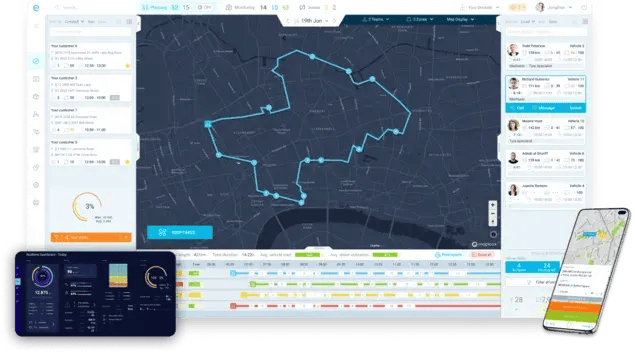
eLogii operates as the execution layer between the case management system and the field agent.
A key thing you should note here:
eLogii doesn't replace case management platforms, but acts on the data they hold to make field execution measurably better.
In debt collection operations, eLogii enables dynamic, probability-aware route optimization that reduces wasted repeat visits.
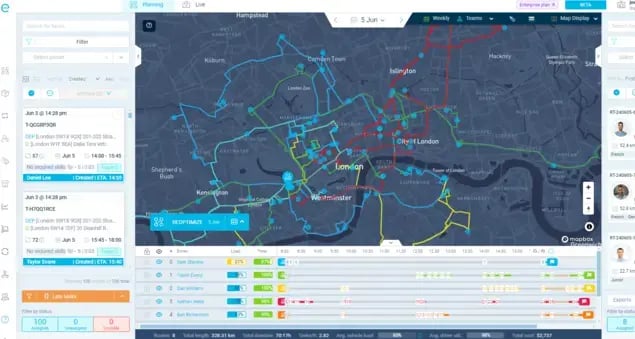
Revisit logic integrates contact outcomes in real time so that retry scheduling reflects what's actually happening in the field.
Compliance-window constraints reduce regulatory exposure without requiring manual tracking. And visit density optimization improves doors-per-day across the entire operation.
eLogii complements existing systems of record.

For enforcement operations managing 50 to 500+ agents, it provides the execution intelligence that case management systems were never designed to deliver.
Who This Is (and Isn't) For
This article and the execution approach it describes applies to a specific operational profile.
Right for you if you run:
- Field-based debt collection with 50 to 500+ agents
- Court-authorized or regulated enforcement with compliance obligations around visit sequencing
- PE-backed collection businesses where recovery velocity and operational efficiency are primary value levers
- Centralized planning functions managing geographic scale across multiple regions
Not for you if you run:
- Call-center-only debt collection with no field component
- Low-volume or ad-hoc enforcement where a single planner manages retry logic manually
- Operations where repeat visits are genuinely negligible as a share of total visit volume
This distinction isn't a judgment. These are different operating models with different economics.
The execution maturity described here pays for itself only when repeat visit volume is large enough to move the financial needle.
The Bottom Line
Repeat visits explode in debt collection operations for structural reasons:
- Static retry rules
- No probability weighting
- Geographic dispersion
- Planner bandwidth that worsens at scale
Manual scheduling and generic field tools don't solve this because they weren't designed for probabilistic environments where visit outcomes drive future visit requirements.
What changes the math is execution maturity: probability-weighted routing, revisit-aware optimization, compliance-window automation, and continuous re-optimization.
These capabilities reduce avoidable repeat visits without touching statutory obligations or increasing compliance risk.
The organizations getting this right treat execution as a performance lever (NOT overhead):
- They measure repeat visit rates as a KPI.
- They free planners from retry queues.
- They recover debt faster because their agents spend more time at doors that open.
If you want to see how this actually works, and how an execution-first approach to debt collection can reduce repeat visits in your operation, this is the next-step you need to take:
FAQ about Repeat Visits in Debt Collection
What is a repeat visit in debt collection and why does it happen?
A repeat visit is any return to a property after a prior attendance, including no-contact attempts, access refusals, statutory retries, partial-outcome follow-ups. Some retries are legally required, but most aren't because cases re-enter the queue without adjustments for contact probability, time-of-day patterns, or geography. Scheduling design drives repeat visit volume far more than debtor behavior does.
How do repeat visits affect doors-per-day and agent productivity?
Every avoidable repeat visit uses the same travel time and stop time as a completed case, but produces nothing. That cost compounds across the operation, including retry cases scattered through routes reduce density and drag down efficiency for every other case on the same run.
What is the difference between a statutory retry visit and an avoidable repeat visit?
Statutory retries are required by regulation or court order. Avoidable ones come from poor scheduling, including cases dropped into a generic queue with no timing logic or geographic grouping. Better planning cuts those without touching your legal obligations.
Why do existing field service management tools struggle with debt collection visit scheduling?
FSM tools are built for fixed, linear workflows, which debt collection isn't. Each visit outcome changes what happens next, and FSM platforms don't have the success-probability logic or compliance-window enforcement to handle that.
How do high-maturity enforcement operations measure and reduce repeat visit rates?
Mature operations track repeat visit rate alongside doors-per-day and case progression. Retry logic handles routine cases automatically, so planners focus on exceptions and high-value accounts with visit outcome data feeding directly into the next scheduling decision.