Using telematics for field operations gives you a live view of every vehicle in your fleet. The tool allows you to see who's moving, who's idle, and who just arrived on site.
But despite all that data, you still face the same outcome:
Visibility is excellent, but execution is still manual.
The gap between seeing what's happening and deciding what should happen next is where productivity, margin, and SLA performance quietly erode.
That's why in this article we're going to cover:
- What telematics is built to do
- Why optimization is a fundamentally different problem
- Where the assumption breaks in live field operations
- How the best operators connect visibility to execution
- And more
If your field service operations are already running with telematics in place, this article is for you.
Here's what you'll find in this guide:
Key Takeaways
- Telematic systems are visibility tools that tell you where vehicles are and what has happened to them. They aren't optimization tools that decide where technicians should go next or how to rebalance their day when jobs change in real time.
- Field service optimization requires prescriptive decision-making. This includes balancing SLAs, technician skills, geography, and reactive jobs simultaneously. That's a problem telematics wasn't designed to solve.
- Alerts and rules aren't a substitute for route optimization. Configuring thresholds and geofences can accelerate response time, but they can't resolve competing constraints or reduce your planner's workload at scale.
- The cost of the gap between telematics and field service optimization is compounding. Treating visibility as execution leads to excess mileage, repeat visits, SLA breaches, and planner overload.
- High-maturity teams use telematics as an input in a more comprehensive tech stack. They feed telematics data into a purpose-built execution layer that makes optimization decisions in real time.
We Already Have Telematics. So Why Our Field Operation Isn't Optimized?
The answer is a distinction that sounds simple but has significant financial consequences:
Operational visibility ISN'T operational optimization.
Your fleet may be fully equipped with telematics, with a GPS on board every vehicle, with dashboards showing real-time locations, idle times, and driving behavior.
And yet you're still asking yourself the same questions over and over again:
- Why are your planners still manually reworking routes by 10am?
- Why do SLAs still slip on Tuesdays when reactive volume spikes?
- Why is it that the more data you have, the less control you seem to have over the actual day?
Your compliance team may be happy. Your CFO approved the investment years ago. But you're still not seeing the cost-saving gains you were hoping for.
Efficiency doesn't come from visibility:
- Knowing where your vehicles are doesn't decide where they should go next.
- Seeing that a technician arrived late doesn't fix the downstream cascade.
- Recording a failed visit doesn't reschedule it.
These are two entirely different problems.
Telematics solves the first one well.
But it was never built to solve the second one. Neither will it give you the returns you're looking for.
What Telematics Is Actually Designed to Do
Telematics is a technology that collects and transmits vehicle and driver data in real time, including location, speed, fuel use, engine diagnostics, and driving behavior.
Platforms like Samsara, Geotab, Motive, and Verizon Connect have made this capability standard across commercial fleets. And it's genuinely valuable.
The core strengths of a telematics system are well established:
- GPS location tracking: Real-time positions for every vehicle in the fleet
- Driving behavior monitoring: Speeding, harsh braking, idling, and seatbelt compliance
- Fleet utilization and compliance reporting: Hours of service, vehicle usage patterns, and regulatory data
- Predictive maintenance alerts: Engine fault codes, mileage thresholds, and service schedules
These capabilities matter.
They reduce insurance costs, improve safety, support compliance, and give operations leaders a clearer picture of fleet activity.
Samsara, for example, is a leading telematics system and fleet management platform that specializes in vehicle tracking, driver safety monitoring, and automated maintenance.
Keep in mind:
This article isn't a criticism of telematics platforms. They do exactly what they're designed to do. The issue is what they're expected to do on top of that.
Telematics answers "what happened" and "what's happening now."
It doesn't answer "what should happen next."
This table is a quick reveal of what telematics systems do and don't do:
| What Telematics Does Well |
What Telematics Wasn't Built For |
| Real-time vehicle location tracking |
Route sequencing and optimization |
| Driver behavior monitoring |
SLA-aware scheduling |
| Compliance and hours-of-service reporting |
Same-day re-optimization |
| Vehicle health and maintenance alerts |
Skills-based dispatch |
| Fleet utilization analysis |
Visit-level decision-making |
Why Field Service Optimization Is a Different Class of Problem
Field service optimization is a prescriptive problem. It requires a system to evaluate competing constraints and decide what should happen next, given everything it knows about the operation right now.
Your telematics describes the current state of the fleet.
On the other hand:
An optimization engine prescribes the next best action given all constraints simultaneously.
The constraint landscape in field service operations is large and interconnected:
- SLA windows and contractual response times
- Technician skill sets and certifications
- Geography, travel time, and traffic conditions
- Reactive vs. planned work ratios
- Job durations and site access rules
- Parts availability and vehicle capacity
Telematics carries none of this context.
It knows where a vehicle from your fleet is, but it doesn't know what certifications your technician holds, which SLA you're about to breach, or whether the next job requires a specific part that's sitting in a different van or storage facility.
Consider a failed visit at 9am. It creates a snowball effect for your operations:
→ That job needs rescheduling.
→ A nearby technician needs reassignment.
→ SLA windows across six downstream jobs need re-evaluation.
→ Travel times shift.
→ Your planner has to recalculate the entire afternoon for two or three technicians.
Telematics shows the failure clearly. It doesn't resolve the spiral.
Telematics is descriptive.
Optimization is prescriptive.
Those are fundamentally different functions, and mixing them up is where the expectation mismatch begins.
Where Your Assumption About Telematics Systems Breaks in Live Operations
In live field service operations, the day rarely goes to your plan. And when it doesn't, your telematics record the disruption faithfully while your planners scramble to fix it manually.
That's because telematics systems show disruption but don't resolve it.
On the other hand, field services operate under completely different set of circumstances that involve:
- Same-Day Changes: A technician calls in sick. A job overruns by 45 minutes. A no-access visit wastes two hours of travel. Telematics captures all of this in real time. But it gives the planner no guidance on what to do next. Who picks up the orphaned jobs? Which downstream SLAs are now at risk? What's the least-cost way to rebalance the remaining schedule?
- Reactive Jobs: When an urgent job drops in mid-morning, telematics shows which technician is closest. But closest doesn't mean best. The nearest technician might lack the required certification, be carrying a full SLA load for the rest of the day, or have three jobs that will breach if they're pulled off-route. Real efficiency depends on far more than what looks efficient on a map, including time windows, job durations, technician skills, certifications, location access rules, and traffic. Without factoring these in, routes fall apart, and service windows get missed.
- Failed Visits: Telematics confirms the technician arrived and left. It doesn't trigger rescheduling, evaluate breach risk for the customer's SLA, or communicate with the end customer about what happens next.
These events are embedded into the service you provide, while your telematics treat each one as disruption. That's why each action becomes a manual decision.
The result is your planner having to hold the full operational picture in their head, including routes, SLAs, skills, location, time remaining in the day.
Telematics gives them one input (location), while the other five or six are completely missing from your planned schedule.
Why Adding Rules and Alerts to Your Telematics Still Doesn't Optimize Operations
Many telematics platforms now offer configurable alerts, geofencing rules, and basic routing modules. Rules and alerts in telematics look like optimization without delivering on the promise.
And these are capabilities you shouldn't dismiss.
However, it's also where the gap between your expectation and results widens:
- Alerts tell a planner a threshold has been crossed. A vehicle left a geofence. A technician has been idle for 30 minutes. A job hasn't started by 11am. Each alert is useful. But the planner still has to determine what to do, who is affected, and in what order to act. The alert surfaces the problem. The human still carries the decision.
- Rules enforce conditions but can't balance competing ones. If two rules conflict, say assign the nearest available technician and protect the SLA on the next three jobs, a rule set produces a tie. It doesn't produce a solution. Someone still has to arbitrate.
As operations scale, your rule sets grow. More rules create more edge cases. And more edge cases require more human arbitration.
You hire more operations managers and planners, and your planning team grows. But the efficiency of your field operations doesn't.
Hiring more planners doesn't raise efficiency or tech performance at scale.
Only automation accelerates response. And only optimization replaces the decision burden.
Here's what we mean:
| What Alerts and Rules Do |
What Optimization Does |
| Notify when a threshold is crossed |
Resolve the situation across all constraints |
| Enforce a single condition |
Balance competing conditions simultaneously |
| Require planner intervention per alert |
Reduce planner intervention to exceptions |
| Trigger on individual events |
Evaluate cascading impact of each event |
| Add complexity as rules grow |
Scale without proportional human effort |
| Speed up planner awareness |
Replace the decision burden entirely |
That's why adding more rules, more alerts, and more planners doesn't raise the efficiency of your field operations at scale.
Simply put:
They're just not the same thing.
While treating them like they are comes at a heavy cost.
The Cost of Treating Telematics as an Optimization Tool
When a business assumes telematics is the optimization layer, it delays the decision to invest in a real execution system. That delay has a measurable cost, which compounds daily.
This includes:
- Planner Overload: Without an execution system, planners carry the cognitive burden of optimization manually. They're holding route logic, SLA priorities, skill matrices, and live disruptions in their heads simultaneously. Manual routing and job assignments take up so much time that planners rarely get to review data, spot inefficiencies, or test new ways to improve. This is expensive, error-prone, and doesn't scale.
- False Confidence: Telematics dashboards are full of data, which creates the appearance of operational control. You can see every vehicle. You can track every arrival. But the data is descriptive, and the optimization isn't happening. The dashboard tells you what happened. It doesn't tell you whether it was the right thing.
- Margin erosion: Excess mileage, under-utilized technicians, repeat visits, and SLA breach penalties are all symptoms of the gap between visibility and optimization. Companies using both telematics and optimization platforms report 20 to 35% higher operational efficiency, 25 to 50% faster response times, and up to 40% less time spent on planning. Those gains only become available when an execution layer is added on top of the telematics foundation.
Every day without optimization is another day of avoidable waste. The decision to wait isn't neutral.
Believing telematics optimizes execution hides the real bottleneck.
How High-Maturity Teams Actually Use Telematics
High-maturity field operations are organizations that have separated the visibility function of their telematics from the optimization function of an execution system, and connected the two.
The correct architecture looks like this:
- Telematics provides live vehicle location, driving behavior data, and utilization metrics as inputs.
- An execution system consumes those inputs alongside job data, SLA requirements, technician skills, and operational constraints, then makes optimization decisions in real time.
In this model, the planner's role changes:
Instead of manually resolving every disruption, they supervise outcomes and handle genuine exceptions.
The system handles the calculation. The planner handles judgment calls.
Here's what that looks like in practice:
→ Overnight, the execution system builds optimal routes for the next day, incorporating all constraints.
→ During the day, as telematics streams live location data.
→ The execution system re-optimizes when anything changes:
A technician running late, a cancelled visit, a new urgent job.
→ The planner sees a clean, updated picture. (Not a fire that requires immediate reaction.)
When it comes to an actual use case, here's a simplified view of what that looks like:
The eLogii and Samsara integration combines eLogii's advanced route optimization and field service management capabilities with Samsara's real-time telematics and fleet tracking.
This is the pattern:
Telematics = Data Layer
Optimization = Decision Layer
The result:
Your telematics becomes the technology that feeds data into execution systems, building on your existing tech stack without replacing them.
What Real Optimization Requires Beyond Telematics
Real optimization in field service requires a system purpose-built to evaluate and balance competing constraints at the visit level. Telematics was never designed to do this.
Four capability requirements define the gap:
- Continuous Re-Optimization: The system must recalculate routes and schedules as conditions change throughout the day, not just once during overnight planning
- SLA-Aware Trade-Off Logic: It must weigh one customer's urgency against another's compliance window and make the best decision across the full operation
- Visit-Level Decision-Making: It must account for technician skills, job type, parts availability, and site access for each individual visit
- System-Initiated Actions: It must act on changes without requiring a planner to intervene for every adjustment
These are capability requirements, because we want to stay vendor-neutral here because the principle matters more than the label.
Telematics data is an important input to a real optimization system.
Live vehicle locations, traffic conditions, and arrival confirmations all make the optimization engine smarter.
The two are complementary. They serve different functions, because optimization starts where telematics stops.
How eLogii Works with Telematics Systems to Optimize Field Service Operations
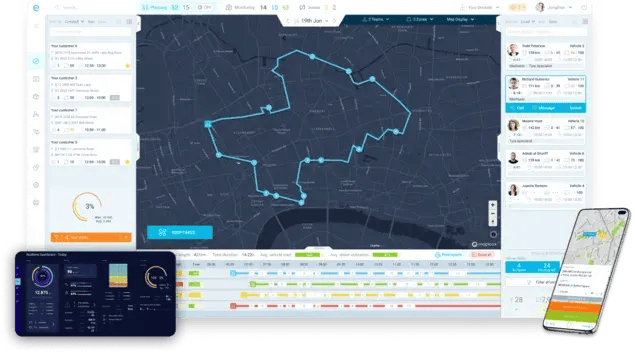
eLogii is the execution layer that sits alongside telematics, consuming its live location data and making optimization decisions in real time.
- Telematics platforms like Samsara, Geotab, Motive, and Verizon Connect remain in place as the fleet visibility and compliance layer.
- eLogii adds the optimization and execution layer that turns that data into prescriptive decisions: which technician goes where, in what order, adjusted continuously as the day unfolds.
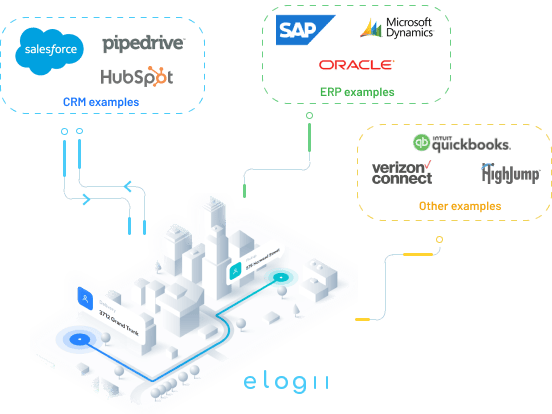
eLogii offers API integration with Samsara telematics and camera systems, allowing teams to combine live vehicle data with route optimization for enhanced safety, compliance, and performance tracking.
The two platforms are already working together in the field, particularly in cases where complex field routing is required.
This isn't a replacement conversation. It's a complementary one.
- Telematics does what it does best: visibility, safety, compliance, and fleet data.
- eLogii does what telematics can't: build optimized routes, rebalance schedules in real time, enforce SLA trade-offs, and reduce planner workload.
Organizations that connect their telematics data to an execution layer stop firefighting and start running planned, optimized operations.
What Kind of Field Operations This Is For
This distinction matters if you're running complex, SLA-driven field operations with high daily volatility, reactive work injection, and technicians operating across large territories.
It doesn't matter as much if your routes are largely static, job types are predictable, and the same technicians visit the same sites on a fixed schedule with low variance. In that case, the optimization gap is narrow and the investment case is weaker.
The gap is most expensive in these environments:
- Safety and compliance operations with legally binding SLA windows
- Pest control and facilities management businesses with high reactive/PPM ratios
- PE-backed operations under margin pressure where operational efficiency directly affects EBITDA
| The Optimization Gap Is Significant If... |
The Optimization Gap May Be Narrow If... |
| Daily schedules change frequently due to reactive work |
Routes are static and repeat weekly |
| SLA complexity varies by customer or contract |
Service windows are uniform and flexible |
| Reactive work accounts for 20%+ of daily volume |
Nearly all work is planned in advance |
| Planning team is growing but efficiency isn't |
One planner handles the full operation comfortably |
| Technician skill variation affects job assignment |
All technicians can do all job types |
The Bottom Line
Telematics is foundational infrastructure. It gives you visibility into your fleet, supports compliance, improves safety, and provides the live data that modern field operations depend on.
None of that is in question.
But telematics describes what's happening. It doesn't decide what should happen next.
When you assume those are the same capability, they delay investment in the execution layer that actually drives efficiency, protects SLAs, and reduces planner workload.
If your operation has telematics deployed and you're still experiencing daily replanning, SLA pressure, and growing planner headcount, the bottleneck isn't visibility. It's execution.
Your next step: Evaluate whether your current telematics setup is connected to a system that can make optimization decisions in real time. If it isn't, explore how telematics and execution systems work together to close the gap.
FAQ about Telematics for Field Service Operations
Can telematics optimize field service routes?
Telematics records what happens - location, speed, arrival times - but it doesn't evaluate SLA windows, technician skills, or job duration to build routes. That requires a separate, prescriptive system. Telematics feeds data into that process; it doesn't replace it.
What is the difference between telematics and route optimization in field service?
Telematics describes what's happening, where vehicles are, what drivers are doing. Route optimization decides what should happen, weighing constraints like geography, SLAs, skills, and job types to build the best possible schedule. They serve different functions, and field operations need both.
Why do field service operations have planning problems even with telematics deployed?
Telematics records disruptions but doesn't fix them. When a technician calls in sick or an urgent job drops mid-morning, someone still has to manually rebalance the schedule, assess SLA risk, and reassign downstream work, usually with incomplete information.
How do high-performing field service teams use telematics alongside optimization?
Telematics acts as the live data layer, feeding vehicle locations and driver data into a purpose-built execution system. That system handles the rest: SLA requirements, skills, job constraints, automatic route adjustments. Planners supervise outcomes instead of firefighting every disruption manually.
What types of field services benefit from adding an execution layer to telematics?
Operations with high daily volatility, SLA-driven work, and significant technician skill variation see the greatest impact. If your team runs 50 or more vehicles, plans shift constantly, and your planners spend more time firefighting than improving, an execution layer fills the gap telematics alone can't.