Pest control CRM software sits at the center of most field service operations, and for good reason. It holds the customer records, service agreements, and job history that keep the business running.
But if you're managing 50 or more technicians across mixed planned and reactive workloads, you've likely noticed something:
Your CRM tool knows everything about your customers and almost nothing about what's happening in the field right now.
That gap between customer data and operational execution is where most enterprise pest control operations lose margin:
- Planners manually bridge CRM and dispatch.
- Technicians arrive without updated service history.
- Billing runs on incomplete job data.
The CRM is doing its job. But the problem is that its job was never route optimization, real-time dispatch, or field completion capture.
This article breaks down:
- Why CRM integration matters for pest control operations at scale
- How data should flow through a properly connected stack
- Where standalone CRM hits its operational ceiling
- What a downstream execution layer actually delivers
- And more
So if you're running multi-site, SLA-bound operations with 50 to 500+ technicians and four to eight visits per tech per day, you're already dealing with this problem.
Here's a quick overview of what you can expect to find in this guide:
Key Takeaways
- CRM is a system of record, not a system of execution. It holds customer data, contracts, and job history, but it has no native capability for route optimization, real-time dispatch, or field-level scheduling across dozens of technicians.
- Integration bridges the gap between customer data and field operations. Without it, planners become the manual connection point between CRM and dispatch, which is one of the most consistent hidden costs in multi-technician pest control.
- The data loop has to close both ways. Completion timestamps, compliance evidence, and field status updates originate outside CRM and must flow back into it, or the customer record becomes stale and billing runs on incomplete data.
- Operational visibility depends on connected systems. Revenue per customer, SLA compliance by technician, and route efficiency against plan are only measurable when CRM, scheduling, and execution layers share a live data loop.
- Stack architecture matters more than any single platform. Open APIs, bidirectional sync, and webhook support determine whether your CRM can participate in an integrated operation or remains an isolated database.
Why CRM Integration Matters in Pest Control Operations
Pest control operations at scale run on two distinct categories of data:
- Customer relationship data: who the customer is, what contract they hold, their service history, and when the next visit is due.
- Operational execution data: which technician is going, what route they're taking, whether they've completed the job, and what evidence they captured on site.
Most operations treat these as the same thing. They aren't.
CRM systems are built to manage the first category. They're excellent systems of record for customer data, service agreements, and billing triggers.
What they don't do is execute jobs in the field. They have no concept of technician capacity, real-time location, route efficiency, or dynamic rescheduling across a fleet of 500 technicians. Not to mention running mixed planned and reactive workloads with multi-site SLA requirements.
The argument here isn't that CRM software falls short. CRM was designed for a specific job, and it does that job well.
The argument is that operational execution at enterprise scale requires a downstream layer that CRM was never built to provide. Integration is what connects those two worlds.
What Is Pest Control CRM Software Integration?
CRM integration in a field service context is the process of connecting the system that holds customer data, contracts, and job history to the downstream tools that execute those jobs in the physical world.
In pest control operations, this means connecting CRM to scheduling software, dispatch systems, route optimization tools, mobile technician apps, and ERP or billing platforms.
The distinction that matters at enterprise scale is straightforward:
CRM is a system of record.
Dispatch and route optimization are systems of execution.
Integration is what bridges them.
Why does this matter more than standalone CRM capability?
Because at 50+ technicians running four to eight visits per day across mixed planned and reactive workloads, the data sitting in CRM has zero operational value until it flows into tools designed to act on it.
A service agreement in CRM doesn't become a completed job until a technician has been assigned, routed, dispatched, and confirmed on site.
CRM initiates that chain. It doesn't run it.
| Function |
CRM (System of Record) |
Execution Layer (System of Operations) |
| Customer data storage |
✔ Primary owner |
Receives via integration |
| Contract and SLA management |
✔ Primary owner |
Reads SLA constraints for scheduling |
| Job/work order creation |
✔ Triggers creation |
Converts to scheduled, routed jobs |
| Route optimization |
✘ No native capability |
✔ Core function |
| Technician dispatch |
✘ No native capability |
✔ Core function |
| Real-time rescheduling |
✘ No native capability |
✔ Core function |
| Field completion capture |
Receives data back |
✔ Captures on-site via mobile app |
| Compliance evidence |
Stores for record |
✔ Collects in the field |
Core CRM Data Flow in Pest Control Operations
The customer lifecycle in pest control follows a predictable path:
- Leads enter CRM
- Convert to service agreements
- Generate recurring job records
- Trigger technician assignments
Each step after the initial record creation, however, requires systems that CRM doesn't natively operate.
Here's how the data flow should work in a connected stack.
CRM holds the customer record and triggers work order creation.
- The scheduling system converts that work order into a time-slotted job, applying capacity constraints, time-window rules, and service frequency logic.
- The dispatch layer assigns a technician based on real-time location, workload, and qualification.
- The mobile app delivers job details to the field, including site address, treatment requirements, compliance notes, and access instructions.
- Once the technician completes the job, completion data, timestamps, and compliance evidence flow back into CRM and billing.
The critical dependency here is the return loop.
Field status updates, completion timestamps, and on-site evidence all originate outside CRM. Without integration, that data never makes it back into the customer record.
The result is an incomplete system of record, which means stale customer data, inaccurate billing, and ops leaders who can't see job status without calling the field.
At scale, fragmented data flow compounds fast:
- Planners spend hours manually bridging systems.
- Customer records drift out of sync.
- Billing cycles slow down because completion data arrives late or incomplete.
The CRM looks full of data, but the data doesn't reflect what actually happened in the field.
Key Benefits of CRM Integration in Pest Control Software
The benefits of CRM integration are best understood as operational outcomes with direct margin implications, not as software features.
1. Unified Customer and Job Visibility
A single customer record accessible across CRM, scheduling, dispatch, and billing eliminates the information lag that causes repeat visits, missed service history, and conflicting job notes.
Without this, technicians arrive at a site without knowing what the last tech did. Planners duplicate data entry across systems. Managers can't see job status without picking up the phone.
2. Fewer Manual Errors
Duplicate data entry across disconnected systems is one of the most consistent hidden costs in multi-technician pest control operations. Every manual transfer between CRM and scheduling introduces error potential: wrong address, wrong treatment type, wrong service frequency.
At 200+ jobs per day, even a small error rate compounds into repeat visits, SLA breaches, and billing disputes. This is a margin issue, not just an admin inconvenience.
3. Faster Job Scheduling and Dispatch
When a service agreement record in CRM automatically generates a scheduled job in the dispatch system, planners stop serving as the manual bridge between the two.
CRM-triggered job creation reduces the gap between a contract going live and a technician being dispatched. That operational velocity matters when you're onboarding new accounts while maintaining recurring service commitments.
4. Improved Customer Communication
Integrated systems enable accurate, automated customer updates: ETAs, appointment confirmations, and completion notifications grounded in live operational data rather than manually sent messages.
Without integration, customer-facing communications are decoupled from actual field progress, which drives inbound calls and undermines service perception on high-value accounts.
5. Better Reporting and Analytics
The reporting data that matters most only becomes available when CRM, scheduling, and field completion systems are connected. Revenue per customer per visit, SLA compliance rates by technician, job frequency against contract terms, route efficiency against planned duration.
These are leadership metrics. An ops-focused CFO or COO can't make defensible resourcing or pricing decisions without closed-loop data flowing from CRM through execution and back.
How CRM Integrates with Pest Control Field Operations
Integration isn't a single connection. It's a chain of data handoffs where each system in the stack has a defined role. CRM's role is to initiate the chain, not to run it.
CRM to Scheduling System
A won service agreement or triggered recurring job in CRM becomes a time-slotted entry in the scheduling system. This is where operational planning begins.
The scheduling system adds what CRM cannot: capacity awareness, time-window constraints, technician availability, and service frequency rules.
CRM to Dispatch System
Scheduled jobs convert into technician assignments through a dispatch layer that requires real-time knowledge of technician location, current workload, and qualifications.
CRM knows who the customer is. The dispatch system decides who goes there and when.
CRM to Mobile Technician App
Job details flow to the field through the mobile execution layer: site address, service history, treatment requirements, compliance notes, access instructions, and customer-specific SLA requirements.
This data originates in CRM but is delivered through the technician's app. The app is the operational interface, not CRM.
CRM to Route Optimization
CRM feeds job data into the scheduling system, which feeds optimized routes. CRM does not optimize routes. It provides the inputs that make optimization possible.
Route optimization is a downstream capability that depends on CRM data but operates entirely outside CRM's native functionality. This distinction is architecturally important for any operation evaluating its tech stack.
Common Integration Challenges in Pest Control CRM Systems
Most integration failures in pest control operations are structural, not caused by user error. Five issues show up repeatedly at enterprise scale.
| Challenge |
Root Cause |
Operational Impact |
| Data silos between platforms |
CRM, scheduling, dispatch, and billing operate independently |
Planners manually transfer data; managers work from outdated job status |
| Poor or absent API connectivity |
CRM or FSM platforms don't expose the endpoints needed for bidirectional integration |
Forces manual workarounds regardless of individual tool capability |
| Real-time sync delays |
Batch syncing rather than live webhooks |
Operational decisions made on stale data; completed jobs don't free up capacity in the planning view |
| Legacy systems without integration support |
Older platforms built before API-first architecture became standard |
Entire data flows require manual intervention or custom middleware |
| Field adoption of mobile apps |
Technicians don't consistently update job status in the mobile app |
Completion data never reaches CRM; customer record remains incomplete |
The API connectivity issue deserves special attention.
Whether your CRM and field service platforms can exchange data bidirectionally is a procurement and architecture decision, not a configuration one. If the endpoints aren't there, no amount of implementation effort will bridge the gap.
And the field adoption challenge is worth noting because it's the one that breaks technically complete integrations.
The most sophisticated data architecture falls apart if technicians don't update job status on the mobile app. Completion data never flows back, and the customer record stays frozen at the last manual update.
Best Practices for CRM Software Integration in Pest Control Operations
This section is architectural guidance for operations leaders evaluating or redesigning their tech stack, not an implementation checklist.
- Prioritize open API architecture at procurement. Systems that expose bidirectional APIs and support webhooks enable real-time data flow. Systems that don't will require manual bridging regardless of how capable they are individually. This is the single most important technical criterion when selecting any platform in the stack.
- Standardize data structure before integration. Integration surfaces data inconsistencies that manual processes hide. Customer records, job types, service codes, and frequency definitions need consistent taxonomy across CRM and all downstream systems. Without standardization, integration amplifies the mess rather than solving it.
- Automate job creation at the CRM layer. Manually converting CRM records into scheduled jobs is the most common source of planning lag in pest control operations. The trigger from service agreement to scheduled job should be automatic.
- Treat mobile-first field connectivity as an operational requirement. The execution layer only closes the data loop if technicians update job status in real time. App design, field training, and adoption tracking are operational priorities, not IT afterthoughts.
- Apply centralized scheduling logic. In multi-technician, multi-region operations, scheduling decisions should flow through a single optimization layer with visibility into all constraints. Regional planners working in silos create scheduling conflicts that a centralized system would catch before technicians leave the depot.
How CRM Integration Improves Operational Efficiency
The business impact of a properly integrated pest control CRM stack shows up in four areas that a COO or ops-focused CFO will recognize immediately.
- Reduced administrative workload. When job creation, technician assignment, and completion sync are automated, planner time shifts from data entry to exception management. At 50+ technicians, this is a meaningful leverage point. You're not reducing planner headcount for the sake of cost cutting. You're redirecting skilled planning time from rote bridging work to the judgment calls that actually need a human.
- Faster job turnaround time. CRM-triggered job creation, automated dispatch, and mobile completion capture remove the manual handoffs that add hours or days between a service agreement going active and a technician completing the first visit. For operations onboarding new commercial accounts with SLA commitments, that turnaround speed is a competitive differentiator.
- Improved technician utilization. When CRM data flows accurately into route optimization, technicians spend less dead time between jobs. The same workforce completes more visits per day without additional headcount. This is the metric that translates most directly into margin improvement at scale.
- Better customer retention. Customers on recurring service agreements expect consistent visit frequency, accurate service history, and timely communication. All of those depend on a connected stack. Fragmented systems produce the inconsistencies, missed visits, wrong treatment notes, late notifications, that drive churn in your highest-value accounts.
How Route Optimization Integrates with Pest Control Operations
Route optimization sits downstream of both CRM and scheduling in the connected stack. It is an execution layer, not a CRM feature or a scheduling add-on.
Software like eLogii receives structured job data from the scheduling system and converts it into optimized, constraint-aware field routes:
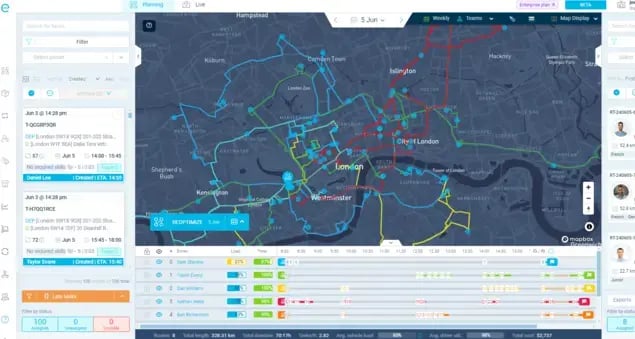
The data dependency is specific.
Route optimization requires accurate job locations, time windows, technician start points, skill requirements, and estimated service durations. All of this originates in CRM and gets structured by the scheduling layer. If either upstream system has gaps, route quality degrades.
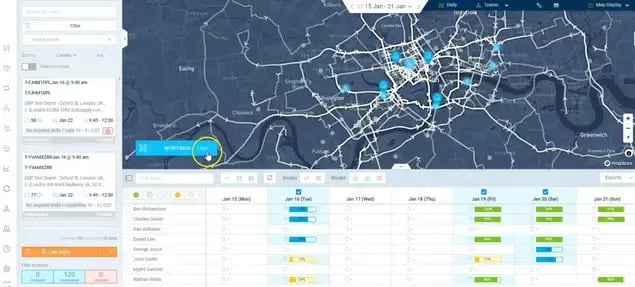
At scale, the operational outcome is significant.
When route optimization runs against a full day's job data across 50+ technicians, it reduces mileage, balances workloads, and surfaces scheduling conflicts before technicians leave the depot. Problems caught at the planning stage cost a fraction of what they cost once a van is already on the road.
eLogii operates as the execution layer that sits downstream of CRM and FSM platforms in pest control operations. It receives job and customer data via API, optimizes and dispatches at scale, and pushes completion evidence back into the record systems.
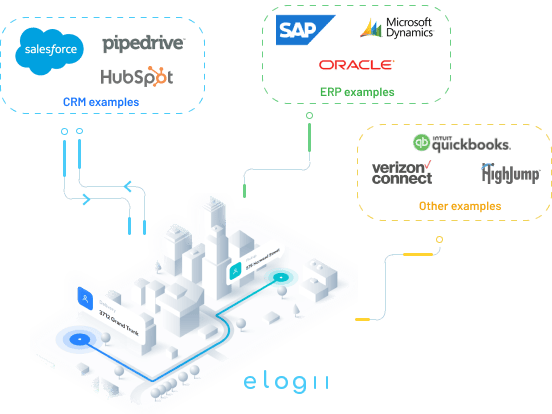
The CRM remains the system of record. Route optimization is the system that turns those records into efficient field operations.
Choosing the Right Pest Control CRM Integration Stack
This is a structural decision, not a software review. The question isn't which CRM brand to buy. The question is whether your selected systems can connect bidirectionally at the data layer.
| Evaluation Area |
What to Assess |
Why It Matters for Operations |
| API availability and documentation |
Public API docs, developer support, endpoint coverage |
Determines whether integration is possible without custom middleware |
| Bidirectional data sync capability |
Can data flow from CRM to execution and back? |
One-way sync leaves the customer record incomplete after field execution |
| Scheduling and dispatch integration |
Does CRM connect to scheduling and dispatch tools natively or via API? |
Without this, planners remain the manual bridge between systems |
| Mobile app and field connectivity |
Does the mobile layer receive CRM data and push completion data back? |
The data loop breaks if the field can't read or write to the stack |
| Real-time webhook support |
Does the system push updates on events, or batch-sync on a schedule? |
Batch sync means operational decisions are made on stale data |
| Vendor support for integration build |
Does the vendor actively support integration, or just offer an API? |
Documentation without implementation support extends timelines significantly |
The ecosystem principle applies here: a CRM that records customers perfectly but can't connect to dispatch, route optimization, and mobile execution is operationally incomplete. Integration capability of the stack matters more than the feature set of any single platform.
Operations that try to run everything through one platform, CRM, scheduling, dispatch, routing, mobile, typically compromise on depth in at least one layer.
Enterprise complexity usually demands best-in-class systems connected by API rather than a lowest-common-denominator all-in-one.
Bottom Line: CRM Is the Foundation of Pest Control Operations, But Not the Solution to Scale
CRM is the system of record that makes pest control operations legible. It holds the customers, contracts, service history, and billing triggers that every other system in the stack depends on.
That role is foundational and irreplaceable.
The value of CRM is multiplied when it connects bidirectionally to the execution layer.
Every job that CRM records becomes operationally visible, optimizable, and accountable. Every completion that flows back from the field makes the customer record more accurate, the billing cycle faster, and the reporting more defensible.
The direction of travel for enterprise pest control operations is clear:
Fully connected field service ecosystems where CRM, scheduling, route optimization, and mobile execution operate as a single data loop rather than separate tools managed by separate teams.
If your CRM is the only operational tool in your stack, you're using a system of record to run a system of execution. The gap between those two things is where planning time, mileage costs, and SLA failures accumulate.
Closing that gap isn't about replacing your CRM. It's about connecting it to the execution layer that turns customer data into completed, compliant, profitable field work.
And if you want to know more about how you can improve your pest control operations, here's the next step you need to take:
FAQ about Pest Control CRM Software Integration
What is CRM integration in pest control operations?
CRM integration is the process of connecting your CRM, the system that holds customer records, contracts, and job history, to the operational tools that execute those jobs: scheduling software, dispatch systems, route optimization tools, and mobile technician apps. The goal is to make customer data operationally executable rather than trapped in a standalone database. When properly integrated, data flows bidirectionally so field outcomes update the customer record automatically.
Can a CRM system manage pest control routes and technician dispatch on its own?
No. CRM has no native concept of routes, technician capacity, real-time location, or dynamic rescheduling. These functions require purpose-built execution layer tools connected to CRM via integration. CRM can trigger a job, but converting that job into an optimized route assigned to the right technician at the right time requires downstream systems that CRM was never designed to provide.
What systems should integrate with a pest control CRM?
The key integration points are scheduling software (converts CRM records into time-slotted jobs), dispatch systems (assigns technicians based on location and availability), route optimization tools (builds efficient field routes from scheduled jobs), mobile technician apps (delivers job details and captures completion data), and ERP or billing platforms (closes the financial loop from completed work). Each plays a specific role in the data flow from customer record to completed job.
How does CRM integration affect operational costs in pest control?
A connected stack reduces planning overhead by automating job creation and technician assignment. It cuts repeat visits by giving technicians accurate service history. It improves technician utilization by feeding accurate job data into route optimization. And it accelerates billing cycles by syncing completion data automatically. Each of these outcomes has a direct margin impact that compounds across a fleet of 50+ technicians.
What should pest control operators look for in a CRM integration stack?
Focus on open API architecture with documented endpoints, bidirectional sync capability so field data flows back to CRM, real-time webhook support rather than batch syncing, and proven connectivity to route optimization and mobile execution layers. The integration capability of the overall stack matters more than the feature set of any individual platform. Evaluate how systems connect, not just what each one does in isolation.