Everything you need to know about Doors per Day Rate, including what it is, how to measure it, and what actually improves debt enforcement productivity.
ON THIS PAGE
Doors-per-Day in enforcement operations is a metric few companies can move sustainably. So, in this guide, we're going to show you how to actually increase this KPI continuously over time and at scale.
We're going to breakdown exactly:
- What your Doors-per-Day rate actually captures
- Why this KPI degrades as your operations grow
- How to move it up without adding more planners
- How to do it without putting pressure on your agents
- How adding an execution layer to your tech stack solves all of this
- And more
So if you're looking to move your doors per day metric and actually impact your team performance in the right direction, this article is for you.
Here's a quick rundown of what else you can expect in this guide:
Key Takeaways
- Doors-per-day measures system efficiency by reflecting how well your operation creates viable visit opportunities. It doesn't measure agent effort, which is why misreading it as a productivity score leads to the wrong interventions.
- Scaling enforcement operations increases friction faster than capacity. This includes geographic fragmentation, repeat-visit inflation, and static routing, which cause waste to grow disproportionately as you add agents and cases.
- Most lost doors are lost between visits through travel inefficiency, idle gaps, and failed-contact clustering. These cost more throughput than anything happening at the doorstep.
- Forcing the metric directly creates compliance and retention risk by putting pressure on planners and agents without execution redesign. This is what drives rushed visits, higher revisit rates, and agent burnout.
- Sustainable improvement comes from execution design through denser routing, revisit-aware sequencing, and continuous re-optimization. This moves doors-per-day by reducing friction rather than demanding more effort your staff.

What Is the Doors-per-Day Metric? And What It Does (and Doesn't) Measure?
Doors-per-Day is a metric that measures how many debtors an enforcement agent has visited (doors) in a day.
In efficient systems, it also captures viable visit opportunities for enforcement agents. This distinction matters because the metric is routinely misread as a measure of how hard agents work or how many cases they close. It is neither.
Consider the difference between throughput and effort:
An agent can work a full, demanding shift and complete six visits across a fragmented territory. Another agent, working the same hours with comparable effort, can complete 11 visits on a dense, well-sequenced route.
Effort is constant. Throughput is a function of execution design.
There's a second distinction worth drawing:
Visit opportunity vs Visit success.
- Doors-per-Day = attempted contacts.
- Doors-per-Day ≠ resolutions, payments collected, or cases progressed.
Conflating the two leads to misdiagnosed performance problems and misallocated management attention.
When an ops leader reads a low doors-per-day figure as an agent performance issue rather than a routing or scheduling issue, the interventions that follow address the wrong variable entirely.
Typically, this includes activities such as:
- Revised targets
- Performance conversations
- Increased pressure on agents to perform
In reality, the metric is telling you something about how your system is designed. Not how your people are performing.
Here's a table that gives you the complete scope of what your doors-per-day KPI measures (and doesn't):
| In Scope (What Doors-per-Day Measures) | Out of Scope (What It Does Not Measure) |
|---|---|
| Visit opportunities created per agent per shift | Case resolution or debt recovery outcomes |
| System-level throughput efficiency | Individual agent effort or work ethic |
| Route density and sequencing effectiveness | Compliance quality at each visit |
| Scheduling and dispatch performance | Debtor cooperation or contact success rate |
Why Doors-per-Day Declines as Operations Scale
Most enforcement leaders assume that adding agents improves aggregate doors-per-day. In practice, the metric often stays flat or declines.
This commonly happens because coordination overhead scales faster than capacity, which includes:
- Geographic fragmentation: As case volumes grow, agent territories expand or overlap imprecisely. Average travel time between doors increases, and viable visit density per route drops. You have more agents covering more ground, but each agent is reaching fewer doors per shift.
- Repeat-visit inflation: Failed contacts generate reschedule queues. If those reschedules aren't managed dynamically, they layer into existing routes inefficiently. Each repeat enforcement visit consumes a slot that could have served a first-attempt contact, and the net effect on case progression is often negative.
- Static routing: Route plans built at the start of a day or week cannot absorb the contact failures, access issues, and priority changes that occur in real enforcement field conditions. A plan that looked dense and efficient at 7 AM is fragmented by 10 AM. Agents are executing sequences that no longer reflect reality.
- Planner bottlenecks: Centralized planning teams can only rebalance routes manually at limited intervals. Between those rebalance points, agents execute suboptimal sequences with no correction mechanism.
The scaling insight is direct:
As scale increases, wasted motion grows faster than agent count, which causes the gap between planned and executable doors-per-day to widen with every agent you add.
Hidden Friction That Caps Your Doors-per-Day
Most debt enforcement operations assume doors-per-day is lost at the door:
- Debtor isn't present
- Access is denied
- There is no response
In reality, the lost throughput occurs between visits, in transit time and idle gaps that don't appear on any individual agent's performance report.
This is the operational hidden friction that prevents your Doors-per-Day rate from growing:
- Failed contact clustering: When contacts fail in a given area on a given day, the natural response is to reschedule. But if those reschedules aren't reintegrated into nearby live routes, agents travel back to the same geography on a separate day. The travel cost per case doubles without any additional value delivered.
- Travel inefficiency: Routes that were geographically dense at planning time become fragmented as visits are added, removed, or reordered during the day. Agents spend increasing proportions of their shift in transit rather than at doors - and this proportion grows with every mid-day disruption.
- Idle gaps: Handover periods, late-start sequences, and unoptimized mid-day transitions create dead time that accumulates across a team of 50, 100, or 300 agents into substantial throughput loss.
- Priority reshuffling: When a high-priority case is inserted into a live route, the manual resequencing required creates downstream inefficiency for every remaining visit on that agent's schedule.
Most lost doors are lost between visits, which means the friction is in the system, and not at the doorstep.

Why Pushing the Doors-per-Day Metric onto Agents Backfires
When doors-per-day is set as a direct pressure target with no accompanying change to execution design, your agents adapt in predictable ways:
→ They compress visit times.
→ They skip procedural steps.
→ They select easier-access addresses over higher-priority cases.
The result:
The number on your dashboard may climb briefly, but everything underneath it deteriorates.
These are the three major concerns that we frequently see in debt enforcement agencies when you force the doors-per-day metric onto your agents:
- Compliance risk: Debt enforcement operations are regulated environments. Rushed visits that compress compliance windows or documentation requirements create legal and regulatory exposure that far outweighs any short-term throughput gain. In court-ordered visit programs, a single compliance failure can have consequences that dwarf the cost of a missed door.
- Higher revisit rates: Agents who prioritize speed over contact quality produce more inconclusive outcomes. Those inconclusive outcomes re-enter the reschedule queue and inflate future route density without progressing cases. You're generating more work, not more results.
- Accelerated agent attrition: Sustained pressure without systemic support is a recognized driver of enforcement agent burnout and turnover. Replacement and retraining costs erode whatever throughput gains the short-term target pressure produced - and experienced agents carry institutional knowledge about territories, debtor patterns, and compliance nuances that can't be replaced quickly.
When doors-per-day is forced, success probability falls.
The metric may temporarily rise while case progression rates, compliance quality, and agent retention all decline. In essence, you're optimizing the dashboard while degrading the operation.
What Actually Increases Your Doors-per-Day Metric Sustainably
Sustainable doors-per-day improvement comes from reducing the friction the system imposes on agents.
Your goal is to create more viable visit opportunities within the same shift, without increasing drive time, pressure, or compliance risk.
Here's what you need to do to achieve it:
- Denser routing: Grouping visits by proximity, compliance window, and contact probability, rather than by case priority alone. This increases the number of doors an agent can reach within a shift. The agent works the same hours, drives less, and reaches more doors. Enforcement route planning that accounts for geographic density is the single largest lever you have.
- Revisit-aware sequencing: This turns failed visits from a liability into a routing input. Scheduling repeat contacts into routes that are already passing through the relevant geography, rather than treating them as standalone reschedule jobs, eliminates redundant travel. Failed visits become route-building data rather than route-disrupting noise.
- Probability-weighted prioritization: Sequencing visits by likelihood of successful contact at a given time of day - based on case history and debtor profile - increases the proportion of doors that result in meaningful outcomes rather than another failed attempt.
- Continuous re-optimization: The difference between a route plan that adapts in near-real time as conditions change and one that holds its original shape until a planner manually intervenes is the difference between sustainable throughput growth and a plateau.
This table shows how this kind of dynamic operational planning and debt enforcement management compares to what you're currently doing with static scheduling:
| Execution Variable | Static Scheduling | Dynamic Execution |
|---|---|---|
| Route density | Fixed at plan time, degrades through the day | Continuously recalculated as conditions change |
| Revisit handling | Queued separately, scheduled in next planning cycle | Integrated into live routes passing through same geography |
| Failed contact response | Logged, manually rescheduled later | Triggers immediate nearby-route resequencing |
| Route adaptation | Holds original plan until planner intervenes | Adjusts automatically to real-time field conditions |
| Planner workload | Route building and manual rebalancing | Exception management and constraint oversight |
Doors-per-day rises when your execution absorbs uncertainty.
Why Manual Scheduling Can't Unlock Your Doors-per-Day KPI
Doors-per-day is capped by how fast your system can adapt to operational changes that happen in real-world situations. Manual scheduling sets that adaptation speed at human reaction time, which is insufficient for the volume and variability of scaled enforcement operations.
Experienced enforcement planners carry genuine domain knowledge, such as debtor geography, compliance constraints, court deadlines, agent capabilities. That knowledge is valuable and you shouldn't discard it.
But the limit isn't your planner. It's the structural ceiling that manual scheduling imposes on enforcement agent efficiency.
A planner can build a well-structured route plan at the start of a day. What they can't do is continuously rebalance 40, 100, or 300 simultaneous agent routes as conditions change in real time.
The cognitive and time cost is simply too high, because debt enforcement field operations generate too many variables, too quickly. That's too much for any human to process and act on at the speed which is required.
The failure cascade is predictable:
When a static plan hits its first wave of failed contacts (typically within the first two hours of a field day) the planner must choose between:
- A reactive manual rebalance (time-consuming and imprecise), or;
- Leaving agents to execute a degraded plan (guaranteed throughput loss).
Neither option is good for your business.
The reaction-time problem makes this concrete because by the time your planner receives a failed-contact notification, he has to:
→ Processes it
→ Identify a resequencing option
→ Communicates it to the agent
Only then can your agent act on it.
By then, the window for a nearby alternative visit may have already closed.
And as all of that happens, your opportunity cost compounds with every minute of delay.
How High-Maturity Enforcement Teams Approach Doors-per-Day Rates
Enforcement operations with consistently strong doors-per-day figures share a common trait:
They treat their doors-per-day metric as a lagging indicator.
What they don't try to do is manage toward it directly. Instead, they manage the execution conditions that produce it.
In these operations, planners focus on exception management and constraint handling rather than individual route construction.
They set parameters, review edge cases, and approve escalations, while execution logic handles sequencing.
The planner's expertise is applied where it matters most:
- Compliance decisions
- Complex case handling
- Service zone strategy
- And other key decision-making
What they don't spend their time on is routine route-building that a system handles more effectively.
High-maturity debt collection operations also build feedback loops into their process.
Contact outcome data such as failed, partial, resolved, and deferred cases continuously refine territory density, time-of-day sequencing, and revisit prioritization.
Your doors-per-day rate improves incrementally as data quality improves. While each week's execution performance feeds the following week's planning intelligence.
Compliance integration is another distinguishing factor.
Instead of treating compliance windows as scheduling constraints that reduce doors-per-day, these teams integrate them as sequencing inputs.
Compliance requirements shape routes rather than interrupt them. The result is that enforcement productivity metrics improve alongside compliance quality, rather than at the expense of it.
The cultural signal is telling:
In high-maturity debt enforcement operations, a low doors-per-day figure prompts an investigation into route design and execution friction.
It DOESN'T prompt a conversation with individual agents about their effort.
How eLogii Helps to Increase Your Doors-per-Day Rate in Debt Enforcement Operations
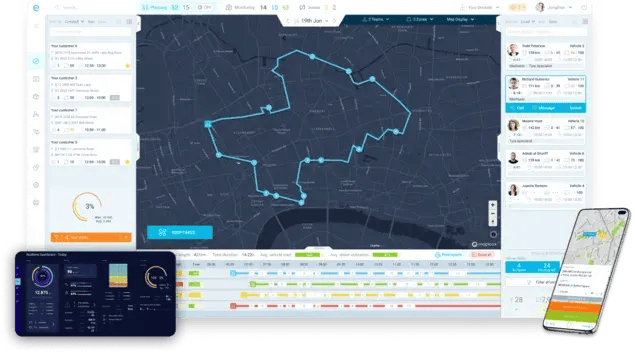
eLogii functions as the execution layer for enforcement field operations.
Simply put:
eLogii is the system that sits between your case management platform (system of record) and your agents in the field.
Case management systems hold the debt data, court orders, debtor records, and compliance requirements. They are systems of record, and they do that job well.
What they aren't designed to do is translate that data into dynamically optimized, continuously updated field execution sequences that increase viable visit density without adding agents.
That is what eLogii does.
The execution friction described throughout this article (static routing, repeat-visit inflation, planner bottlenecks, failed-contact cascades) is precisely what the execution layer is designed to reduce:
- Routes become denser.
- Revisits are absorbed into live sequences.
- Agents spend more of their shift at doors and less of it in transit.
eLogii doesn't replace case management systems or enforcement compliance workflows. It adds a dynamic optimization layer that case systems aren't built for.
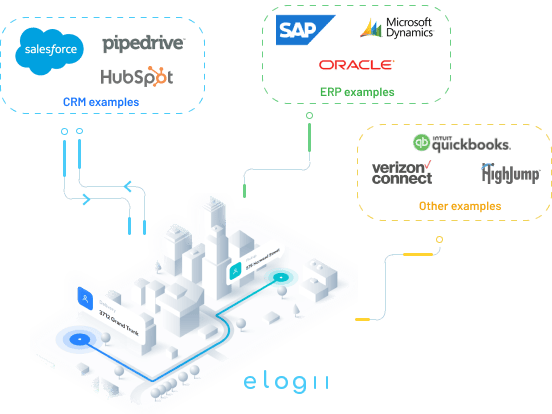
The result is that the two systems work together:
system of record → your case management system (Clio, Lexis, Filevine, Civica, Salesforce) defines what needs to happen.
execution layer → eLogii determines how and when it happens in the field, with continuous adaptation as conditions change.
For debt enforcement agencies managing 50 to 500+ agents, this is the layer that moves doors-per-day beyond the plateau that manual scheduling and static route planning impose.
Who This Approach Is (and Isn't) For
This execution-layer approach is built for scaled enforcement agencies operating 50 or more agents under court-ordered or compliance-driven visit mandates.
If you have centralized planning or dispatch functions, active doors-per-day tracking, and a performance management culture ready to focus on execution design rather than pressure alone, this is directly relevant.
PE-backed enforcement businesses are a strong fit.
Portfolio companies under performance improvement mandates where throughput per agent is a direct value-creation lever will find that execution-layer optimization delivers measurable, auditable improvement without the risks associated with pressure-based target increases.
This approach isn't the right fit for every enforcement organization.
Low-volume debt enforcement operations running manual or paper-based scheduling, organizations without centralized dispatch, and field services businesses that are compliance-adjacent but not enforcement-specific will not see the return.
The execution-layer approach requires operational maturity and data infrastructure to deliver value.
That's a practical reality, not a judgement.
The Bottom Line
Doors-per-day plateaus because execution friction compounds faster than agent effort can compensate. The metric is telling you something about how your operation is designed, not how hard your people are working.
Pressure isn't the fix. It temporarily inflates the number while degrading compliance quality, case progression, and retention underneath.
The operations that sustain strong doors-per-day figures do so by removing friction from the system:
- Denser routing
- Revisit-aware sequencing
- Continuous re-optimization
This is what can allow your agents reach more doors within the same shift without being asked to work harder or cut corners.
That's an execution design problem. And it has an execution design solution.
Ready to see how execution-first enforcement teams increase doors-per-day?
Explore dynamic enforcement execution with eLogii:
FAQ about Doors-per-Day Metric in Debt Enforcement
What is the doors-per-day metric in enforcement operations?
Doors-per-day measures how efficiently an enforcement operation creates viable visit opportunities for agents within a given shift. It is a throughput and system-efficiency metric, not a measure of individual agent effort or case resolution. A low figure typically signals routing, scheduling, or execution design issues rather than workforce performance problems.
Why does doors-per-day plateau even when enforcement teams add more agents?
More agents means more coordination, not just more capacity. Territories spread thinner, reschedules stack onto already-packed routes, and static routing falls apart as field conditions shift. Wasted motion scales faster than headcount, so doors-per-day stays flat.
What is the difference between enforcement scheduling and enforcement execution?
Scheduling means building a route plan before the field day starts. Execution is what happens after by adapting that plan as failed contacts, priority shifts, and access issues emerge in real time. The schedule is your starting point, while execution is what actually drives throughput.
How do failed visits affect doors-per-day over time?
Failed contacts that don't get rerouted to nearby active routes pile up in reschedule queues, forcing agents to cover the same geography on separate days. This raises cost per case and widens the gap between planned and actual doors-per-day.
What does an execution-layer solution do that a case management system does not?
A case management system holds the data - debt records, court orders, compliance requirements. eLogii takes that data and turns it into optimized field sequences, adapting routes as conditions change. The case system defines what needs to happen; eLogii determines how and when it happens on the ground.
