The cost of inefficient delivery routes in distribution quietly erodes margins in a way you're dramatically underestimating.
While you scrutinize every basis point in procurement contracts and pricing decisions, routing inefficiency operates as a structural margin leak that compounds across fuel waste, labor overtime, customer churn, and growth constraints.
It's one of the largest controllable drains on EBITDA, yet it rarely makes it onto the agenda.
The math is stark:
For typical distributors, routing decisions touch 20-40% of total operating expense. That's comparable to procurement spend or sales compensation.
But while pricing strategy gets quarterly reviews and supply chain negotiations involve the C-suite, routing often remains a dispatch-level operational detail.
The assumption is that experienced planners and decent software keep things "good enough." They don't. The margin pressure facing distribution CEOs in 2026 makes routing efficiency a strategic imperative, not an operational nicety.
They create overtime creep, degrade customer experience at scale, waste fleet capital, and prevent you from absorbing growth without cost explosion.
This article quantifies routing inefficiency through seven distinct cost layers using finance-first language.
You'll:
- Understand cost per stop as a strategic metric
- See illustrative enterprise ROI scenarios
- Gain CFO-ready justification for route optimization investment
- And more
Knowing what's the true cost is the first step to treating routing as the board-level agenda item it deserves to be.
Key Takeaways
- Routing inefficiency drains 20-40% of operating expense but rarely gets board-level attention despite being one of the largest controllable hits to distribution EBITDA.
- Seven cost drivers matter: excess fuel, overtime at 1.5-2x base pay, missed deliveries triggering churn and penalties, underutilized vehicles ($50,000-$150,000 each), constrained growth capacity, weakened competitive position, and fuel price volatility exposure.
- At enterprise scale, inefficient routing creates key-person dependency risks and blocks M&A integration without systematic optimization.
- Labor costs up 15-25% since 2020, fuel volatility, and pricing pressure have turned routing efficiency from an operational detail into a strategic lever affecting valuation multiples and ROIC.
- Manual planning systems create non-linear cost growth where adding 20% more customers requires 20% more trucks and drivers, blocking market expansion, new depot openings, and acquisition synergies in PE-backed platforms.
Why Routing Inefficiency Becomes a Strategic Risk at Scale
For small operations running a dozen routes, inefficient routing is an operational annoyance. At enterprise scale, it becomes a structural threat to profitability and growth.
The math changes fundamentally when you're running hundreds of vehicles and thousands of daily stops.
A 5% routing inefficiency that costs a small distributor $30,000 annually becomes a $2 million EBITDA leak for an enterprise operation.
CFOs see this variance hit quarterly results. But most distribution groups still treat routing as a dispatch-level problem rather than a board-level one.
The real danger emerges when growth collides with manual planning systems.
We've seen distribution companies hit a ceiling where they simply can't absorb more volume without exploding their cost structure.
Adding 20% more customers shouldn't require 20% more trucks and drivers, but without systematic distribution delivery cost reduction, that's exactly what happens.
The inability to scale delivery operations efficiently becomes a hard constraint on market expansion, new depot openings, and acquisition integration.
Enterprise routing complexity creates another risk most executives underestimate: key-person dependency.
When route planning lives in the heads of two or three veteran dispatchers, you're one resignation or retirement away from operational chaos.
This tribal knowledge doesn't survive demand spikes, seasonal peaks, or the integration of acquired distribution centers. The businesses that rely on manual planning spend the week before Christmas just trying to keep the wheels on.
M&A creates its own routing nightmare.
Acquiring a new distribution network while maintaining service standards and cost efficiency becomes nearly impossible without dynamic route optimization distribution capabilities.
We've watched PE-backed platforms struggle to capture acquisition synergies because they can't systematically optimize routing across merged operations.
In commoditized distribution markets, particularly foodservice distribution, building materials delivery, and wholesale trade, delivery reliability and cost efficiency are often the only meaningful differentiators left.
When your competitors deliver faster and cheaper because they've invested in routing optimization, you don't just lose margin. You lose customers.
The 7 Cost Layers of Inefficient Delivery Routes
Routing inefficiency creates margin erosion through seven interconnected cost layers that compound at enterprise scale. Each layer operates differently, but together they create a structural drag on EBITDA that most executive teams significantly underestimate.
1. Excess Miles and Fuel Volatility Exposure
Poor route sequencing, backtracking, and inefficient clustering routinely add 10-20% excess miles to manually planned routes.
The operational cause is straightforward:
Planners optimize for straight-line distance rather than actual road networks. This creates routes that look efficient on paper but waste fuel in reality.
The financial impact extends beyond the immediate fuel cost. Every excess mile driven increases your exposure to volatile fuel pricing. And fuel consumption is a cost line you can't control.
But here's what CFOs often miss:
Fuel costs are uncontrollable, but miles driven are entirely controllable.
Route optimization removes controllable waste from an uncontrollable cost line.
At enterprise scale with 150+ vehicles, that 15% mileage reduction translates to $200,000-$400,000 in annual fuel savings. More importantly, every dollar wasted on excess fuel is a dollar unavailable for growth investment or margin protection.
This is a capital allocation problem, not just an operations efficiency issue.
2. Labor Inefficiency and Overtime Creep
Inefficient routes create longer days, missed time windows that require return trips, and unpredictable schedules that prevent workforce optimization.
The result is overtime premiums at 1.5x-2x base pay, amplified by driver shortages that leave you with no scheduling flexibility.
Distribution wages are up 15-25% since 2020, with continued pressure from driver shortages and union activity. Labor inflation is structural, which makes labor efficiency one of the few controllable levers in your cost structure.
Poor routing also increases safety incidents, workers comp claims, and hours-of-service compliance violations when drivers face pressure to complete poorly planned routes.
The executive implication:
Labor inefficiency creates non-linear cost growth. Adding 20% more stops shouldn't require 20% more labor hours, but it will if your routing remains manual.
At scale, this difference between linear and non-linear growth determines whether expansion is profitable or margin-dilutive.
3. Missed Time Windows, Failed Deliveries, and Revenue Risk
Optimistic planning and inability to communicate accurate ETAs lead to missed delivery windows and service failures. The immediate costs are visible: customer churn, contract penalties for SLA failures, and lost share-of-wallet to competitors who deliver reliably.
What doesn't show up in monthly P&L is the compounding revenue risk. A single lost customer represents lifetime value loss, not just one transaction.
In foodservice distribution, building materials, and wholesale, delivery reliability increasingly determines vendor selection. Your routing efficiency directly impacts competitive positioning.
4. Underutilized Fleet and Capital Waste
Inefficient routing forces you to maintain more vehicles to cover the same territory. Poor route density means trucks running partially full, which looks like a utilization problem but is actually a capital efficiency problem.
Every unnecessary vehicle represents $50,000-$150,000 tied up in depreciating assets, plus higher insurance, licensing, maintenance, and facility costs for fleet parking.
PE firms and strategic acquirers evaluate distribution businesses on ROIC (return on invested capital). Fleet bloat directly reduces valuation multiples.
The metric that matters is stops per vehicle per day.
Inefficient routing reduces asset turns, which means you need more capital to generate the same revenue. This capital inefficiency compounds:
The excess CapEx on vehicles could fund growth initiatives, technology investments, or margin protection during market downturns.
5. Dispatcher Headcount and Operational Overhead
Manual route planning requires armies of dispatchers whose institutional knowledge creates key-person risk. This operational overhead should scale sub-linearly with growth, but routing inefficiency creates linear or worse scaling.
The financial impact includes dispatcher salaries and benefits, management overhead to coordinate planning teams, and opportunity cost of talent focused on repetitive tasks instead of strategic work.
Key-person dependency means vacation schedules, turnover, and sick days create operational chaos.
Modern route optimization reduces dispatcher planning time by 60-90%, freeing talent for exception handling and customer service.
The question for COOs:
Can your planning operation handle 50% more volume without adding headcount?
6. Customer Experience Degrades at Scale
As distribution operations grow, manual planning creates inconsistent service quality.
Some routes are well-optimized, others chaotic, with no systematic approach. Service differentiation disappears precisely when competitive pressure intensifies.
Customer acquisition costs are rising while retention becomes harder.
Routing inefficiency undermines the service reliability that drives loyalty and referrals. In regional distribution markets, reputation spreads quickly:
Delivery failures create disproportionate brand damage that limits organic growth and complicates new market entry.
7. Inability to Absorb Growth or Volatility
Manual planning creates operational fragility. Seasonal peaks, promotional surges, and acquisition integration overwhelm inefficient systems, forcing you to turn away business or accept service failures during critical periods.
The financial impact:
Lost revenue during peaks, emergency freight costs, rush hiring at premium wages, and service failures when they matter most. Scalability is a competitive moat.
Companies that can profitably handle volatility with dynamic route optimization win market share from competitors who can't.
For PE-backed distributors, operational leverage determines exit multiples.
Inability to scale efficiently limits enterprise value and makes acquiring competitors value-destructive if routing inefficiency prevents successful integration.
Cost Per Stop: The Metric CEOs and CFOs Should Obsess Over
If you're evaluating SaaS investments, you'd never approve a deal without understanding unit economics. The same discipline applies to distribution delivery operations, where cost per stop is your baseline metric.
Cost per stop is straightforward:
Total delivery operating costs divided by the number of stops completed.
That denominator includes everything:
It's the single number that tells you whether each delivery contributes to gross margin or erodes it.
The reason finance leaders should care is equally straightforward:
Cost per stop directly determines your pricing floor and competitive positioning. At enterprise scale, small improvements create substantial EBITDA impact.
Reduce cost per stop by just $1-2 across 150,000 annual stops, and you've added $150,000-$300,000 in annual margin improvement. Given that distribution businesses typically trade at 4-8x EBITDA multiples, that margin improvement translates to $600,000-$2.4 million in enterprise value creation.
Route optimization turns cost per stop from a black box into a controllable KPI that improves quarter-over-quarter.
Modern routing platforms provide real-time cost per stop tracking across routes, depots, and customer segments. You can see variance analysis against targets, identify trend patterns, and connect operational decisions to financial outcomes.
Cost per stop also unlocks related metrics that matter:
- Cost per route
- Stops per driver per day
- Revenue per stop (which calculates actual delivery profitability)
The executive action here is simple:
You should request cost per stop reporting alongside revenue, gross margin, and EBITDA.
It's the operational metric with the most direct line to enterprise value, and route optimization platforms make it measurable, transparent, and improvable.
What Inefficient Routing Costs at Enterprise Scale: Illustrative ROI
Let's ground this in a realistic scenario:
A mid-size distribution operation running 150 vehicles, completing 700 stops per day across a five-day week. That's 175,000 annual stops. That's typical for a regional foodservice distributor or building materials network.
Now apply the baseline inefficiencies we've outlined:
- 12% excess mileage from poor route sequencing
- 8% labor waste from overtime and backtracking
- five vehicles you wouldn't need with optimal routing
- three full-time dispatchers building routes manually each day
Here's what that inefficiency costs annually:
| Cost Category |
Annual Impact |
| Excess fuel (12% waste at $4/gallon) |
$420,000 |
| Labor inefficiency and overtime |
$280,000 |
| Excess vehicle depreciation (5 vehicles) |
$375,000 |
| Manual dispatcher overhead (3 FTE) |
$240,000 |
Total controllable waste: $1.3M-1.8M annually.
An enterprise route optimization platform changes this math dramatically.
Realistic optimization impact includes 8-15% mileage reduction, 5-10% labor efficiency gains, elimination of 2-4 excess vehicles, and 60% reduction in dispatcher planning time.
That translates to $500K-750K in annual fuel and labor savings, $150K-300K in capital efficiency from fleet rightsizing, and $150K in overhead reduction. Total annual benefit: $800K-1.2M.
The investment?
An enterprise route optimization platform typically runs $50K-150K annually at this scale.
Payback period: 1.5-4 months. Three-year NPV using a conservative 10% discount rate: $2M-3.2M.
But the ROI story doesn't stop at cost reduction.
Route optimization delivers 15-25% improvement in on-time delivery performance, which drives measurable customer satisfaction gains. We've seen distribution groups quantify this as 2-5% revenue retention improvement.
Route optimization is one of the few enterprise investments that cuts costs while simultaneously improving customer experience. The strategic value extends beyond immediate ROI:
You gain scalability to absorb growth, handle demand volatility, and integrate acquisitions without proportional cost increases.
That operational flexibility has option value that doesn't show up in traditional payback calculations but matters enormously if you're evaluating enterprise value and growth capacity.
Why ERP Routing and Manual Planning Fail Financially
Most CFOs we work with assume they've already solved routing because they have tools built into their ERP system or experienced dispatchers who've been planning routes for years. The uncomfortable question is:
Why those capabilities consistently fail to deliver financial results?
ERP routing doesn't function as a sophisticated optimization engine. In fact, ERP vendors built these modules to complete feature checklists, not because they have deep expertise in routing algorithms or last-mile logistics. The result:
A static routing that can't adapt to real-world variables like live traffic patterns, driver skills, customer preferences, or dynamic time windows.
The financial implication is stark:
ERP routing typically achieves 40-60% of the efficiency potential compared to purpose-built route optimization platforms. That "good enough" gap costs mid-size distributors hundreds of thousands annually.
Even worse:
ERP routing has no marginal improvement pathway. It is what it is.
You can't train it, tune it, or leverage machine learning to get incrementally better over time.
Manual route planning presents different but equally expensive problems because planner knowledge and dispatcher expertise don't scale.
Route quality varies dramatically by planner, turnover creates operational chaos, and there's no systematic improvement mechanism.
We consistently see manual planning leaving 15-30% efficiency on the table compared to algorithmic optimization, plus it creates dangerous key-person dependency risk.
Think of ERP routing like using spreadsheets for accounting - technically possible but financially irresponsible at scale.
You wouldn't run a $100M distribution operation on Excel for financial reporting. Still, many CFOs tolerate equivalent limitations in their routing systems.
The strategic risk compounds over time:
Competitors using advanced enterprise route optimization platforms gain a permanent cost advantage that widens with scale.
Distribution enterprises you're competing with that use routing software:
- Complete more stops per vehicle
- Absorb volume growth without adding fleet capacity
- Systematically reduce cost per stop quarter after quarter
The capital allocation case is straightforward:
Paying $50K-150K annually for purpose-built route optimization software generates 5-10x ROI, making it one of the highest-return investments in the distribution tech stack.
The real question is whether you can afford not to make the switch.
How Leading Distribution Groups Fix This Problem
The most sophisticated distribution operations we work with treat route optimization as core infrastructure. In the same strategic category as their ERP or warehouse management system.
They don't treat it as a software purchase.
That framing changes everything about vendor selection, implementation approach, and expected ROI.
When you're running foodservice distribution across multi-temperature zones with 30-minute delivery windows, or coordinating building materials deliveries to active job sites across 20+ locations, basic routing tools don't cut it.
Enterprise-grade distribution logistics optimization software needs:
- API-first architecture for deep ERP integration
- Unlimited users and vehicles without per-seat pricing penalties
- Real-time dynamic optimization that adjusts to delays and cancellations
- Machine learning that gets smarter with every route
The performance gains reflect that sophistication:
- Foodservice distribution groups managing complex multi-temperature requirements and tight time windows consistently see 10-18% efficiency improvements.
- Building materials networks coordinating job-site deliveries with contractor schedules achieve 12-20% gains.
- Wholesale distribution operations optimizing stop density across mixed residential and commercial routes capture 8-15% cost reductions.
Multi-entity distribution groups find additional value in standardization.
When you're operating multiple companies under a holding structure, route optimization becomes your mechanism for sharing best practices and maintaining consistent service standards across locations without forcing operational uniformity.
The selection criteria that matter at this level go beyond feature checklists.
CFOs and IT leaders evaluate:
- API depth for integration complexity
- Configurability for business rules that ERP vendors can't handle
- Scalability to absorb peak volumes without performance degradation
- Vendor financial stability with a credible product roadmap
The winning approach focuses on dispatcher enablement rather than replacement, driver buy-in through demonstrably better routes, and executive dashboarding that drives continuous improvement conversations.
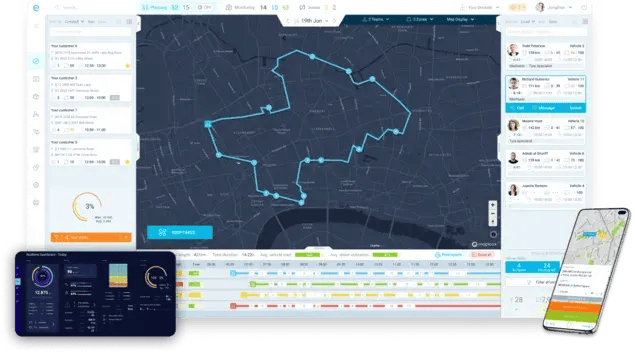
Platforms like eLogii get designed specifically for this use case:
Complex, high-volume distribution operations that need enterprise-grade API integration, unlimited users and vehicles across all pricing tiers, and vertical-specific customization that reflects how foodservice differs from building materials.
The strategic question isn't whether route optimization delivers ROI.
It's whether you optimize faster and better than your competitors. Companies that master last-mile delivery cost reduction create a permanent margin advantage that compounds with every delivery, every day.
Bottom Line: Inefficient Routing Is Solvable
Routing inefficiency is a structural margin leak that compounds across fuel waste, labor overtime, customer churn, and growth constraints.
For enterprise distributors, that 10-20% efficiency gap translates to millions in lost EBITDA annually. But it rarely receives attention until it becomes a crisis.
The margin pressure facing distribution operations in 2026 makes this a strategic imperative.
Rising labor costs, fuel volatility, and competitive pricing wars have eliminated the buffer that once masked routing waste.
The companies that treat this as a dispatch-level problem will continue bleeding margin. The ones that recognize it as a capital allocation and scalability issue will capture sustainable competitive advantage.
What should be on your radar:
- Routing decisions touch 20-40% of operating expense - comparable to procurement spend
- Manual planning creates key-person dependency and prevents M&A integration
- Every excess mile increases exposure to uncontrollable fuel costs
- Growth without routing optimization forces linear cost scaling
The financial case for enterprise route optimization has never been clearer.
The next step?
Book a demo to quantify the cost of inefficient routing in your specific operation. Not as a sales conversation, but as a financial diagnostic that survives CFO scrutiny.
FAQ about Inefficient Routing in Distribution
What is the true cost of inefficient delivery routes in distribution operations?
Manually planned operations lose 3-8% of total delivery costs. At enterprise scale, routing inefficiency becomes one of the largest controllable hits to EBITDA.
Inefficient routing creates seven cost drains: fuel waste (10-20%), labor overtime, customer churn from missed delivery windows, underused fleet capacity, growth constraints, compliance risk, and competitive erosion.
How do you calculate cost per stop and why does it matter for distribution profitability?
Cost per stop divides total delivery expenses by stops completed. Industry benchmarks: foodservice $8-15, building materials $12-22, wholesale $6-12.
A $2 reduction across 500,000 annual stops saves $1 million in margin. PE firms track this metric because it predicts scalability and competitive durability.
What ROI can distributors expect from enterprise route optimization platforms?
Implementation costs run $100,000-500,000, delivering 200-400% first-year ROI for operations with heavy manual planning. The efficiency gap widens as algorithms learn and volume scales.
Mid-size to enterprise distributors typically see 15-25% routing cost reduction with 6-18 month payback. Operations running 50+ vehicles average 8-12% mileage cuts, 10-15% labor hour reduction, and 5-8% more stops per vehicle.
Why do ERP routing modules fail to deliver optimization results at enterprise scale?
ERP modules keep operations running but leave money on the table through persistent overtime, excess mileage, and inability to scale without adding fleet capacity.
ERP routing modules handle basic territory assignment but struggle with dynamic optimization at scale. Purpose-built platforms deliver 12-18% better route efficiency than ERP modules on identical datasets. For 150 vehicles, that gap translates to $300,000-800,000 in annual margin.
How leading distribution companies select and adopt route optimization platforms?
Select vendors based on algorithm transparency, implementation support, and references from similar operations at your scale.
Start with baseline metrics: cost per stop, overtime percentage, and stops per vehicle. Test algorithms on your actual route data before committing, and prioritize measurable efficiency gains over interface appeal.
Integration needs include ERP/WMS sync, real-time driver communication, and customer portals.
Driver adoption matters more than technology. Without dispatcher training and executive sponsorship, teams revert to manual workarounds.