Delivery Logistics
7 Best Apps for Delivery Dispatchers
Top 7 truck dispatch apps for 2024: Find the best solutions for real-time tracking, route optimization, and efficient fleet management.
We compare eLogii and Descartes route optimization. Explore how each solution fits your enterprise distribution, including features, value, and more.
In this article, we’re going to put eLogii and Descartes route optimization software to the test.
The comparison outlines the key differences between these two powerful routing platforms that enterprise distributors need to be aware of when evaluating them.
Because of this, we’re not just going to compare eLogii vs Descartes in terms of features, capabilities, and pricing.
We’re going to focus more on comparing their value in managing enterprise operations. And how well eLogii and Descartes fit the execution-first environment like distribution.
By the end, you should be able to choose the right routing platform for your distribution company. That’s also the right fit for your teams and the entire operation.
Let’s get started.
In the first corner, we have eLogii.
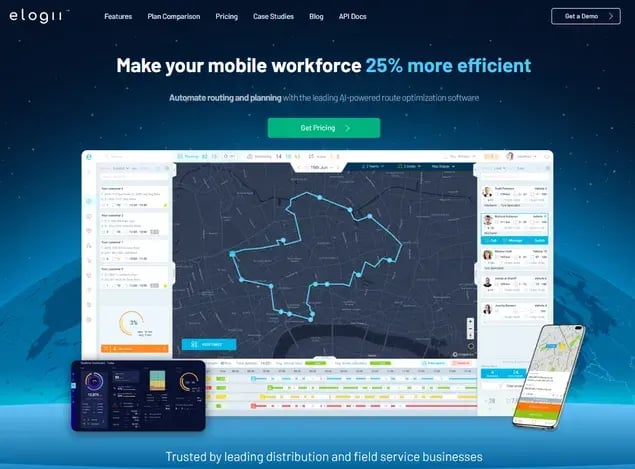
eLogii is an execution-centric route optimization platform designed for distribution execution.
You can use eLogii for:
High-density + High-volume route planning
SLA-driven networks management
Real-time route adjustment
Dynamically scheduling
Dispatcher workflows
Performance monitoring
Distribution analytics
And more
eLogii combines planning and execution to enable rapid adjustments, operational visibility, and efficient handling of same-day volatility in enterprise distribution operations.
eLogii is best for distribution operations where execution agility and real-time adjustments are essential to meeting SLAs and customer expectations.
In the second corner, we have Descartes.
Descartes is a suite-based logistics platform with integrated route optimization, transportation management, compliance, and execution tools.
You can use Descartes for:
Configurable optimization, enabling enterprises to encode business rules, regulatory constraints, and service policies
Data-driven planning across regions and operational domains for large-scale distribution and logistics networks
Descates’ routing and scheduling capabilities are positioned as part of a larger, suite-based architecture that connects planning, customs, yard management, and other logistics functions.
Descartes is often selected where organizations need integrated processes across many logistics domains and value configuration-driven optimization that supports standardized, internationally distributed operations.
Both platforms support capabilities relevant to modern distribution operations:
Multi-driver fleets and depot networks
Multi-delivery zones and territorial planning
High multi-drop density and high delivery volumes
Same-day volatility, peak-day surges, and frequent re-sequencing
Dynamic route adjustment and optimization
Real-time visibility and automated dispatching
Dynamic scheduling and order prioritization
The bottom line is that eLogii and Descartes have similar features. The difference is that eLogii focuses on real-time execution and distribution control, while Descartes focuses on suite-based, configuration-led planning for standardized logistics.

|
Descartes Route Optimization |
eLogii Route Optimization |
|
|
Best For |
Suite-aligned, global logistics operations with cross-domain integration needs |
High-frequency, SLA-driven distribution networks that require execution-first agility |
|
Flexibility |
Configurable via rich rule-sets and integration points |
Highly configurable in-day with dispatcher controls and rapid policy changes |
|
Implementation |
Implementation-led, phased deployments across functions and regions |
Typically faster pilot-to-production cycles focused on depots/regions |
|
Key Strength |
Broad logistics coverage and enterprise integration |
Real-time adjustments, dispatcher workflows, tight planning→execution loop |
|
Pricing |
Enterprise licensing tied to suite adoption and integrated modules |
Usage- and scale-driven pricing with modular add-ons for execution features |
Modern distribution is a mix of operational challenges that affect each other and that route optimization software must address.
In other words:
Route optimization software only works well for distribution enterprises if it fits how your business actually operates. Not just because the algorithms are smart.
Key requirements should include:
High multi-drop density handling (50–500+ stops per route in many regions), with the ability to cluster deliveries efficiently without exceeding driver capacity.
Strict SLAs tied to delivery windows, appointment reliability, and first-time success rates, ensuring contractual obligations and customer expectations are consistently met.
Frequent same-day volatility: cancellations, re-prioritizations, and new orders entering the plan after routes depart, requiring flexible planning and fast adaptation.
Dispatcher-led exception handling with clear override patterns and low-friction tools, enabling operational teams to respond quickly without creating confusion or errors.
Real-time visibility for operations, customer service, and downstream systems, ensuring all stakeholders can make informed decisions during execution.
Integration with telematics, vehicle tracking, and driver communication platforms to monitor progress and intervene before SLA breaches occur.
Ability to manage heterogeneous fleets, including varying vehicle capacities, types, and route restrictions, while optimizing for efficiency and cost.
Intelligent handling of delivery constraints, such as temperature-controlled goods, priority shipments, fragile items, or high-value products.
Continuous feedback loops from completed deliveries and electronic proof of delivery (ePOD), enabling learning from operational outcomes and improving future route quality.
Support for dynamic scheduling, order prioritization, and resource reallocation, allowing the network to absorb sudden spikes in demand or workforce disruptions.
“The difference is less about scale. It’s more about how tightly routing is connected to daily execution.”
For enterprises, the right route optimization for distribution companies must balance optimization quality with operational control.
Algorithms that produce efficient plans are valuable only if those plans can be adapted and executed at scale. And they have to do it without breaking the operation or requiring a disproportionate amount of human intervention.
That’s why execution-centric platforms, real-time operational controls, and robust dispatcher tools are critical when handling modern distribution challenges.
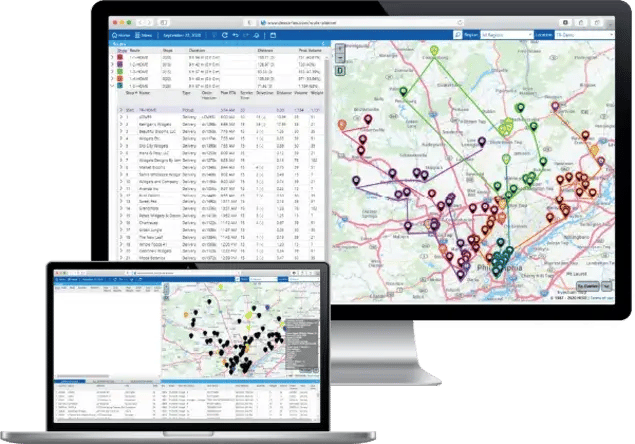
Descartes positions its routing capability as part of an integrated logistics and compliance technology suite. That suite-based approach provides tangible advantages for organizations that need visibility and process continuity across multiple logistics domains.
Suite-based architecture. Routing is one of many modules in a broader platform that includes transportation management, customs, yard, and parcel solutions. That makes it straightforward to integrate routing into end-to-end flows with consistent master data, exception rules, and auditing.
Configuration-led optimization. The product emphasizes configuration—detailed rule-sets, business process modeling, and parameterized optimization—so customers can encode corporate policies, international shipping constraints, and tariff considerations directly into the planning engine.
Enterprise-scale integration. Descartes has an extensive global footprint and pre-built connectors to common ERP, WMS, and telematics providers, making it attractive to organizations with complex, heterogeneous IT landscapes.
Designed for standardized environments. Where processes and SLAs are consistent across geographies and the company values a single platform to govern controls, Descartes’s suite-based approach aligns well.
Maintains consistent business rules across distributed operations.
Scales to multi-region deployments with governance and audit trails.
Supports advanced scheduling scenarios where many planning domains must interoperate.
Descartes’s model is well-suited to organizations where routing is one piece of a broader logistics program, particularly when integration with customs, parcel, or global TMS functions is a priority.
Because the solution sits in a suite and emphasizes configuration, planning outcomes are predictable and consistent with organizational policy, which is valuable for global standardization.
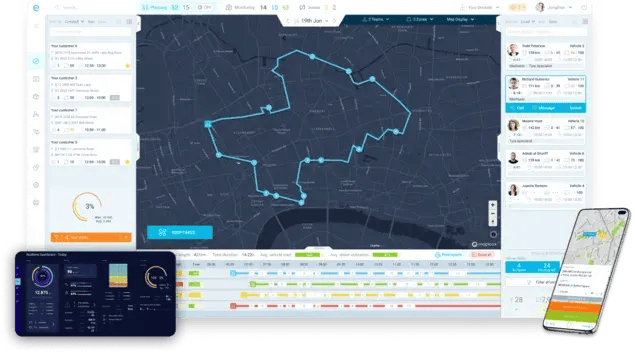
eLogii is positioned explicitly for distribution routing and day-of delivery execution. Its architecture is execution-centric: optimization and execution are closely connected, while dispatchers and operations managers have direct control over mid-day changes.
Purpose-built for distribution routing. eLogii focuses on the problems distribution teams face: dense multi-drop routes, frequent same-day changes, and high expectations for SLA performance.
Execution-first architecture. Planning and execution share the same operational model so changes made in the dispatcher console feed directly into the active route and driver instructions.
Real-time route adjustments. The eLogii delivery execution software supports continuous re-optimization, enabling operators to inject orders, change priorities, and re-sequence routes with minimal friction.
Strong dispatcher workflows. Built-in workflows for exceptions, reassignments, and communications help keep service levels consistent during turbulence.
Fast adaptation to demand shifts and same-day volatility.
Clear dispatcher controls and intuitive interfaces built for rapid decision-making.
Tight operational telemetry: visibility into ETA drift, driver progress, and exception rates.
Distribution users choose eLogii for operations where day-of execution variability is the defining constraint, and where dispatchers must frequently intervene without compromising efficiency.
eLogii’s emphasis on rapid piloting and depot-level deployments can shorten time-to-value for high-volume, SLA-driven networks.
Below, we highlight the main differences as design choices, not flaws.
The right choice depends on whether your operation focuses more on strategic integration across logistics domains, or on operational execution and rapid adaptability.
Descartes: Breadth of capability across logistics domains. Routing is one connected module within a broader platform, with consistent policy application across customs, yard, parcel, and transport planning.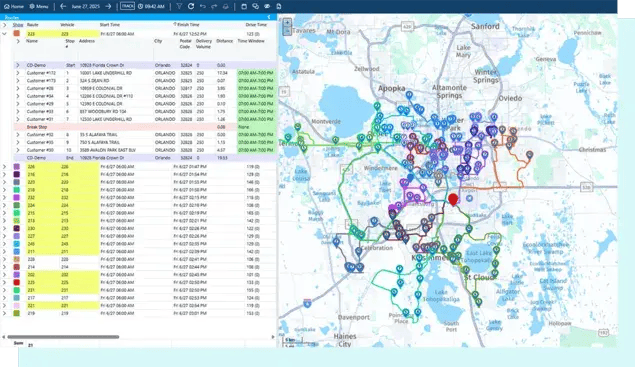
eLogii: Depth in the routing and execution layer. Route planning and optimization is designed as the control plane for distribution teams across the entire operation.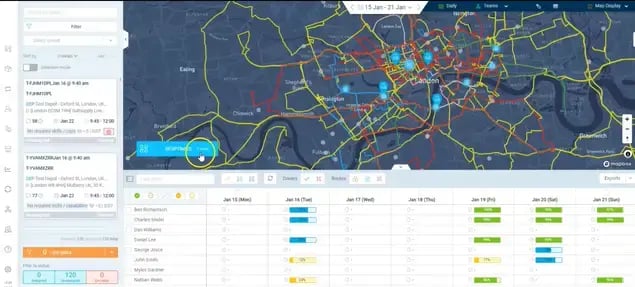
Suite-based benefits: Single source of truth for master data, consistent compliance and auditability, and fewer integration projects when the enterprise requires multiple logistics functions to work together.
Focused routing benefits: Faster iteration on operational rules, tighter dispatch workflows, and less friction when reconfiguring routes for same-day realities.
If your distribution runs many connected logistics functions across many regions, a suite-based system will work well for your operation.
But if your operation often changes during the day and dispatchers need to make quick adjustments to routes and schedules, a focused delivery execution platform like eLogii reduces drag and makes things run smoother.
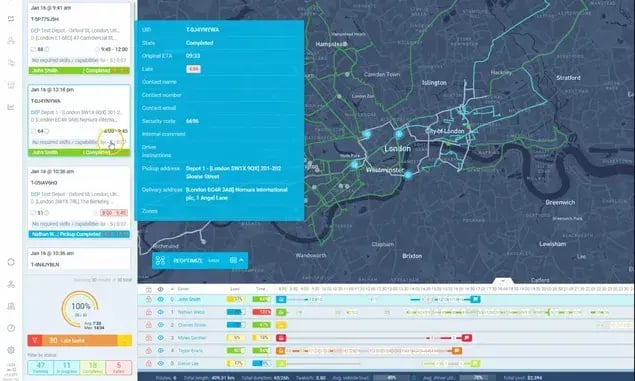
Descartes emphasizes upfront configuration: encode your rules, run scheduled plans, and enforce consistency via rule engines and parameterization.
eLogii emphasizes real-time control: dynamic route optimization, continual re-optimization, fast overrides, and dispatcher-directed changes are central to the operational model.
Configuration-led optimization supports complex, policy-driven environments where routing decisions must reflect legal, tariff, or contractual constraints. It also supports scenarios where batch planning precedes execution and where day-of changes are less frequent.
Real-time operational control supports environments where orders, cancellations, and time-window changes arrive after routes depart. It reduces the friction for dispatchers to re-optimize and keeps drivers aligned with shifting priorities and performance efficiency.
Both eLogii and Descartes create efficient delivery routes, but they handle changes differently. Descartes focuses on detailed planning upfront, while eLogii allows dispatchers to quickly adjust planned routes during the day to handle cancellations, urgent orders, or delays.
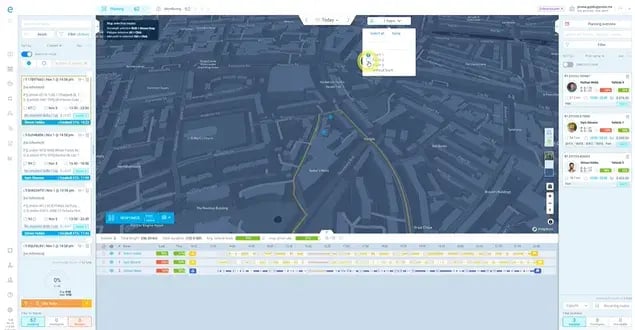
Planning-centric systems optimize for controlled batches and periodic planning cycles. They favor predictability and throughput in environments where planning can be completed with low same-day variance.
Execution-centric systems prioritize the realities of day-of operations, resilience to volatility, rapid re-sequencing, and low-cost dispatcher interventions.
For operations with predictable demand patterns and limited same-day changes, a planning-centric approach yields stable KPIs and predictable cost profiles.
For operations subject to frequent change—same-day delivery, appointment reschedules, customer-initiated changes—the execution-centric model minimizes SLA risk by enabling rapid responses.
Assess how often your routes are materially altered after dispatch. If changes are frequent and impactful, execution-centric routing reduces operational friction and improves first-time delivery performance.
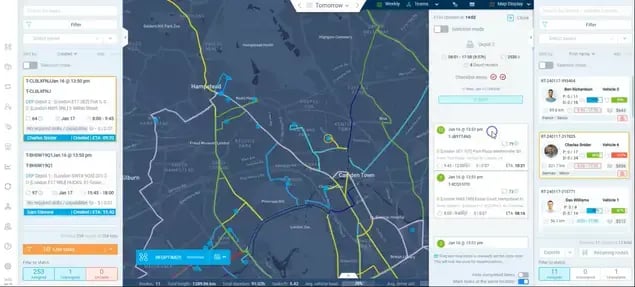
Products designed for enterprise suites often expose powerful configuration capabilities, which can require more training for operational teams to use effectively.
Products built for dispatchers prioritize simple workflows, immediate feedback, and minimal cognitive load under pressure.
Interface complexity: Suite-based systems may surface many capabilities; dispatch teams need curated interfaces to avoid distraction. Execution-focused consoles aim for fewer clicks to change a route or reassign a stop.
Speed under pressure: The speed of making and propagating a change during peak hours is the measure of operational maturity—not just how quickly the engine re-runs optimization but how fast the UI lets a human make a judgment.
Training requirements: Suite-based implementations often include formal training and change management due to the breadth of features. Focused routing solutions typically have shorter ramp-up periods for dispatcher teams.
High adoption requires thoughtful UX and training. Even the best algorithm is ineffective if dispatchers avoid using it because the tool is cumbersome during peak hours.
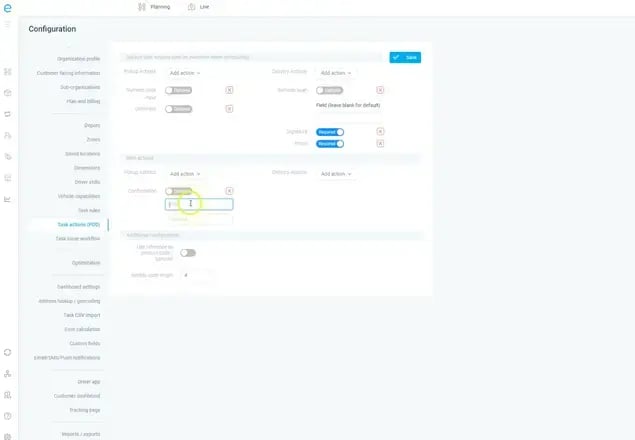
Both platform types recognize proof of delivery as an operational imperative. Their approaches differ in how tightly electronic proof of delivery (ePOD) is integrated with routing and exception workflows.
Integrated ePOD: ePOD functionality should be closely coupled with driver workflows so that collection of signatures, photos, and parcel barcodes feed back into the routing and exception engine in real time. eLogii emphasizes closed-loop execution where POD events influence nearby route adjustments and customer notifications.
Exception capture: When a delivery fails or is partial, capturing structured reasons and rapidly initiating recovery flows (rebooking, return-to-depot, or customer reschedule) reduces dwell and cost. Platforms that make exception capture simple help operations learn from outcomes.
Operational feedback loops: Systems that aggregate ePOD and exception data for analytics enable continuous improvement of service-level predictions and route reliability.
Ask how POD data flows back into route analytics and whether delayed POD results are treated differently from real-time POD in driver-facing feedback and billing reconciliation.
Implementation-led suite deployments often emphasize governance, standardization, and cross-functional alignment; they can deliver durable, organization-wide capabilities but require broader stakeholder coordination.
Focused routing rollouts tend to emphasize rapid pilot → scale cycles, often starting with a set of depots or a specific use case to prove ROI.
Phased rollout strategies: Suite-based implementations frequently follow a roadmap that aligns multiple modules and business processes; success is measured across several dimensions. Execution-focused rollouts are more likely to adopt an agile pilot-first approach.
Control vs speed trade-offs: Suite-based deployments are strong where control, auditability, and multi-domain integration are mission-critical. Execution-first deployments are strong where speed-to-value and day-to-day flexibility are the priority.
Organizational change management: Both approaches require stakeholder alignment. The difference is the scope and cadence of change: enterprise governance vs local operational adoption.
Plan implementations against measurable operational KPIs: first-time delivery rate, average route deviation, dispatcher interventions per 1,000 stops, and SLA compliance by shift. Use pilots that simulate worst-day scenarios to validate time-to-value claims.
No single platform is the universal answer. The correct choice depends on how your organization defines priorities between strategic integration and operational adaptability.
For organizations that require consistent policy enforcement across multiple logistics domains and regions, with a preference for suite-based management and deep configuration.
This is particularly relevant where routing decisions must reflect corporate-wide constraints, regulatory considerations, cross-border movements, or service models across continents.
In these environments, the ability to encode standardized rules and deploy them consistently across business units can outweigh the need for frequent in-day route adjustments.
Enterprise IT teams often value the architectural cohesion and shared data structures that a suite-based platform provides.
For distribution operations where last-mile variability, appointment-driven delivery, and heavy same-day traffic define performance.
With eLogii, your organization will benefit from an execution-centric platform that supports rapid re-optimization and strong dispatcher workflows.
This includes handling high stop density, temperature-controlled goods, retail replenishment, or time-critical B2B deliveries.
In these cases, operational teams need the ability to intervene quickly, rebalance routes, and maintain service levels without escalating every change through complex configuration cycles. And a direct connection between planning and live execution can materially reduce SLA risk.
This is a judgment about operational fit. The right choice is the one that maps most closely to the day-to-day realities of your operations.
To evaluate eLogii and Descartes, ask practical, operational questions that reveal how they behave under stress.
Look for documented workflows and SLAs for re-optimization latency. How long does it take from a dispatcher accepting a change to the driver receiving updated sequencing?
Ask for metrics or case studies showing expected dispatcher actions per 1,000 stops and the tool’s support for bulk or single-stop changes.
Verify whether route changes update driver apps, whether ePOD is real-time, and how customer notifications are triggered following changes.
Ask for a deployment plan mapping pilot, regional scale, and enterprise rollout, including integration checkpoints with WMS/ERP and telematics systems.
Confirm that ePOD, photo capture, barcode scans, and timestamps are supported and that they feed back into analytics for SLA reconciliation and billing.
For Descartes, probe configuration policies, business rules, and governance; for eLogii, ask how rules are deployed and changed without requiring heavy IT cycles.
Request a demonstration that simulates peak volumes, cancellations, and appointment squeezes to see how each platform behaves under pressure.
Clarify APIs, webhook patterns, batch vs streaming sync, and how driver telematics are ingested.
Verify how POD and exception data tie back to route performance KPIs and whether analysts can slice by depot, route, driver, or customer.
Ask how the system models vehicle, driver, and shift constraints during forecasted surges. Can planners simulate peak scenarios weeks in advance? Does the engine support temporary fleet expansion, subcontractor onboarding, or variable shift patterns without major reconfiguration?
In large enterprises, route parameters and service rules may require oversight. Clarify who can modify routing logic, how changes are logged, and whether approval workflows exist. This is particularly important when balancing centralized governance with depot-level flexibility.
Evaluate whether SLA adherence is visible at the route, stop, and customer level throughout the day (not only in post-delivery reports). Can the system proactively flag risk of late delivery and recommend corrective action before a breach occurs?
Understand how driver KPIs are captured and surfaced. Does the system track route adherence, dwell time, idle time, and completion rates? Can operations teams identify patterns that inform coaching or route redesign?
For enterprises operating several depots within overlapping regions, ask whether routes can be optimized across depot boundaries. Can work be dynamically reassigned between facilities to absorb local spikes or vehicle breakdowns?
Enterprise environments inevitably experience delayed ERP updates, telematics gaps, or network interruptions. Clarify how the platform behaves under partial data conditions. Does it queue changes? Can dispatchers continue operating without interruption? How are reconciliation processes handled once systems reconnect?
Use these questions to guide your selection workshops and proof-of-concept scenarios.
Both eLogii and Descartes are enterprise-grade solutions. Both platforms are capable of supporting large-scale distribution networks. And both tools can improve route efficiency and reduce delivery costs.
The right choice comes down to the operating model you want to adopt:
If your priority is cross-domain integration, consistent governance, and standardized global processes, a suite-based, configuration-led platform aligns with those goals.
If your priority is rapid adaptation to same-day volatility, strong dispatcher workflows, and continuous real-time re-optimization, an execution-first platform is likely to deliver more immediate operational benefits.
The key difference here is:
Execution adaptability vs suite-based integration.
So the question isn’t which software is better. It’s whether eLogii or Descartes route optimization are an operational fit for your reality and business priorities.
If you’re currently evaluating these two options, use controlled pilots that stress the system under real operational volatility.
This will allow you to make a decision based on how each platform performs when your operation is at its most challenged.
Demos should reflect these worst-case scenarios. And we can provide exactly that.
Book a demo to see how eLogii supports dynamic, execution-led distribution routing.

Top 7 truck dispatch apps for 2024: Find the best solutions for real-time tracking, route optimization, and efficient fleet management.
Discover the benefits of Electronic Logging Devices (ELDs) for long-haul truckers. Ensure compliance, track fleets, and avoid costly fines...
Handle delivery exceptions effectively and minimize their impact on your business. Get insights on causes, consequences, and prevention strategies.
Be the first to know when new articles are released. eLogii has a market-leading blog and resources centre designed specifically to help business across countless distribution and field-services sub sectors worldwide to succeed with actionable content and tips.
